
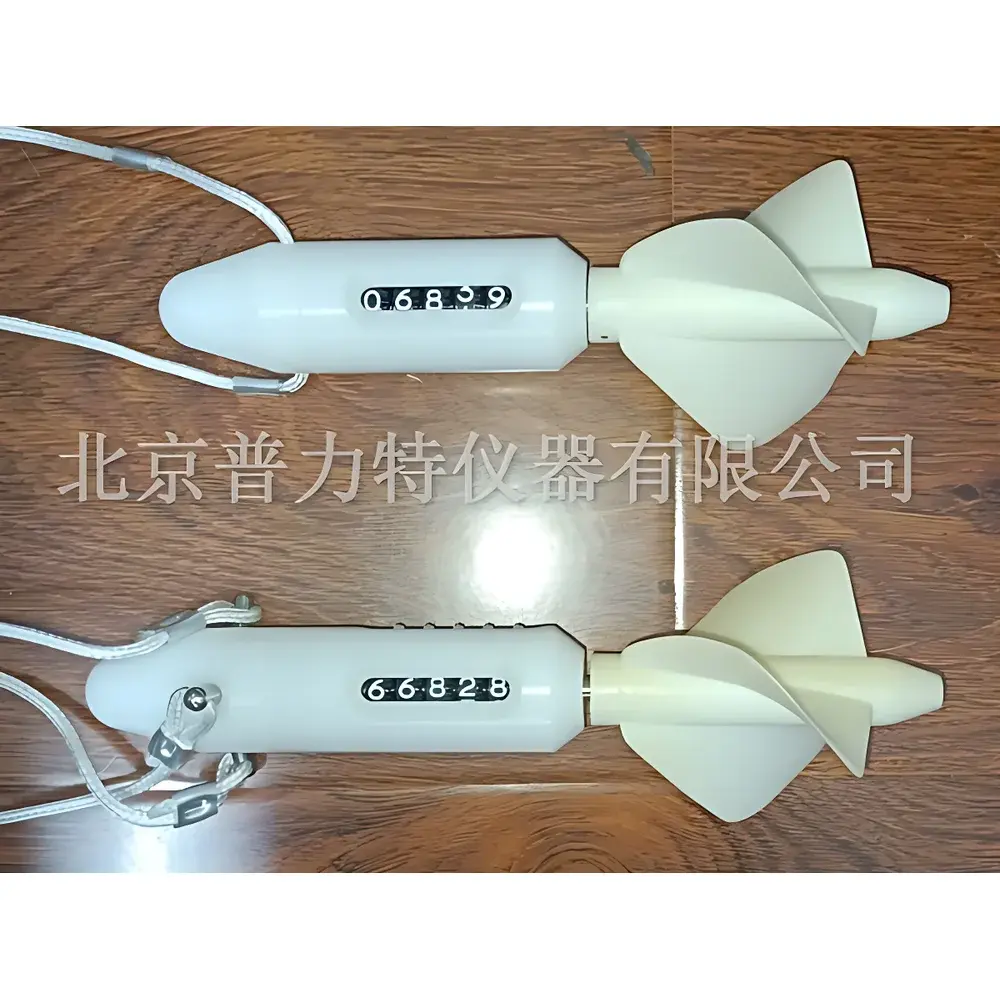
Purity PF-R & PF-NR Biological Net Flow Meters
| Brand | Purity |
|---|---|
| Origin | Beijing, China |
| Model | PF-R, PF-NR |
| Compliance | GB 17378.7–2007 |
| Length | 195 mm (PF-R), 215 mm (PF-NR) |
| Impeller Diameter | 75 mm |
| Connection | Dual-point mounting |
| Counter | 7-digit mechanical register |
| Flow Direction Handling | PF-R — bidirectional (reverse rotation enabled) |
Overview
The Purity PF-R and PF-NR Biological Net Flow Meters are precision-engineered mechanical flow measurement instruments designed specifically for quantitative estimation of filtered water volume in plankton sampling operations. Based on the principle of impeller rotation induced by water velocity across a towed net mouth, these meters convert linear flow into discrete mechanical counts via calibrated gear-driven transmission. Each revolution of the 75 mm diameter impeller corresponds to a fixed volumetric displacement—calibrated per GB 17378.7–2007, China’s national standard for marine environmental monitoring. The PF-R variant is optimized for horizontal towing configurations where bidirectional flow may occur (e.g., vessel maneuvering or tidal reversal), enabling the impeller to rotate in both forward and reverse directions without mechanical lockup. In contrast, the PF-NR model is engineered for vertical net deployment (e.g., Bongo or WP-2 nets), where reverse flow is mechanically suppressed to prevent erroneous counting during retrieval. Both units feature a robust, corrosion-resistant housing suitable for prolonged immersion in seawater and comply with field-deployable durability requirements for oceanographic survey platforms.
Key Features
- Conformance to GB 17378.7–2007: Fully aligned with China’s mandatory standard for plankton net flow calibration, including impeller geometry, counter resolution, and mounting interface specifications.
- Bidirectional vs. Unidirectional Operation: PF-R supports reversible impeller rotation for accurate integration of net transit in variable-current environments; PF-NR incorporates a one-way clutch mechanism that halts rotation during reverse flow, eliminating overcounting in vertical hauls.
- 7-Digit Mechanical Counter: Non-electronic, maintenance-free register with tactile readout—immune to electromagnetic interference, battery failure, or data corruption in remote marine settings.
- Dual-Point Mounting System: Precision-machined stainless steel brackets ensure rigid alignment with net frame geometry, minimizing flow disturbance and torque-induced misalignment during high-speed tows.
- Marine-Grade Construction: Housing and impeller fabricated from acetal copolymer (POM) and 316 stainless steel components, providing long-term resistance to biofouling, saltwater corrosion, and mechanical abrasion.
Sample Compatibility & Compliance
These flow meters are validated exclusively for use with standard plankton net configurations—including but not limited to WP-2, Bongo, and NORPAC-style nets—with nominal mouth diameters ranging from 20 cm to 1 m. They are not intended for use with filtration systems, pump-driven circuits, or non-towed passive samplers. Calibration traceability is established per GB 17378.7–2007 Annex B, which defines impeller rotational coefficient (K-factor) determination using gravimetric flow verification under controlled flume conditions. While not certified to ISO/IEC 17025 or ASTM D1129, the design and verification methodology aligns with internationally accepted practices for field hydrographic instrumentation used in ICES, IOC-UNESCO, and NOAA-affiliated monitoring programs.
Software & Data Management
As fully mechanical instruments, the PF-R and PF-NR require no firmware, drivers, or proprietary software. Count data are manually recorded during post-deployment net processing and entered into laboratory information management systems (LIMS) or spreadsheet-based analysis workflows. For GLP-compliant studies, users are advised to document meter serial numbers, pre- and post-tow counter readings, net geometry, towing speed, and depth profiles in auditable field logs. Though lacking digital output, their mechanical integrity ensures full auditability: counter values remain physically immutable and independently verifiable at any time—supporting regulatory requirements for raw data retention under ISO 17025 Clause 7.5.2 and FDA 21 CFR Part 11 principles of data integrity (ALCOA+).
Applications
- Quantitative plankton abundance estimation in coastal and open-ocean surveys, supporting ecosystem assessment under national marine biodiversity monitoring frameworks.
- Calibration and validation of automated imaging systems (e.g., ZooScan, Imaging FlowCytobot) by providing ground-truth volumetric intake metrics.
- Time-series studies of phytoplankton and zooplankton community structure where inter-annual comparability depends on consistent flow measurement methodology.
- Training and standardization exercises for marine biology students and technical staff in accredited oceanographic institutions.
- Integration into integrated observing systems (e.g., IOOS, EMODnet) where mechanical redundancy complements electronic sensor arrays in harsh deployment environments.
FAQ
What is the calibration basis for these meters?
Calibration follows GB 17378.7–2007 Section 6.3, requiring empirical K-factor derivation via flume testing at three flow velocities (0.2, 0.5, and 1.0 m/s), with uncertainty ≤ ±3.5% (k=2).
Can the PF-R be used for vertical tows?
While mechanically capable, PF-R is not recommended for vertical deployments due to potential count inflation during net retrieval; PF-NR is the designated configuration for such applications.
Is replacement of the mechanical counter possible in the field?
No—the 7-digit register is factory-assembled and sealed; recalibration is required after any disassembly or component replacement.
Do these meters meet international standards such as ISO 7145?
They are not certified to ISO 7145 (velocity-area method for open channel flow), as they operate on impeller-based displacement principles and are application-specific to plankton net hydrometry.
What maintenance is required between deployments?
Rinse thoroughly with deionized water after seawater exposure; inspect impeller for fouling or debris; verify free rotation and counter incrementation using manual rotation before each cruise.






