
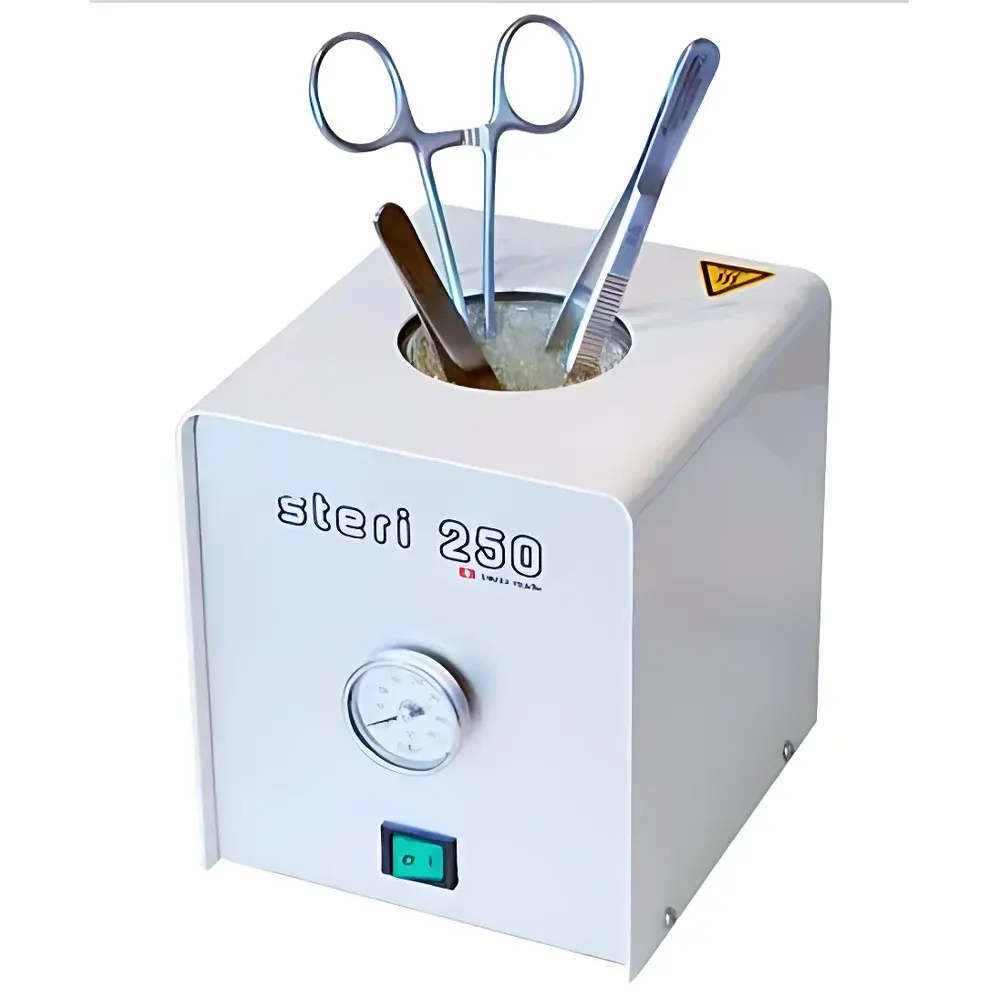
Keller STERI 25/250/350 Mini Rapid Glass Bead Sterilizer
| Origin | Switzerland |
|---|---|
| Manufacturer Type | Authorized Distributor |
| Origin Category | Imported Instrument |
| Model | STERI 25 / STERI 250 / STERI 350 |
| Pricing | Available Upon Request |
Overview
The Keller STERI 25/250/350 Mini Rapid Glass Bead Sterilizer is a compact, benchtop thermal sterilization system engineered for immediate, non-chemical decontamination of small laboratory instruments. It operates on the principle of dry-heat sterilization via high-temperature glass bead media—typically silica-based beads heated to 250 °C (STERI 250) or 350 °C (STERI 350)—enabling rapid microbial inactivation through conductive heat transfer. Unlike autoclaving or chemical immersion, this method delivers sub-second sterilization of metal loops, needles, forceps tips, and micro-pipette parts without moisture exposure, corrosion risk, or residual toxicity. Designed and manufactured under Swiss engineering standards, the STERI series complies with core microbiological safety requirements for routine aseptic technique in clinical labs, microbiology teaching facilities, and QC environments where speed, repeatability, and minimal footprint are critical.
Key Features
- Three model variants (STERI 25, STERI 250, STERI 350) differentiated by maximum operating temperature and chamber volume—optimized for varying throughput and sterility assurance levels.
- Precision solid-state temperature control with digital PID regulation ensures ±2 °C stability across the operational range (180–350 °C), verified per ISO 17025 traceable calibration protocols.
- Stainless steel insulated chamber with ceramic-lined heating element and reinforced borosilicate glass viewing window for real-time bead condition monitoring.
- Automatic thermal cut-off and overtemperature protection circuitry compliant with IEC 61010-1 safety standards for laboratory electrical equipment.
- Low power consumption (≤300 W for STERI 25; ≤650 W for STERI 350) and rapid heat-up time (<8 minutes to 250 °C from ambient).
- Ergonomic, low-profile housing (W × D × H: 140 × 160 × 220 mm for STERI 25) suitable for biosafety cabinets, laminar flow hoods, or crowded benchtops.
Sample Compatibility & Compliance
The STERI sterilizers accept all standard stainless steel, nickel-chromium, or tungsten-carbide instrument tips—including inoculation loops (up to Ø1.2 mm), micro-spatulas, needle points, and microelectrode shanks—provided they are free of organic residue and non-polymeric coatings. Instruments must be inserted vertically to a depth of ≥30 mm for validated dwell time (≥5 seconds at 250 °C; ≥2 seconds at 350 °C). The system meets EN 556-1:2015 requirements for “sterility assurance level (SAL) of 10−6” when used per manufacturer’s instructions. It supports GLP-compliant documentation workflows when integrated with external lab notebooks or electronic lab records (ELN), though it does not include built-in audit trail functionality. Not intended for sterilizing liquids, plastics, or wrapped items.
Software & Data Management
The STERI 25/250/350 operates as a standalone hardware unit with no embedded firmware, touchscreen interface, or network connectivity. Temperature setpoint and status indication are managed via analog dial and LED indicators—ensuring electromagnetic compatibility (EMC) in sensitive instrumentation zones and eliminating cybersecurity or software validation overhead. For regulated environments requiring traceability, users may log sterilization cycles manually or integrate with third-party environmental monitoring systems via optional 4–20 mA analog output (available on STERI 350 with OEM configuration). No FDA 21 CFR Part 11 compliance features are included, as the device is classified as Class I non-electronic medical equipment under EU MDR Annex XVI and US FDA 21 CFR §892.1.
Applications
- Routine sterilization of microbiological inoculation tools between sample transfers in BSL-1 and BSL-2 laboratories.
- Point-of-use decontamination in dental operatory settings, veterinary clinics, and pharmaceutical R&D cleanrooms.
- Teaching laboratories requiring rapid, visual, and intuitive sterilization methods for student training in aseptic technique.
- QC/QA labs performing environmental monitoring (e.g., ISO 14644-1 particle counting stations) where chemical-free tool sanitation avoids cross-contamination.
- Field-deployable sterilization for mobile diagnostic units or resource-limited settings where autoclave infrastructure is unavailable.
FAQ
What is the recommended maintenance interval for the glass beads?
Beads should be inspected visually before each use for discoloration, sintering, or surface cracking. Replace every 6–12 months depending on cycle frequency; Keller recommends using only OEM-certified silica beads (Cat. No. KB-STERI-BEAD-500g) to maintain thermal uniformity and avoid contamination.
Can the STERI unit be used for sterilizing plastic or coated instruments?
No. Plastics, Teflon-coated tips, or rubber components will melt or degrade at operational temperatures. Only fully metallic, uncoated, and thermally stable instruments are compatible.
Is validation support provided for GMP environments?
Keller supplies IQ/OQ documentation templates and factory calibration certificates (traceable to METAS, Switzerland). Site-specific PQ must be performed by the end user per ISO 13485 or EU GMP Annex 15 guidelines.
How does glass bead sterilization compare to flaming with a Bunsen burner?
Flaming introduces uncontrolled thermal gradients, soot deposition, and oxidation damage to fine tips. The STERI system delivers reproducible, calibrated, and residue-free heat—reducing tip deformation and extending instrument service life.
Does the STERI series require external exhaust or ventilation?
No active fume extraction is needed under normal operation. However, placement in a well-ventilated area or under a chemical hood is advised if used continuously for >4 hours/day to manage ambient heat dissipation.



