
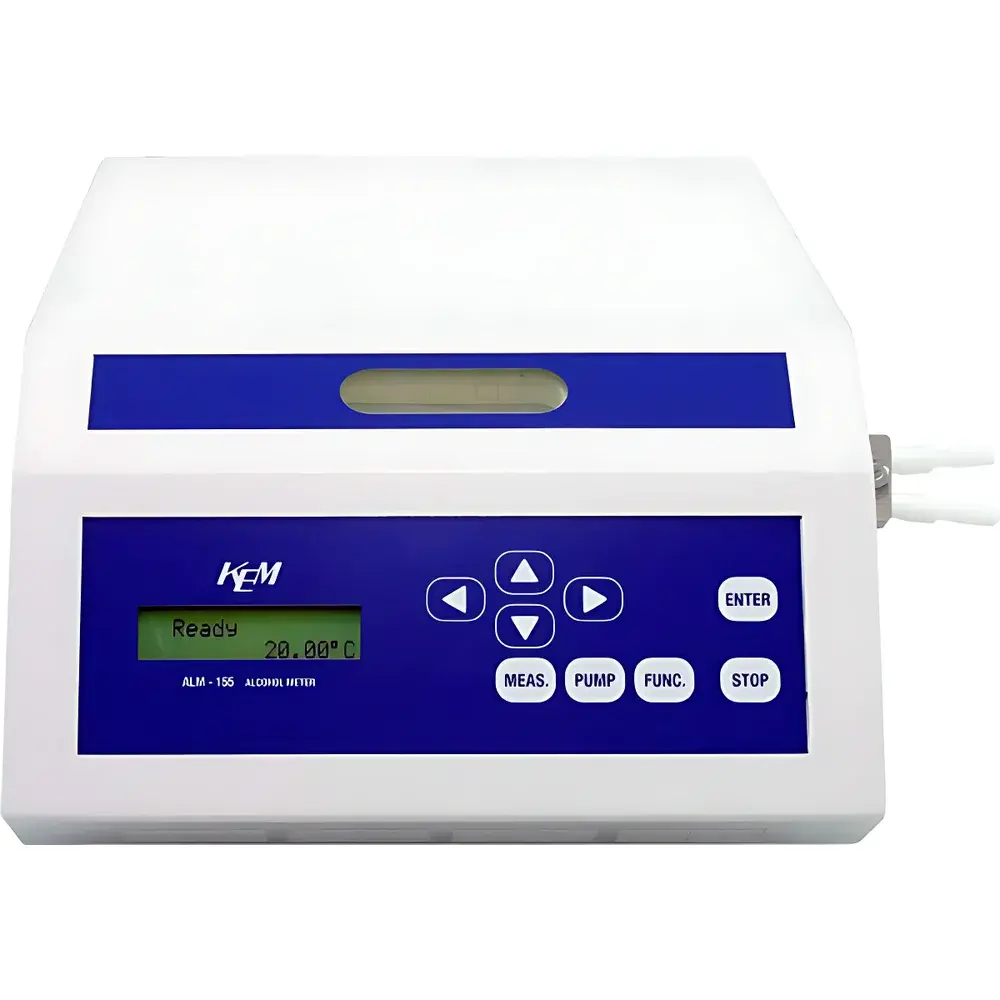
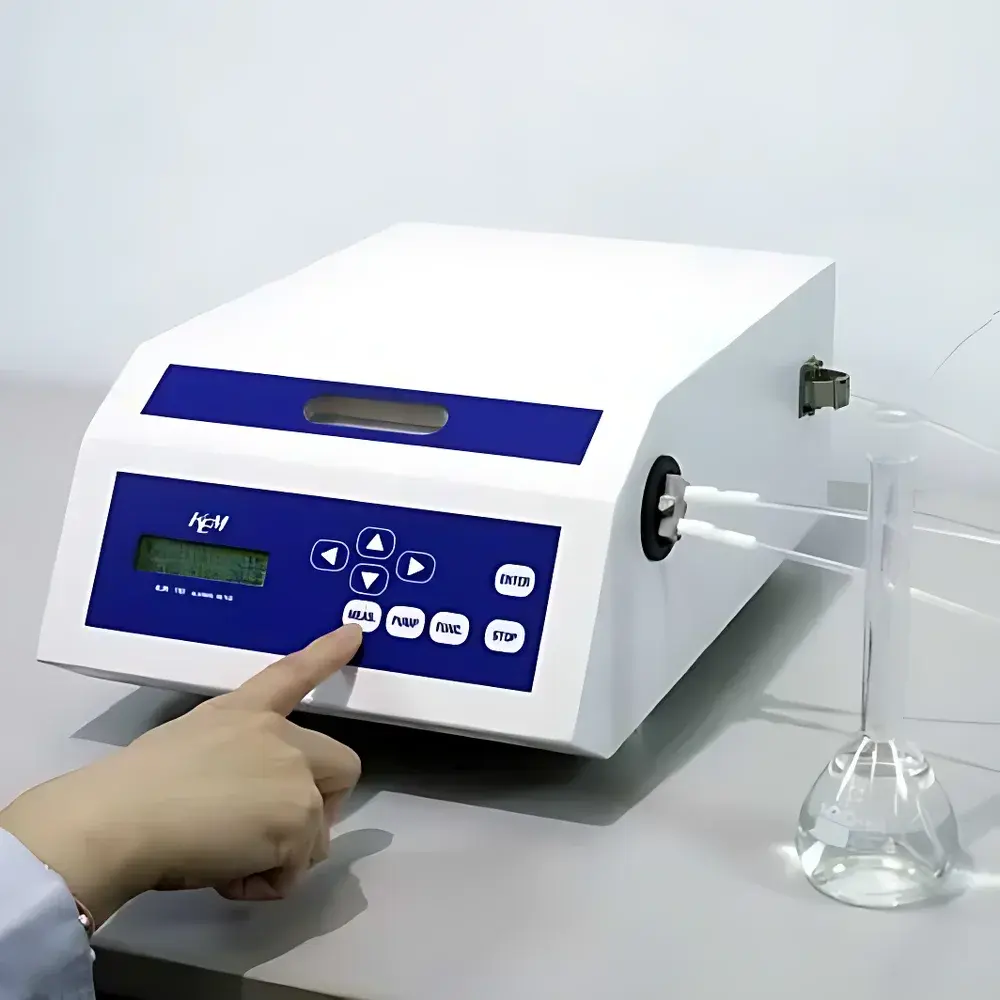
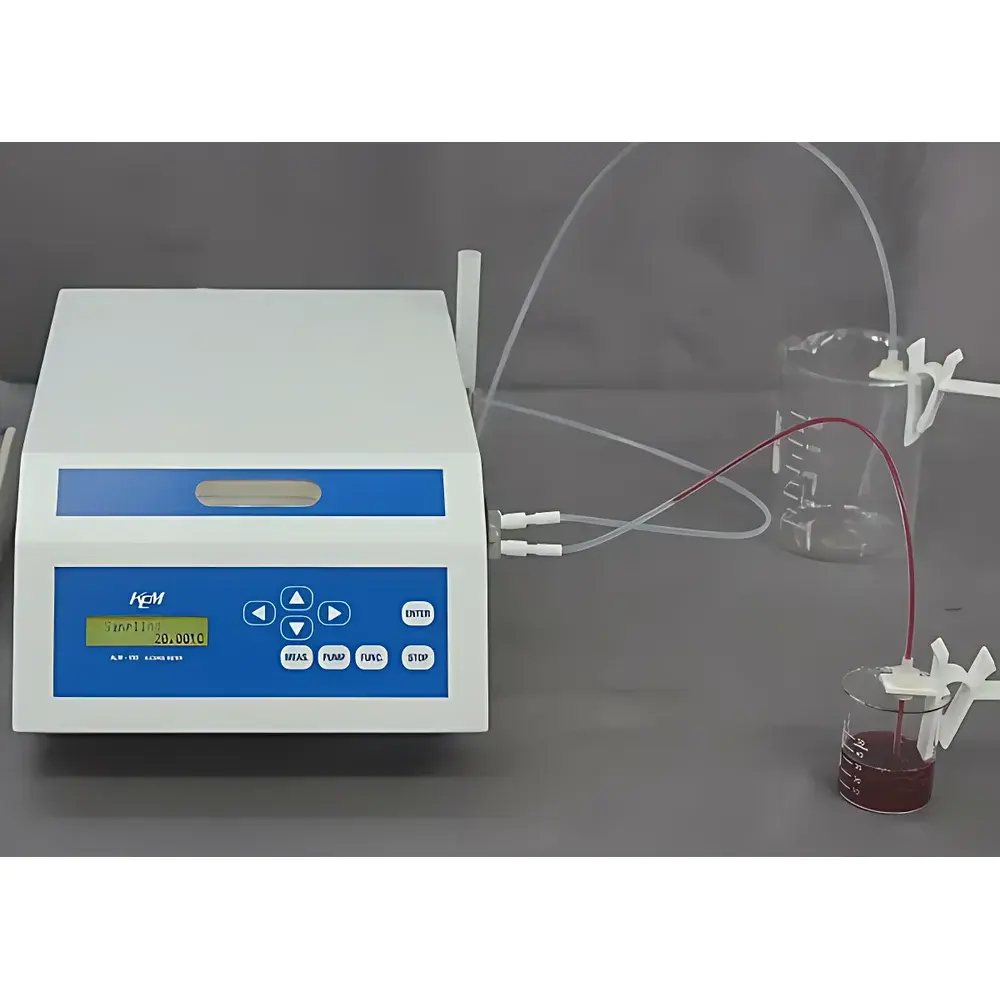
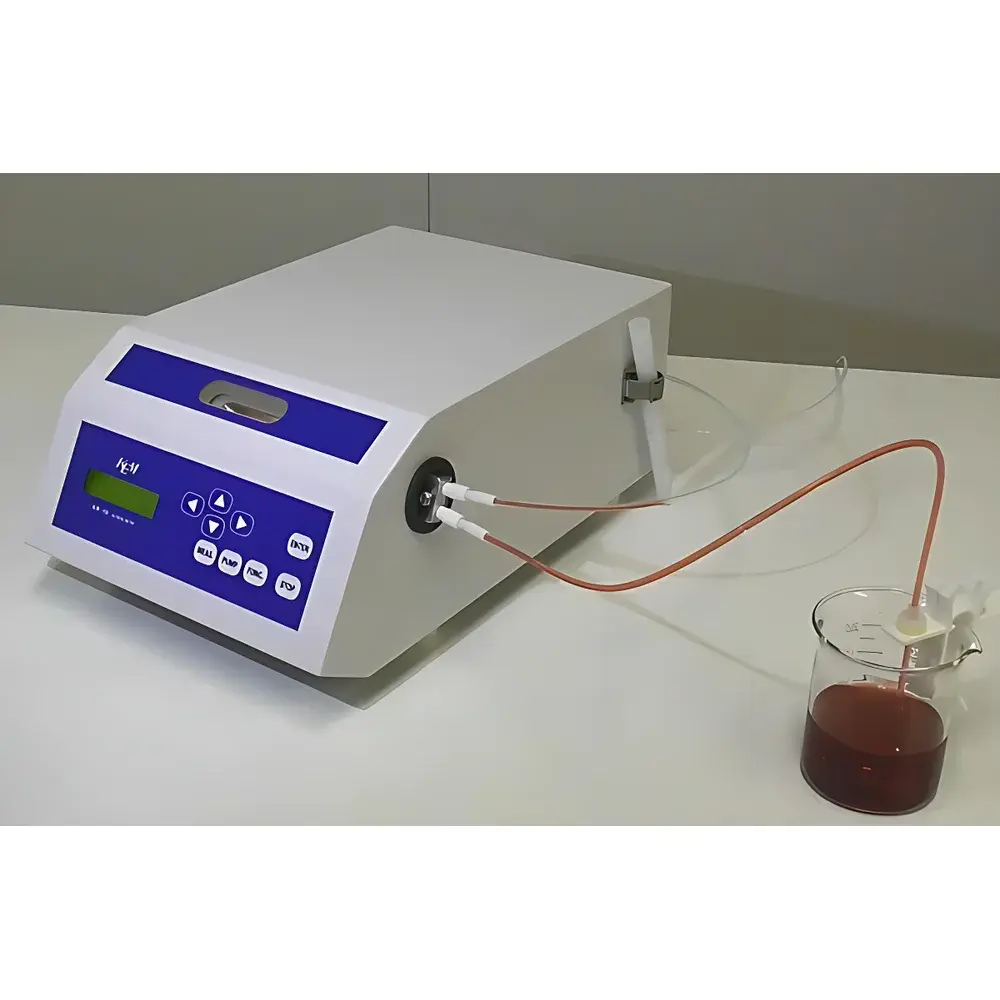
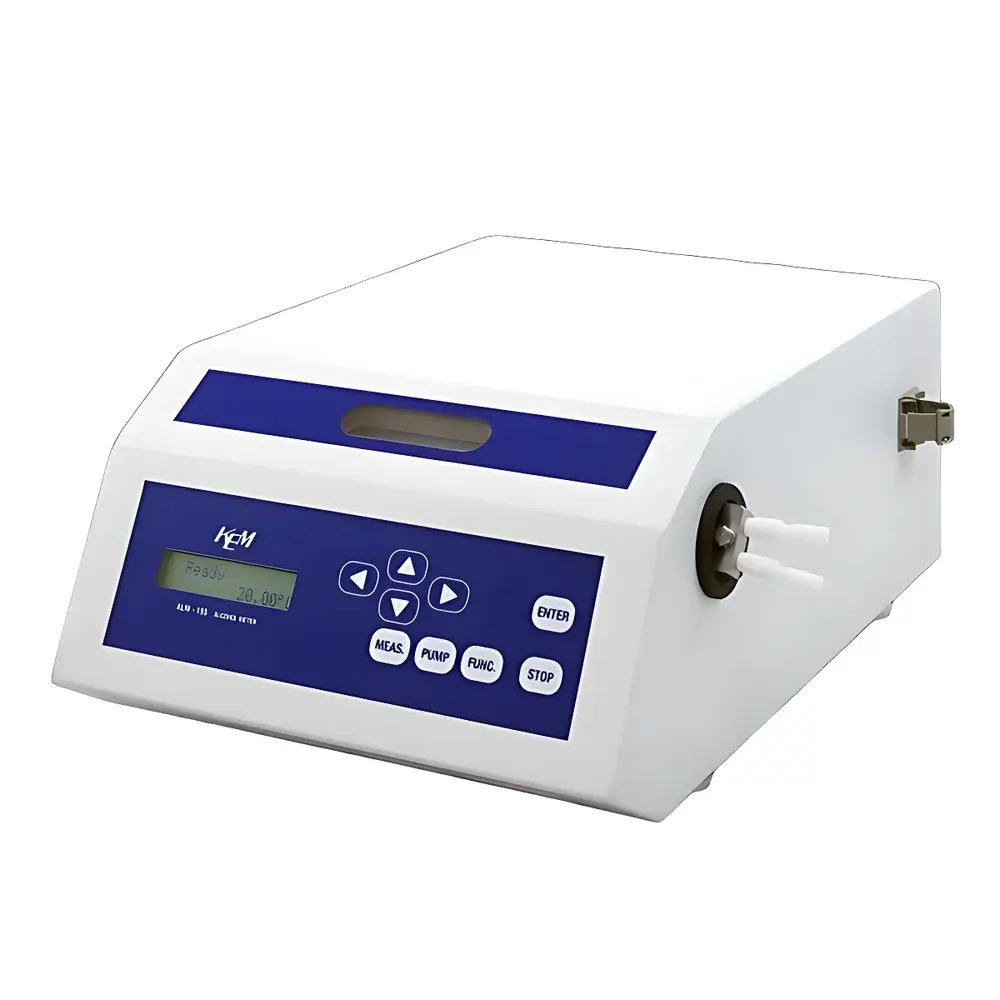
KEM ALM-155 High-Precision Digital Alcohol Meter (U-Tube Oscillating Density Method) Compliant with GB 5009.225-2023
| Brand | KEM (Kyoto Electronics Manufacturing) |
|---|---|
| Origin | Japan |
| Manufacturer | Yes |
| Product Type | Imported Instrument |
| Model | ALM-155 |
| Measurement Time | 2–4 min |
| Alcohol Content Range | 0.00–100.00 vol% |
| pH Range | 0–14 |
| Dimensions (W×D×H) | 270 × 402 × 163 mm |
| Weight | 10 kg |
| Core Technology | U-Tube Oscillating Digital Density Measurement |
Overview
The KEM ALM-155 is a benchtop digital alcohol meter engineered for precise, traceable, and standardized determination of ethanol concentration (alcohol content) in alcoholic beverages and ethanol-containing solutions. It operates on the internationally recognized U-tube oscillating density principle — a primary method defined in GB 5009.225-2023 (National Food Safety Standard for Determination of Ethanol Concentration in Alcoholic Beverages and Edible Alcohol, Method IV), as well as aligned with OIML R 22, HMCE, AOAC 935.11, and NIST SRM-based density–ethanol calibration frameworks. The instrument measures the oscillation frequency of a precisely temperature-controlled U-shaped glass tube filled with sample, converting the frequency shift into density at 20.00 °C with ±0.00001 g/cm³ resolution. Using built-in, standards-compliant alcohol–water density correlation tables (including GB 5009.225-2023 Annex A), it directly computes and displays ethanol concentration as volume percent (vol%) at 20 °C — the legally mandated reference condition for labeling and regulatory compliance in China and many export markets.
Key Features
- High-precision density measurement: ±0.00001 g/cm³ resolution, supported by Peltier-driven thermostatic control fixed at 20.00 °C (±0.02 °C stability)
- Direct alcohol content readout: 0.00–100.00 vol%, with 0.01 vol% resolution and repeatability of ≤0.05 vol% (SD) across full range
- Minimal sample requirement: Only ~8 mL per analysis; automated aspiration via integrated peristaltic pump (10 s fill time)
- Standards-integrated calibration: Single-point calibration using certified pure water (density = 0.998203 g/cm³ at 20 °C); no secondary standards required for routine operation
- Multi-parameter capability: Simultaneous calculation and display of relative density, Brix (0.0–50.0, ±0.02 resolution), Babo (0.0–45.0, ±0.02), and Baumé (0.0–25.0, ±0.01)
- Regulatory-grade data handling: Built-in audit trail support, CSV export via USB, RS-232C interface for printers or LIMS integration, and optional SOFT-CAP software for GLP-compliant data acquisition and reporting
Sample Compatibility & Compliance
The ALM-155 is validated for direct analysis of distilled, fermented, and fortified alcoholic beverages — including beer, wine, huangjiu, baijiu, brandy, whisky, rum, gin, vodka, and liqueurs — following sample preparation per GB 5009.225-2023 Section 6 (distillation to remove non-volatiles, followed by reconstitution to original volume). It also supports analysis of edible alcohol, industrial ethanol, denatured alcohol, tobacco-grade ethanol, and reagent-grade anhydrous ethanol. The instrument complies with ISO/IEC 17025 documentation requirements for testing laboratories and supports 21 CFR Part 11 readiness when used with SOFT-CAP software (electronic signatures, user access control, and immutable audit logs). All internal density–ethanol conversion tables are traceable to OIML R 22 reference data and cross-verified against NIST Standard Reference Materials.
Software & Data Management
The ALM-155 features embedded firmware supporting up to 100 stored measurements with timestamp, operator ID (optional), and sample ID entry. Data export is natively supported in CSV format to USB flash drives for offline review or import into Excel, LIMS, or statistical process control platforms. Optional SOFT-CAP software provides full remote instrument control, real-time graphing of oscillation frequency and density trends, automated report generation (PDF/Excel), and GLP/GMP-aligned electronic record management — including user authentication, change tracking, and FDA 21 CFR Part 11–compliant electronic signatures. RS-232C output enables direct connection to label printers for batch-certified result printing.
Applications
- Quality control labs in breweries, distilleries, and wineries verifying labeled alcohol content per national labeling regulations
- Food safety testing laboratories conducting statutory surveillance under GB 5009.225-2023 and related provincial food inspection protocols
- R&D departments optimizing fermentation profiles or blending ratios through rapid, high-reproducibility ethanol quantification
- Contract testing facilities serving exporters requiring OIML- or AOAC-aligned alcohol certification for EU, ASEAN, or North American markets
- Academic and government research institutes performing method validation studies or interlaboratory comparison trials
FAQ
Does the ALM-155 require distillation prior to measurement for all sample types?
Yes — per GB 5009.225-2023, samples containing sugars, proteins, or other non-volatile solids must be distilled and the distillate reconstituted to original volume before density measurement.
Can the instrument measure undiluted spirits above 60% vol% ethanol without dilution?
Yes — the ALM-155 is validated for the full 0.00–100.00 vol% range without manual dilution; its U-tube design and algorithm accommodate high-viscosity, low-density ethanol–water mixtures.
Is temperature compensation applied during measurement?
No — the system maintains strict isothermal conditions at 20.00 °C using Peltier cooling/heating; all density and ethanol calculations are referenced exclusively to this fixed temperature, eliminating need for post-measurement correction.
How is instrument performance verified between calibrations?
Users may run periodic verification using certified reference materials (e.g., NIST SRM 1821a or equivalent 20 °C ethanol–water standards); deviation from certified values triggers recalibration or service intervention.
Does the ALM-155 meet requirements for ISO/IEC 17025 accreditation?
Yes — when operated with documented SOPs, traceable calibration records, environmental monitoring logs, and SOFT-CAP audit trails, the ALM-155 satisfies Clause 6.4 (Equipment) and Clause 7.7 (Results Reporting) of ISO/IEC 17025:2017.





