
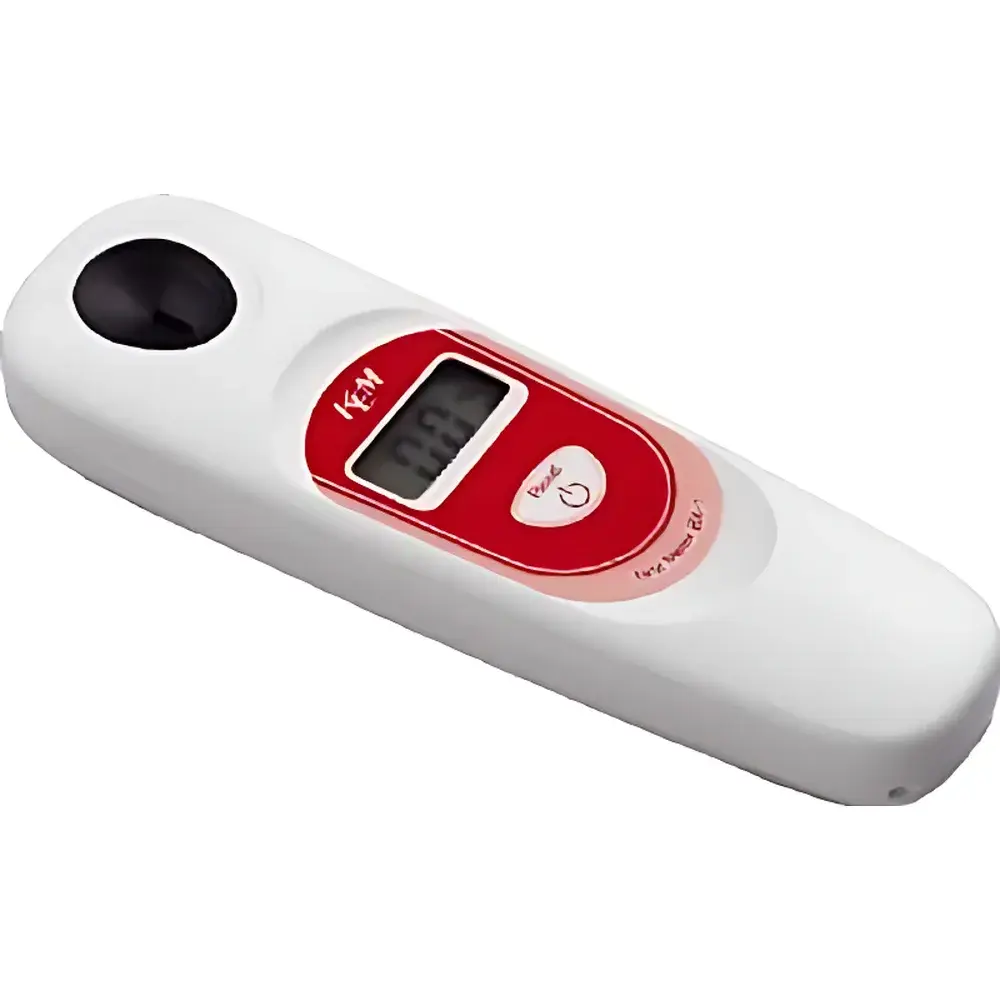
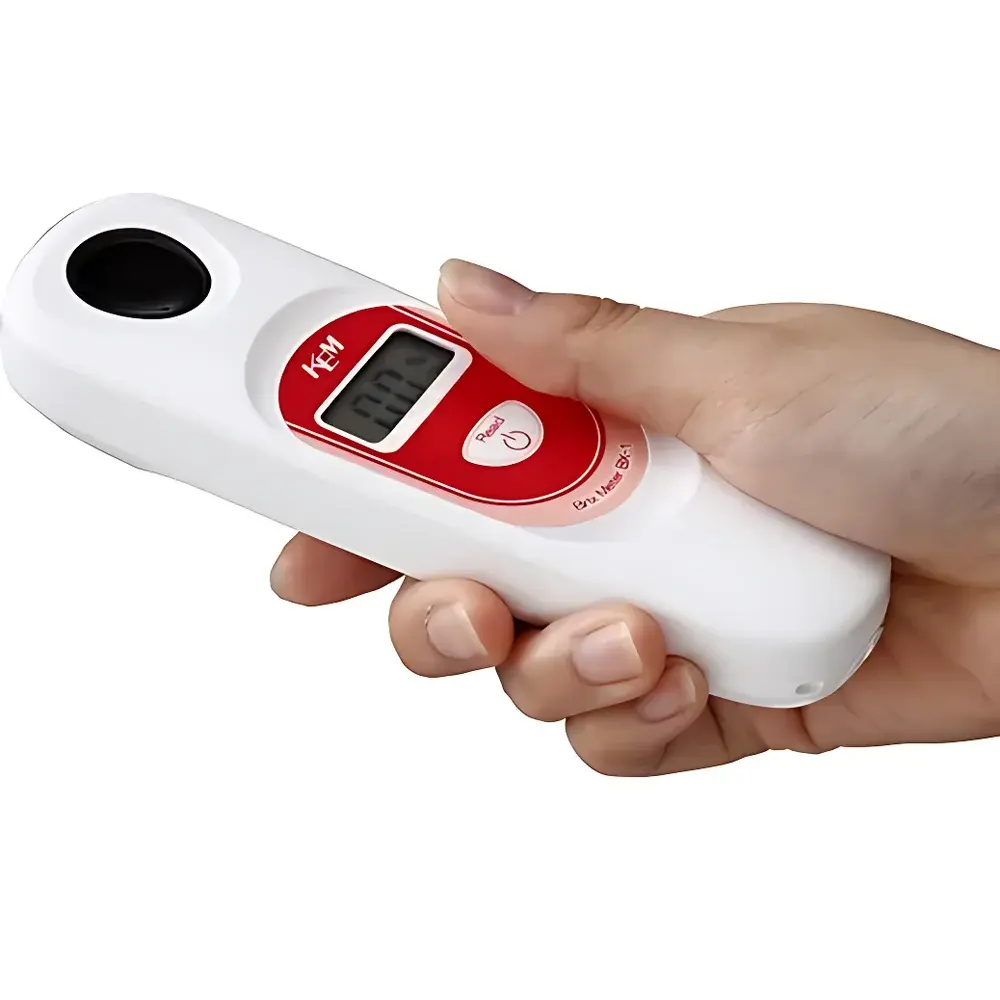
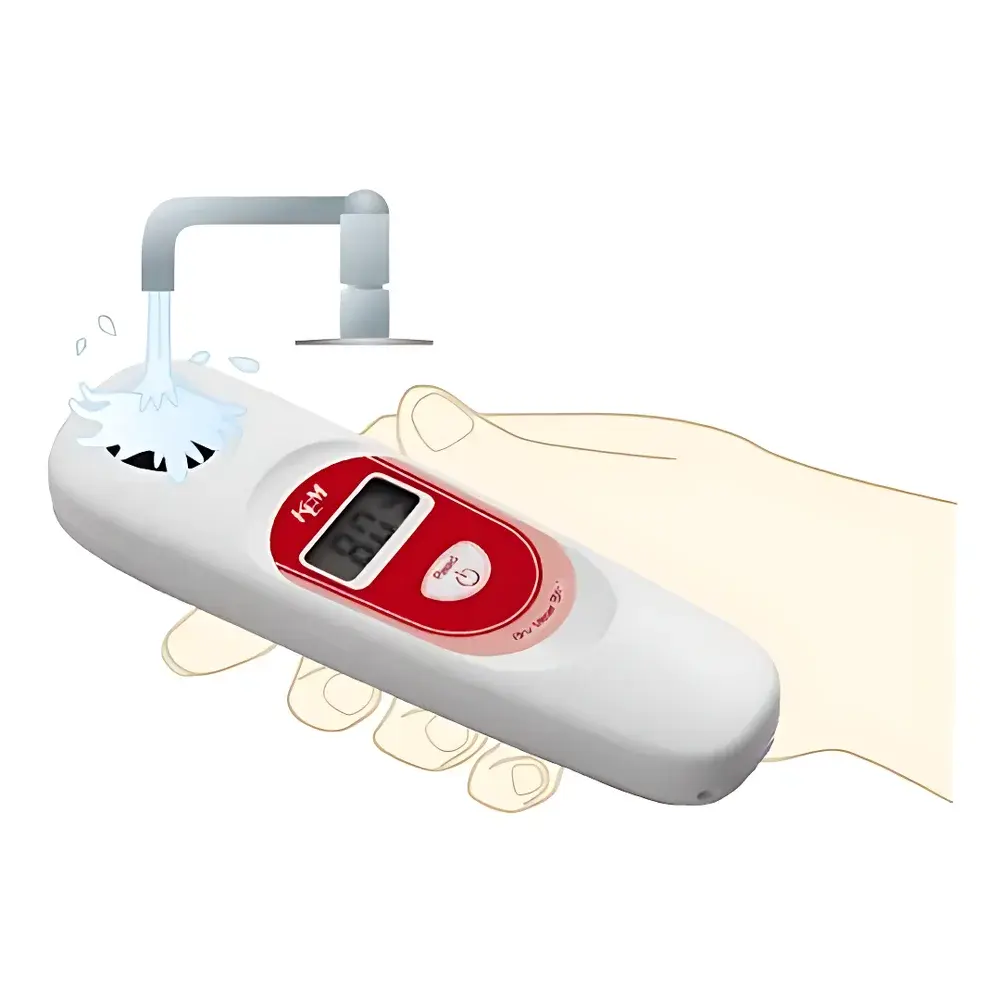
KEM BX-1 Digital Portable Refractometer for Brix Measurement (0–85%)
| Brand | KEM (Kyoto Electronics Manufacturing) |
|---|---|
| Origin | Japan |
| Manufacturer | Yes |
| Import Status | Imported |
| Model | BX-1 |
| Instrument Type | Destructive Sampling Refractometer |
| Measurement Principle | Abbe Refraction |
| Brix Range | 0.0–85.0% |
| Accuracy | ±0.2% Brix |
| Resolution | 0.1% Brix |
| Temperature Compensation | Automatic, 10–75°C |
| Display | LCD |
| Sample Volume | ~0.1 mL |
| Response Time | ≤2 s |
| Power | 2 × AAA batteries |
| Battery Life | ~30,000 measurements |
| IP Rating | IP65 |
| Dimensions | 45(W) × 32(D) × 153(H) mm |
| Weight | ~100 g |
Overview
The KEM BX-1 Digital Portable Refractometer is a precision optical instrument engineered for rapid, field-deployable quantification of soluble solids content in liquid and semi-liquid samples via the Abbe refractive index principle. It operates on the physical correlation between the refractive index of an aqueous solution and its concentration of dissolved solutes—primarily expressed as % Brix (equivalent to grams of sucrose per 100 g solution at 20°C). Designed for routine quality control in food processing, horticulture, beverage production, and agricultural extension services, the BX-1 delivers traceable, repeatable measurements without requiring laboratory infrastructure. Its compact form factor, integrated automatic temperature compensation (ATC), and robust IP65-rated housing enable reliable operation in humid, dusty, or variable-temperature environments—including orchards, packing houses, cold storage facilities, and production lines.
Key Features
- Full-range Brix measurement capability from 0.0 to 85.0%, supporting applications across low-sugar beverages (e.g., sports drinks) and high-concentration syrups or honey.
- High-resolution digital display with 0.1% Brix resolution and ±0.2% Brix accuracy at 20°C, calibrated traceably to NIST-traceable sucrose standards.
- Automatic temperature compensation (ATC) across 10–75°C, eliminating manual correction and ensuring consistent results despite ambient fluctuations—a critical requirement for field use and uncontrolled environments.
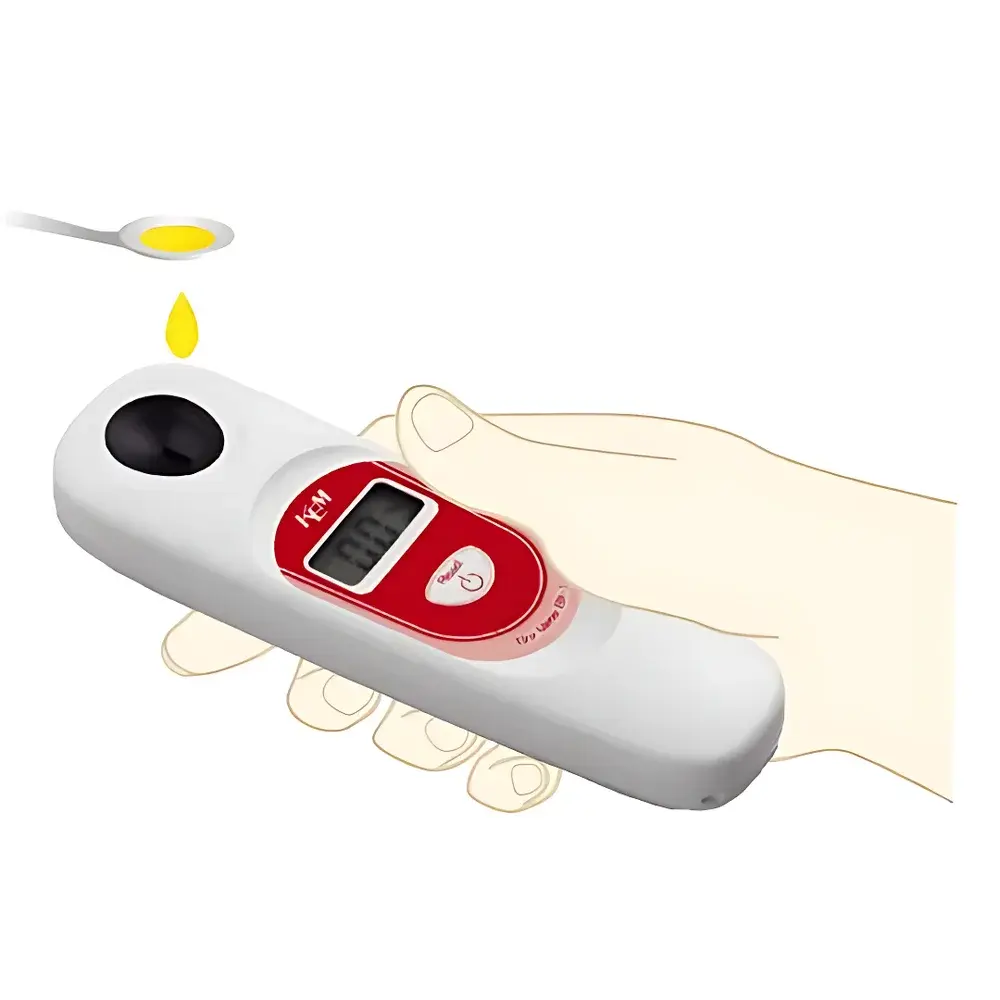
- Minimal sample requirement: only ~0.1 mL (1–2 drops) enables non-wasteful testing of high-value or limited-quantity samples.
- Rugged, pocket-sized design (45 × 32 × 153 mm; ~100 g) with IP65-rated enclosure—dust-tight and protected against low-pressure water jets—ensuring durability during transport and daily handling.
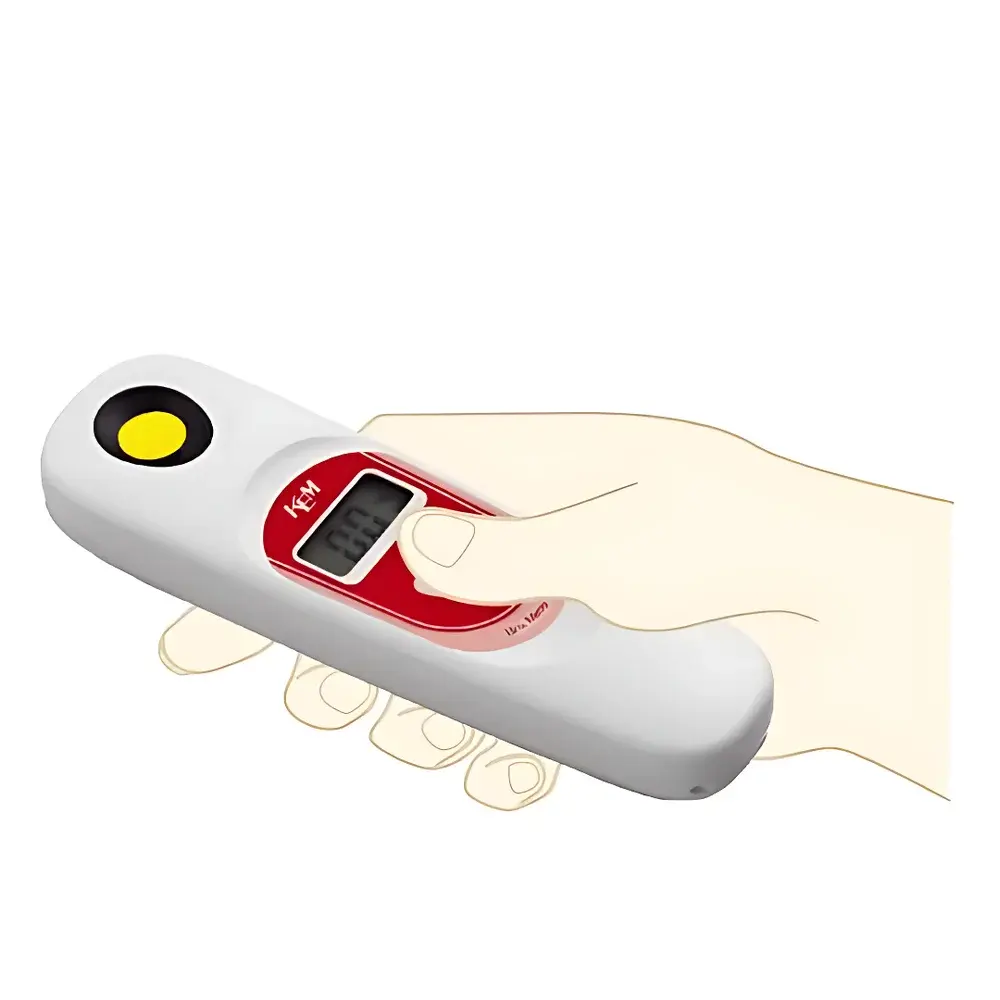
- Fast measurement cycle: stable reading output within ≤2 seconds after sample application, facilitating high-throughput screening.
- Simple two-point calibration using distilled or deionized water (0% Brix) and certified sucrose standard (e.g., 10% or 50% w/w), compliant with ISO 2173 and AOAC Official Method 932.12 protocols.
- Low-power operation on two AAA batteries with an estimated service life of 30,000 measurements, minimizing operational downtime and maintenance overhead.
Sample Compatibility & Compliance
The BX-1 accommodates a broad spectrum of sample types when prepared according to standardized pre-analytical protocols. It is validated for use with clarified liquids (e.g., fruit juices, soft drinks, wine must), semi-viscous suspensions (e.g., purees, nectars), and homogenized extracts from fresh or processed produce (fruits, vegetables, jams, jellies, canned goods, frozen concentrates). For turbid or particulate-laden matrices, filtration through double-layer lens paper or fine-weave gauze is recommended prior to measurement to avoid prism surface interference. Solid or dried samples require aqueous extraction under controlled conditions (e.g., boiling water bath, defined mass-to-volume ratios, cooling to 20°C before filtration) to ensure representative soluble solids recovery. The instrument conforms to international methodological frameworks including ISO 2173 (fruit and vegetable products), AOAC 932.12 (refractometric determination of soluble solids), and supports GLP-aligned documentation when paired with external logging systems.
Software & Data Management
The BX-1 operates as a standalone, battery-powered instrument with no embedded data storage or Bluetooth/Wi-Fi connectivity. All measurements are displayed in real time on the integrated LCD screen and must be manually recorded. This architecture aligns with environments where electromagnetic interference, cybersecurity constraints, or regulatory simplicity are prioritized—such as USDA-inspected facilities, GMP-compliant food manufacturing lines, or field-based agricultural audits. While the device itself does not generate electronic records, its consistent accuracy, ATC stability, and adherence to ISO/AOAC reference methods ensure full compatibility with laboratory information management systems (LIMS) and electronic batch record (EBR) workflows when readings are transcribed into validated digital logs. Calibration events and verification checks can be documented per FDA 21 CFR Part 11 expectations through external audit trails.
Applications
- Horticultural maturity assessment: Determining optimal harvest timing for grapes, citrus, mangoes, and stone fruits based on Brix accumulation trends.
- Beverage formulation & QC: Monitoring sugar concentration consistency across batches of juice blends, isotonic solutions, and flavored waters.
- Confectionery & syrup production: Verifying concentration endpoints during evaporation, dilution, or blending operations.
- Academic and extension education: Teaching fundamental principles of optical density, solution thermodynamics, and food composition analysis.
- Small-scale agro-processing: Enabling resource-limited cooperatives and cottage industries to meet export-grade Brix specifications without benchtop instrumentation.
- Research screening: Rapid pre-sorting of germplasm collections or breeding lines for soluble solids content prior to detailed HPLC or enzymatic analysis.
FAQ
What does “destructive sampling” mean for the BX-1?
Destructive sampling refers to the requirement that the test sample must be physically applied to the prism surface and subsequently removed or discarded after measurement—no sample recovery is possible. This is inherent to contact-type refractometry.
Can the BX-1 measure non-sucrose sugars like fructose or glucose accurately?
The BX-1 reports values calibrated to sucrose equivalence. Samples containing significant proportions of fructose, invert sugar, or other solutes will yield approximate Brix values; for compositional specificity, HPLC or enzymatic assays are recommended.
Is cleaning the prism required between measurements?
Yes—residue removal using distilled water and lens tissue is essential to prevent cross-contamination and maintain optical clarity. The IP65 rating permits gentle rinsing under running water.
Does the BX-1 comply with ISO or AOAC standards?
While the instrument itself is not certified, its measurement principle, calibration protocol, and performance specifications fully support compliance with ISO 2173 and AOAC 932.12 when operated per prescribed sample preparation and environmental controls.
How often should calibration be performed?
Calibration is recommended before each measurement session and whenever ambient temperature changes exceed ±5°C—or immediately after exposure to extreme thermal gradients.





