
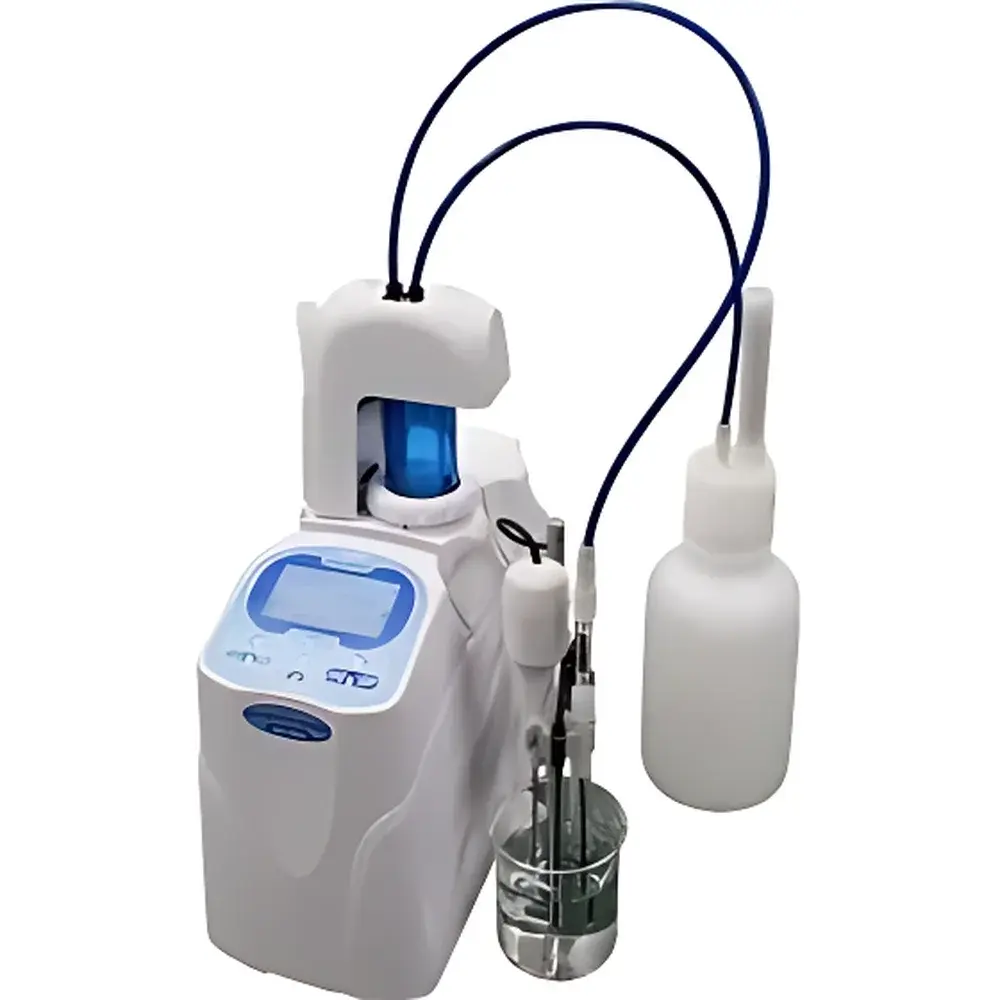
KEM CHA-700 Automated Potentiometric Titrator with Multi-Sample Autosampler
| Brand | KEM (Kyoto Electronics Manufacturing) |
|---|---|
| Origin | Japan |
| Model | CHA-700 |
| Instrument Type | General-Purpose Automatic Potentiometric Titrator |
| Measurement Range | pH: –20.00 to +20.00 |
| mV | –2000.0 to +2000.0 mV |
| Temperature | 0.0 to 100.0 °C |
| Meter Accuracy | ±0.2% of full scale |
| Meter Resolution | pH: 0.01 pH |
| mV | 0.1 mV |
| Temperature | 0.1 °C |
| Titration Endpoint Precision | ±0.3 mV |
| Sample Capacity | 6 positions (plus 1 rinse station) |
| Sample Vessel Compatibility | 200–250 mL glass or polypropylene beakers |
| Stirring Mechanism | Propeller-type magnetic stirrer |
| Communication Interface | SS-BUS (for AT-700 titrator and APB burette control), PUMP port (for optional rinse/waste pumps) |
| Operating Environment | 5–35 °C, ≤85% RH |
| Power Supply | AC 100–240 V ±10%, 50/60 Hz, 20 W |
| Dimensions (W×D×H) | 365 × 443 × 315 mm |
| Weight | Approx. 8 kg |
Overview
The KEM CHA-700 Automated Potentiometric Titrator is a modular, precision-engineered electrochemical analysis system designed for unattended, high-reproducibility potentiometric titrations in regulated and research laboratory environments. Built upon KEM’s legacy of metrological rigor and ISO/IEC 17025-aligned instrument design, the CHA-700 integrates seamlessly with the AT-700 automatic titrator as a dedicated multi-sample autosampler—enabling fully automated sequential analysis without manual intervention between samples. Its core measurement principle relies on real-time monitoring of potential difference (mV) across a reference–indicator electrode pair during controlled reagent addition, enabling precise endpoint detection via first-derivative (ΔE/ΔV) or inflection-point algorithms. The system supports classical acid–base, redox, precipitation, and complexometric titrations, with native compatibility for non-aqueous, low-conductivity, and high-viscosity matrices through optimized electrode positioning and dynamic stirring control.
Key Features
- Modular stack architecture: CHA-700 autosampler mounts directly above the AT-700 titrator, minimizing footprint while ensuring mechanical stability and alignment integrity during vertical sample tray actuation.
- 6-position sample carousel with dedicated rinse station: Accommodates standard 200 mL or 250 mL beakers (glass or PP); position detection via optical sensor ensures error-free sequence execution and prevents run interruption due to misloading.
- Programmable per-sample method assignment: Each sample location can be assigned an independent titration protocol—including blank correction, titer standardization, and multi-step titration sequences—via AT-700 host software.
- Propeller-type stirring mechanism: Provides consistent, turbulence-free mixing across viscosity ranges (up to 1000 mPa·s), critical for reproducible endpoint recognition in heterogeneous or colloidal samples.
- Optional auxiliary fluid handling: SS-BUS-controlled rinse pump (for electrode and burette tip cleaning) and waste evacuation pump support GLP-compliant operation by eliminating cross-contamination and enabling traceable wash cycles.
- LED status interface: Real-time visual feedback for power state, carousel rotation, and cup presence detection—reducing operator dependency during routine startup and troubleshooting.
Sample Compatibility & Compliance
The CHA-700 supports broad sample matrix compatibility, including aqueous solutions, ethanol–water mixtures, glacial acetic acid, and low-dielectric solvents used in non-aqueous titrations (e.g., perchloric acid in acetic anhydride for amine assays). Its wide pH range (–20.00 to +20.00) and extended mV window (±2000 mV) accommodate extreme redox potentials and highly alkaline conditions common in cement, battery electrolyte, or pharmaceutical excipient analysis. All hardware and firmware comply with IEC 61010-1 safety standards. When operated with validated AT-700 methods and audit-trail-enabled software (e.g., KEM TITRAVISION™), the system meets FDA 21 CFR Part 11 requirements for electronic records and signatures, supporting GMP/GLP documentation workflows in QC laboratories.
Software & Data Management
Control and data acquisition are managed exclusively through the AT-700’s embedded operating system and optional PC-based TITRAVISION™ software. Method development includes customizable titrant addition modes (dynamic, fixed-volume, or incremental), endpoint validation thresholds, and post-run calculation templates (e.g., % purity, mg KOH/g, acidity number). Raw mV–volume curves, derivative plots, and statistical summaries (mean, RSD, confidence intervals) are exportable in CSV, PDF, or XML formats. Audit trails record user ID, timestamp, parameter changes, and result modifications—fully traceable for regulatory inspections. Data integrity is reinforced via password-protected access levels and electronic signature capture for report approval.
Applications
- Pharmaceutical QC: Assay of active ingredients (e.g., ibuprofen, ascorbic acid) and residual chloride in APIs per USP and EP 2.2.20.
- Food & Beverage: Total acidity (TA), salt content (argentometric), and SO₂ determination in wines and juices per AOAC 941.12 and ISO 5776.
- Chemical Manufacturing: Acid number (ASTM D974), base number (ASTM D2896), and water content (Karl Fischer coulometric integration via optional module).
- Environmental Testing: Alkalinity profiling in wastewater, fluoride quantification in drinking water (TISAB-buffered potentiometry), and cyanide determination per EPA Method 335.4.
- Academic Research: Kinetic titration studies, pKa determination of weak acids, and ligand-binding stoichiometry in coordination chemistry.
FAQ
Can the CHA-700 operate independently without the AT-700 titrator?
No—the CHA-700 is a dedicated autosampler module requiring the AT-700 main unit for electrode signal conditioning, burette control, endpoint calculation, and method execution.
Is calibration traceable to NIST standards?
Yes—pH and mV calibration routines support certified reference materials (e.g., NIST-traceable pH buffers and redox standards), with calibration logs stored alongside analytical results.
What maintenance is required for long-term reliability?
Routine tasks include quarterly verification of stirrer torque consistency, biannual inspection of SS-BUS cable integrity, and annual electrode performance validation using standardized test solutions.
Does the system support remote monitoring or network integration?
Via optional Ethernet-to-SS-BUS gateway, TITRAVISION™ allows secure remote method upload, real-time run monitoring, and centralized data archiving within LIMS environments.
Are disposable electrodes compatible?
The CHA-700 accepts standard BNC-terminated combination pH/mV electrodes; while reusable glass-body electrodes are recommended for precision work, certain single-use screen-printed electrodes may be adapted with mechanical adapters (not supplied by KEM).





