
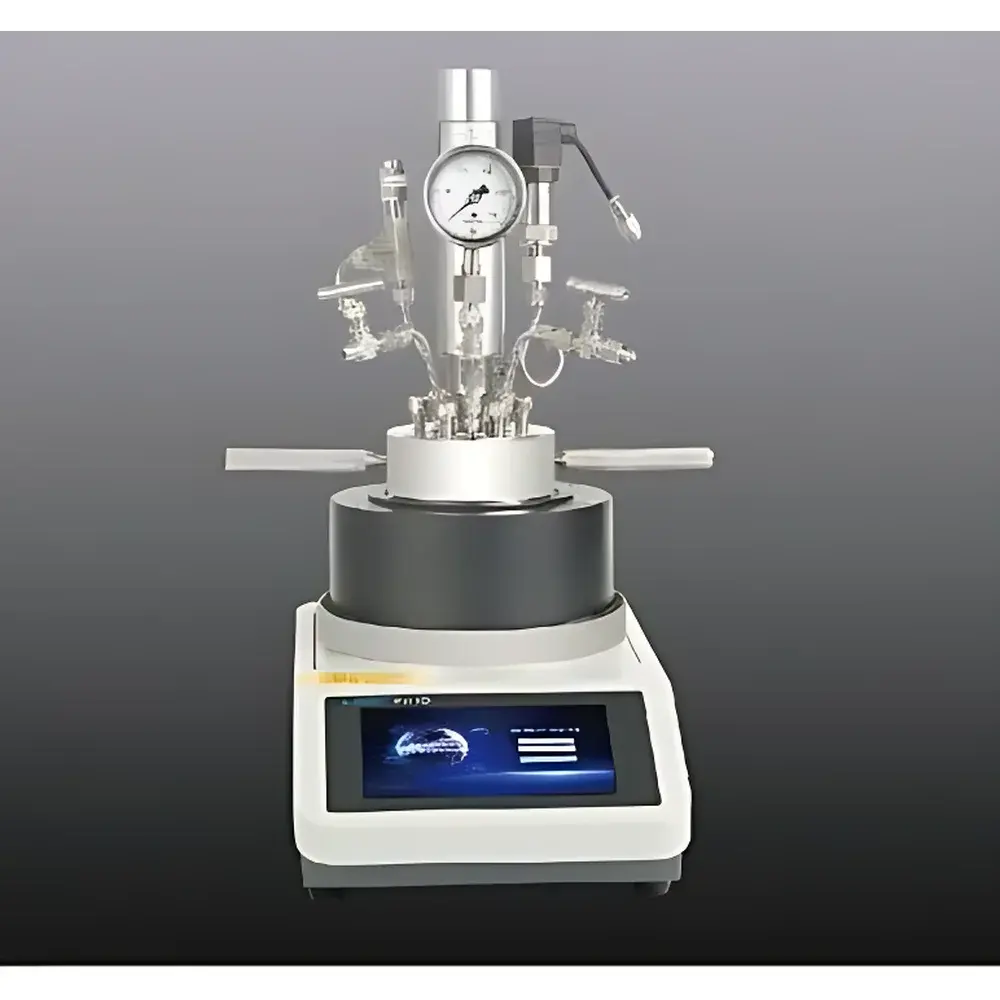
Kemi MSI Quick-Release Mechanical Stirring Reactor
| Origin | Anhui, China |
|---|---|
| Manufacturer Type | Distributor |
| Origin Category | Domestic |
| Model | MSI |
| Price Range | USD 2,800 – 7,000 |
| Usable Volume | Micro-scale |
| Construction Material | Stainless Steel (316L standard, optional Hastelloy C-276) |
| Operating Pressure | High-pressure |
| Capacities | 25 mL, 50 mL, 100 mL, 300 mL |
| Max. Working Temperature | 300 °C (standard), up to 550 °C (optional) |
| Max. Working Pressure | 207 bar (standard), up to 345 bar (optional) |
| Stirring Speed | 0–1400 rpm (infinitely variable) |
| Heating Method | Embedded stainless steel heating module |
| Heating Power | 0.8 kW |
| Temperature Control | Intelligent PID with over-temperature auto-shutdown |
| Pressure Monitoring | Integrated digital pressure transducer with audible over-pressure alarm |
| Safety Features | Tongue-and-groove primary sealing, Swagelok inlet/outlet needle valves (USA), Fitok safety relief valve + custom rupture disc dual protection |
| Interface | 7-inch high-resolution touchscreen display (temperature, RPM, pressure, elapsed time), USB port for data export (CSV format) |
| Power Supply | 200–240 V AC, 50–60 Hz |
| Dimensions (W×H×L) | ≈250 × 460 × 410 mm |
| Compliance | Designed per ASME BPVC Section VIII Div. 1 guidelines for laboratory-scale pressure equipment |
Overview
The Kemi MSI Quick-Release Mechanical Stirring Reactor is an integrated, benchtop-scale high-pressure reaction system engineered for precise kinetic studies, catalytic screening, polymerization trials, and hazardous chemistry under controlled thermal and mechanical conditions. It operates on the principle of magnetically coupled mechanical agitation within a sealed, pressure-rated vessel—eliminating rotating shaft seals while maintaining full vacuum-to-high-pressure integrity (up to 345 bar). The reactor combines a precision-machined 316L stainless steel or Hastelloy C-276 pressure vessel, an embedded resistive heating module with rapid thermal response (≤20 °C/min ramp rate), and a high-torque magnetic drive capable of sustaining stable agitation across the full 0–1400 rpm range—even at elevated viscosities and temperatures up to 550 °C (with optional configuration). Its design adheres to fundamental pressure equipment safety principles aligned with ASME Boiler and Pressure Vessel Code (BPVC) Section VIII Division 1, ensuring structural reliability during exothermic or gas-evolving reactions.
Key Features
- Quick-release clamping mechanism with ergonomic assist tools enables sub-90-second vessel opening/closing without torque wrenches—reducing operator fatigue and cross-contamination risk between runs.
- 7-inch capacitive touchscreen HMI displays real-time temperature, pressure, stirring speed, and elapsed time with intuitive icon-driven navigation; supports multi-language UI (English, German, Chinese).
- Dual-stage pressure safety architecture: certified Fitok spring-loaded safety relief valve (set point adjustable) paired with a calibrated rupture disc—both independently qualified per ISO 4126-2.
- Embedded PID temperature control with adaptive tuning eliminates thermal overshoot; supports ramp-hold programs and external thermocouple input for jacket or internal probe redundancy.
- USB 2.0 interface logs all process parameters at user-defined intervals (1–60 sec) into timestamped CSV files—compatible with LIMS integration and compliant with FDA 21 CFR Part 11 when used with validated electronic signature workflows.
- Modular accessory compatibility includes catalyst baskets, liquid sampling ports with septum-sealed valves, reflux condensers, gas sparging nozzles, and cryogenic cooling jackets (−20 °C to 200 °C).
Sample Compatibility & Compliance
The MSI reactor accommodates heterogeneous, multiphase, and highly viscous systems—including slurries, molten polymers, supercritical fluids, and corrosive reagents (e.g., HF, Cl₂, H₂S). Standard 316L construction meets ASTM A240 requirements for general corrosion resistance; Hastelloy C-276 variants satisfy NACE MR0175/ISO 15156 for sour service applications. All pressure-retaining components undergo hydrostatic testing at 1.5× maximum allowable working pressure (MAWP) with traceable certification. The system supports ISO/IEC 17025-compliant calibration protocols for temperature (Pt100 Class A), pressure (0.25% FS accuracy), and rotational speed (±1 rpm resolution). Documentation packages include Factory Acceptance Test (FAT) reports and material test certificates (MTCs) per EN 10204 3.1.
Software & Data Management
No proprietary software installation is required—the reactor functions as a standalone instrument with onboard data logging. All operational parameters are stored in non-volatile memory and exported via USB flash drive in plain-text CSV format, enabling direct import into MATLAB, Python (pandas), JMP, or ELN platforms. Timestamps include UTC synchronization (via manual entry), and each record contains unique batch ID, operator ID field, and event markers for alarm triggers (e.g., “OVERPRESSURE_ALARM_20240517_142233”). Audit trail functionality meets GLP Annex 11 and GMP Annex 11 expectations when combined with institutional electronic signature policies. Optional RS-485 Modbus RTU output supports integration into centralized SCADA or DCS environments.
Applications
- Catalyst evaluation under industrially relevant P/T conditions (e.g., Fischer–Tropsch, hydrodesulfurization, asymmetric hydrogenation)
- Kinetic modeling of esterification, transesterification, and polycondensation (e.g., PET, PBT synthesis)
- Solvent-free oxidative reactions using O₂ or air at elevated partial pressures
- Supercritical CO₂-assisted nanoparticle synthesis and crystallization
- Corrosion testing of alloy candidates in simulated geothermal or flue-gas desulfurization environments
- Batch-wise photochemical reactions with integrated LED irradiation ports (optional add-on)
FAQ
What pressure and temperature ratings apply to the standard MSI configuration?
Standard units are rated for 207 bar MAWP and 300 °C. Higher ratings (345 bar / 550 °C) require Hastelloy C-276 construction and upgraded gasket materials—subject to individual FAT validation.
Is the magnetic coupling suitable for viscous polymer melts?
Yes—the high-torque drive maintains nominal speed stability up to 50 Pa·s viscosity at 300 °C; optional dual-blade impellers improve radial mixing efficiency in non-Newtonian systems.
Can the reactor be operated under inert atmosphere prior to pressurization?
Absolutely. Integrated Swagelok needle valves support sequential purge cycles (vacuum → inert gas → pressurization) with real-time pressure monitoring throughout.
How is calibration traceability maintained?
Each unit ships with NIST-traceable calibration certificates for temperature (±0.3 °C), pressure (±0.25% FS), and speed (±1 rpm); annual recalibration services are available with ISO/IEC 17025-accredited providers.
Does the system comply with explosion protection directives for Zone 1 environments?
The base unit is rated for non-hazardous location use only. For Zone 1 deployment, optional ATEX-certified explosion-proof enclosures and intrinsically safe sensor interfaces are available upon request.



