
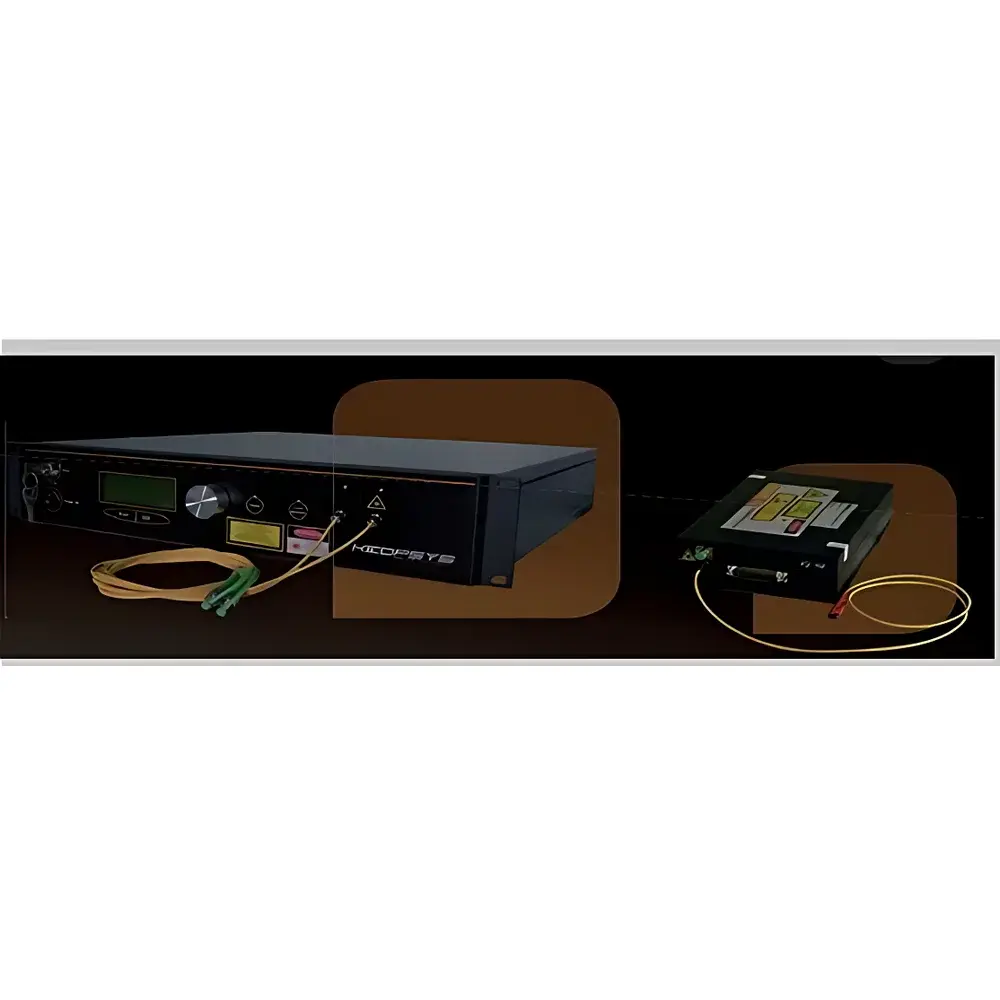
Keopsys PEFA-SP-C Series Short-Pulse Fiber Amplifier
| Brand | Keopsys |
|---|---|
| Origin | France |
| Model | PEFA-SP-C Series |
| Wavelength Range | 1535–1565 nm |
| Saturation Output Power | up to +33 dBm |
| Pulse Width | 0.3–10 ps |
| Peak Power | up to 1 kW |
| Repetition Rate | 10 MHz – 100 GHz |
| Compliance | CE, RoHS |
Overview
The Keopsys PEFA-SP-C Series Short-Pulse Fiber Amplifier is a high-performance, polarization-maintaining erbium-doped fiber amplifier engineered for ultrafast optical systems requiring precise amplification of sub-nanosecond pulses. Based on master oscillator power amplifier (MOPA) architecture, it operates within the C-band (1535–1565 nm), delivering exceptional gain stability and minimal nonlinear distortion under high peak power conditions. Designed for integration into demanding scientific and industrial laser systems—including time-resolved spectroscopy, coherent LIDAR, nonlinear frequency conversion, and ultrafast pump-probe setups—the PEFA-SP-C leverages low-noise, single-mode PM fiber components to preserve temporal pulse fidelity and polarization extinction ratio (>20 dB) across its full operating range. Its compact, air-cooled module form factor enables OEM integration without external water cooling or complex thermal management.
Key Features
- High saturation output power up to +33 dBm (2 W average), supporting high-energy pulse extraction without gain saturation-induced distortion
- Sub-picosecond to 10-ps pulse width compatibility with minimal pulse broadening (<5% FWHM increase typical at rated output)
- Wide repetition rate tuning from 10 MHz to 100 GHz—enabling synchronization with RF-driven modulators and cavity-dumped oscillators
- Integrated polarization-maintaining (PM) input and output paths using Panda-type PM fiber; maintains >20 dB PER over temperature (−5 °C to +45 °C)
- Low amplified spontaneous emission (ASE) spectral density: <−30 dBc/nm at 1 nm offset from signal wavelength
- Internal monitor photodiode with analog APC interface (0–5 V) for closed-loop power stabilization (±0.5% long-term stability)
- Compliant with IEC 60825-1:2014 (Class 4 laser product) and EN 61326-1:2013 (EMC for laboratory equipment)
Sample Compatibility & Compliance
The PEFA-SP-C accepts free-space collimated or fiber-pigtailed seed inputs via FC/APC or E2PS connectors (customizable). It is compatible with mode-locked fiber oscillators (e.g., Er:fiber, Yb:fiber seeds at 1550 nm or 1064 nm with SHG), electro-optic modulators, and pulse pickers. All internal optics and doped fiber segments are qualified per Telcordia GR-1221-CORE for reliability in continuous operation. The amplifier meets ISO 9001-certified manufacturing standards and supports traceable calibration reports (NIST-traceable power meter verification available upon request). For regulated environments, firmware supports optional audit trail logging aligned with FDA 21 CFR Part 11 requirements when integrated with compliant host controllers.
Software & Data Management
The PEFA-SP-C includes RS-232 and USB-C digital interfaces for remote configuration of gain setpoint, APC enable/disable, and status monitoring (input power, output power, diode current, case temperature). Keopsys’ LabControl Suite (v3.2+) provides GUI-based parameter sweeps, real-time oscilloscope-style pulse train visualization (via external fast photodiode), and CSV export of timestamped power/temperature logs. All communication protocols are ASCII-based and documented in the publicly available API Reference Manual (Rev. D). Firmware updates retain user-defined settings and support dual-bank rollback—ensuring continuity during GLP/GMP validation cycles.
Applications
- Coherent Doppler LIDAR for wind profiling and atmospheric sensing (meeting NASA ESTO instrument readiness level 6 requirements)
- Pump-probe experiments in ultrafast physics, including carrier dynamics in 2D materials and photoinduced phase transitions
- Optical parametric chirped-pulse amplification (OPCPA) front-end seeding at 1550 nm
- Fiber-based frequency comb stabilization and octave-spanning supercontinuum generation
- Atomic physics platforms: optical lattice clocks, magneto-optical traps (MOTs), and stimulated Raman adiabatic passage (STIRAP)
- Non-destructive testing via laser ultrasonics—leveraging high peak power for efficient thermoelastic coupling in metals and composites
FAQ
What is the maximum allowable seed pulse energy for stable amplification without SBS onset?
For 10-ps pulses at 10 MHz repetition rate, the recommended maximum seed pulse energy is ≤50 pJ to maintain stimulated Brillouin scattering (SBS) threshold margin >6 dB. Higher energies require customized large-mode-area (LMA) gain fiber options.
Can the PEFA-SP-C be operated in constant-current mode instead of APC mode?
Yes—digital control registers allow disabling APC and setting fixed pump diode current (0–1200 mA, 1 mA resolution); however, output power drift may exceed ±3% over 8 hours without feedback.
Is there an option for analog modulation of output power?
Analog modulation bandwidth is DC–10 kHz (−3 dB) via dedicated 0–5 V input; modulation depth is linear up to 20 dB attenuation from max output.
Does the unit include built-in isolation against back-reflected light?
Yes—a 30 dB polarization-dependent isolator is integrated at the output stage; optional 40 dB broadband isolator upgrade available for high-reflectivity target applications.
What is the warm-up time to achieve specified power stability?
Thermal equilibrium and power stability (±1%) are achieved within 15 minutes from cold start at 25 °C ambient; active thermoelectric cooler (TEC) stabilizes pump diode junction temperature to ±0.1 °C.



