
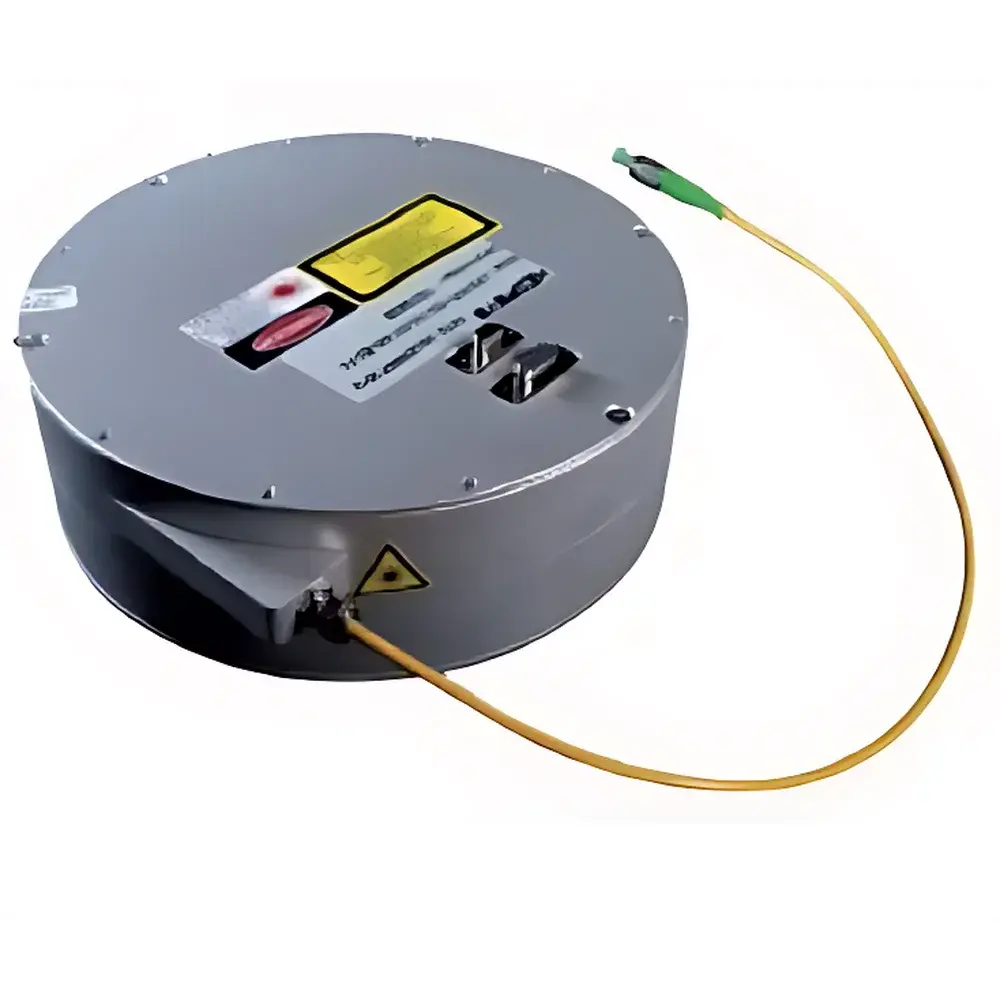
Keopsys PEFL-MIRVISION Series 1.5 µm High-Power Pulsed Erbium-Doped Fiber Laser
| Brand | Keopsys |
|---|---|
| Origin | France |
| Model | PEFL-MIRVISION Series |
| Operating Wavelength | 1545 ± 1 nm |
| Pulse Width (FWHM) | 0.5–200 ns |
| Repetition Rate | 15 kHz–2 MHz |
| Pulse Energy | up to 350 µJ |
| Peak Power | up to 25 kW |
| Average Power | 3–10 W |
| Beam Quality (M²) | 1.5–2.5 |
| Polarization | Linear or Random (≥15 dB) |
| Output Connector | FC/APC or Collimator |
| Seed Reference Output (Optional) | 1 m SMF pigtail, >0.1 mW peak power, FC/PC |
| Operating Temperature Range | −35 °C to +65 °C |
| Compliance | MIL-STD-810G, RTCA DO-160G |
| Control Interface | RS232/USB, TTL trigger |
| Maintenance | All-fiber, maintenance-free architecture |
Overview
The Keopsys PEFL-MIRVISION Series is a high-performance, all-fiber pulsed erbium-doped fiber laser engineered for demanding industrial, aerospace, and scientific applications requiring robust 1.5 µm laser sources. Operating at a nominal wavelength of 1545 ± 1 nm—within the eye-safe spectral region defined by IEC 60825-1 and ANSI Z136.1—the system delivers precisely controlled nanosecond pulses with exceptional temporal stability and beam fidelity. Its core architecture leverages master oscillator power amplifier (MOPA) topology, where a low-noise semiconductor seed diode drives a fully integrated, polarization-maintaining erbium-doped fiber amplifier stage. This design eliminates free-space alignment, ensures long-term pointing stability, and enables operation under extreme mechanical stress. The laser’s pulse generation is governed by direct electronic control of both seed modulation and amplifier gating, supporting flexible pulse shaping without external modulators. With an M² factor between 1.5 and 2.5 across its full operating envelope, the PEFL-MIRVISION maintains diffraction-limited focusability critical for time-of-flight ranging, nonlinear frequency conversion, and high-resolution LIDAR scanning.
Key Features
- All-fiber monolithic construction ensuring zero realignment requirements and intrinsic immunity to thermal drift
- Comprehensive environmental hardening validated per MIL-STD-810G (vibration, shock) and RTCA DO-160G (airborne equipment qualification)
- Wide operational temperature range (−35 °C to +65 °C) with active thermal stabilization of pump diodes and gain fiber
- Integrated microcontroller enabling local diagnostics, fault logging, and bidirectional communication via RS232 or USB
- Low-latency TTL triggering (<50 ns jitter) for precise synchronization with external detectors, scanners, or data acquisition systems
- Configurable polarization output—linear (≥15 dB extinction ratio) or random—with optional polarization-maintaining delivery fiber
- Compact OEM module form factor (typically <200 × 120 × 40 mm) optimized for integration into embedded platforms and airborne payloads
- Energy-efficient design with wall-plug efficiency exceeding 15% in standard configurations
Sample Compatibility & Compliance
The PEFL-MIRVISION series is designed for use with standard single-mode fiber (SMF-28 or equivalent) and compatible collimation optics rated for >10 kW/cm² peak intensity. Its 1.5 µm emission avoids atmospheric water vapor absorption bands while maintaining sufficient photon energy for efficient second-harmonic generation (SHG) in PPLN or KTP crystals. The system complies with CE marking requirements under Directive 2014/30/EU (EMC) and 2014/35/EU (LVD), and meets Class 1M laser safety classification when equipped with appropriate beam termination or interlocks. For regulated environments—including defense contracting, aviation instrumentation, and GLP-compliant metrology labs—the laser supports audit-ready event logging and firmware version traceability. Optional seed reference output facilitates closed-loop timing calibration in multi-channel coherent detection systems.
Software & Data Management
Keopsys provides the MIRVISION Control Suite—a cross-platform application (Windows/macOS/Linux) supporting real-time parameter monitoring, waveform capture, and non-volatile configuration storage. The suite implements IEEE 1174-compliant command syntax over serial/USB interfaces and supports SCPI-like scripting for automated test sequences. All operational parameters—including pulse energy, repetition rate, and internal temperature telemetry—are timestamped and exportable in CSV or HDF5 format. Firmware updates are performed via signed binary packages with SHA-256 verification. For integration into larger testbeds, DLL and Python API bindings are supplied, enabling direct control from LabVIEW, MATLAB, or custom C++ applications. Audit trails record user-initiated changes, system faults, and thermal events—fully compliant with FDA 21 CFR Part 11 requirements when deployed with validated IT infrastructure.
Applications
- Long-range coherent and direct-detection LIDAR for terrain mapping, forestry inventory, and autonomous vehicle perception
- Time-of-flight (ToF) distance measurement in industrial automation, robotic guidance, and precision metrology
- Obstacle detection and avoidance systems for UAVs, helicopters, and maritime navigation platforms
- Underwater depth profiling using blue-green harmonic generation (e.g., 772 nm via SHG in BBO)
- Multi-spectral remote sensing exploiting differential atmospheric transmission windows near 1.55 µm
- Nonlinear optical pumping for mid-IR supercontinuum generation in fluoride or chalcogenide fibers
- Material processing applications requiring high peak intensity with minimal thermal load—e.g., thin-film ablation and micromachining of polymers
FAQ
Is the PEFL-MIRVISION laser certified for airborne deployment?
Yes. Units configured with the aerospace-grade housing option undergo full RTCA DO-160G Section 21 (vibration), Section 22 (shock), and Section 25 (temperature cycling) testing. Documentation includes test reports and compliance declarations.
Can pulse width be adjusted dynamically during operation?
Pulse width is set at factory configuration or via firmware update; real-time analog adjustment is not supported. However, discrete pulse width selection (e.g., 2 ns / 10 ns / 50 ns) can be switched via digital command within <100 µs.
What cooling method is required?
Conductive cooling only. No forced air or liquid cooling is needed. Thermal management relies on aluminum chassis conduction and internal heat spreading layers.
Is there a version with fiber-coupled harmonic output?
Keopsys offers custom-integrated SHG modules delivering 772 nm output via PM fiber; contact engineering support for power-level and packaging specifications.
Does the laser support external cavity feedback for linewidth narrowing?
No. The MOPA architecture is optimized for pulse energy and stability—not narrow-linewidth CW operation. For coherent applications, external phase modulation or injection seeding is recommended.





