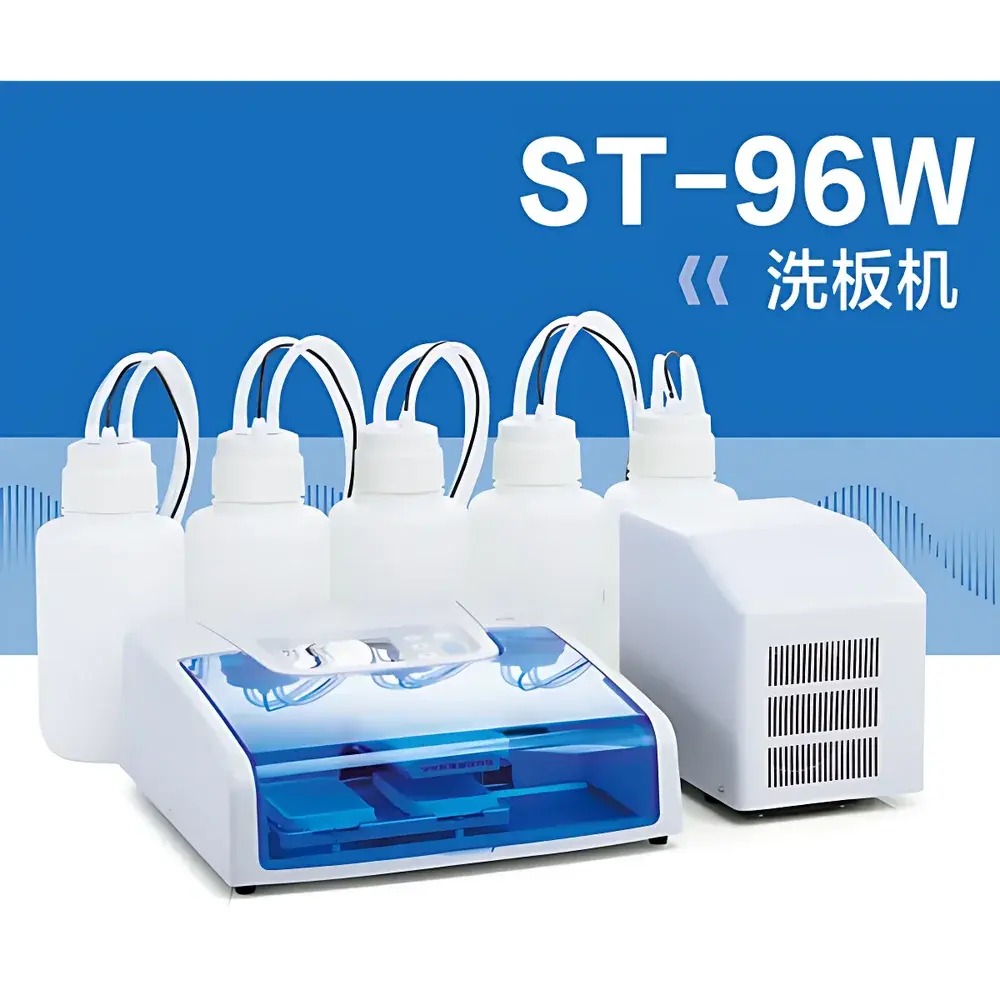
KHB ST-96W 96-Channel Microplate Washer
| Brand | KHB |
|---|---|
| Origin | Shanghai, China |
| Model | ST-96W |
| Instrument Type | Multifunctional Plate Washer |
| Wash Head | 96-pin |
| Rinse Head Configuration | 1–8 independent rinse channels |
| Wash Solution Channels | 2 |
| Waste Liquid Channels | 2 |
| Soak Time Range | 0–999 s |
| Wash Cycles | 1–100 |
| Residual Volume per Well | ≤ 0.8 µL |
| Orbital Shaking Function | Adjustable |
Overview
The KHB ST-96W 96-Channel Microplate Washer is an engineered solution for high-throughput, reproducible plate washing in ELISA, cell-based assays, and other microplate-dependent immunoassay workflows. Designed around the principle of precision fluid dispensing and aspiration under controlled hydrodynamic conditions, the ST-96W employs a dual-channel wash solution delivery system coupled with synchronized 96-pin aspiration to ensure uniform wetting, consistent dwell time, and minimal cross-well carryover. Its architecture adheres to core requirements of GLP-compliant laboratory environments—particularly in clinical diagnostics and biopharmaceutical QC labs—where traceability, repeatability, and low residual volume are critical for assay fidelity. Unlike entry-level washers relying on fixed-volume peristaltic pumps, the ST-96W integrates externally mounted, maintenance-friendly diaphragm pumps that reduce mechanical vibration and acoustic noise (<55 dB(A) at 1 m), thereby enhancing operator comfort during extended batch processing.
Key Features
- 96-pin stainless-steel wash head with precise vertical alignment and auto-height calibration for consistent tip immersion across all well geometries (U-, V-, and flat-bottom 96-well plates)
- Independent control of up to eight rinse zones—enabling selective washing of sub-arrays or staggered protocols without manual reconfiguration
- Dual independent wash solution inlets and dual waste aspiration paths, supporting simultaneous use of primary and secondary wash buffers (e.g., PBS + detergent-containing buffer) with zero cross-contamination risk
- Programmable soak duration (0–999 s) and cycle count (1–100), with real-time feedback on aspiration vacuum pressure and fluid level detection in waste reservoirs
- Adjustable orbital shaking function (amplitude: 1–5 mm; frequency: 100–1,200 rpm), optimized for dislodging loosely bound reagents without compromising cell monolayer integrity in adherent assays
- Front-access service panel and tool-free wash head removal—reducing mean time to repair (MTTR) and enabling routine maintenance by lab personnel without field engineer support
Sample Compatibility & Compliance
The ST-96W accommodates standard ANSI/SLAS-format 96-well microplates (including deep-well and skirted variants) and supports compatibility with common assay consumables from Corning, Greiner Bio-One, and Thermo Fisher Scientific. All fluid-contact surfaces—including tubing, manifolds, and wash nozzles—are constructed from medical-grade PTFE and 316 stainless steel, compliant with ISO 10993-1 for biological safety. The instrument meets electromagnetic compatibility standards per IEC 61326-1 and electrical safety requirements per IEC 61010-1. While not FDA 510(k)-cleared as an IVD device, its operational parameters align with CLSI EP25-A guidelines for microplate washer verification and support audit readiness for ISO 13485 and CAP-accredited laboratories.
Software & Data Management
The ST-96W operates via an embedded Linux-based controller interfaced through a 7-inch capacitive touchscreen (840 × 480 resolution) with glove-compatible responsiveness. All wash protocols—including custom sequences, multi-step buffer switching, and timed shake-wash cycles—are stored locally with timestamped versioning. Audit trail functionality logs user ID, protocol execution time, parameter modifications, and error events—meeting ALCOA+ principles for data integrity. Export options include CSV-formatted run reports via USB 2.0 port; integration with LIMS systems is supported via RS-232 serial output (Modbus RTU protocol). No cloud connectivity or remote access capabilities are implemented—ensuring full data sovereignty within regulated environments.
Applications
- Routine ELISA washing in clinical diagnostic laboratories performing infectious disease serology (e.g., HBV, HIV, HCV antibody screening)
- Preparation of plates for chemiluminescent and fluorescent immunoassays requiring ultra-low background and high signal-to-noise ratios
- Cell-based assay workflows including cytokine capture arrays and receptor-binding studies where gentle yet thorough removal of unbound ligands is essential
- High-volume QC testing in contract development and manufacturing organizations (CDMOs), particularly for lot-release of monoclonal antibody therapeutics
- Research applications involving multiplexed sandwich assays on coated magnetic bead platforms, where residual carryover directly impacts multiplex ratio accuracy
FAQ
Does the ST-96W support 384-well plates?
No. The ST-96W is mechanically and hydraulically configured exclusively for 96-well format plates. It does not accommodate 384-well or 1536-well microplates.
Can wash parameters be locked to prevent unauthorized modification?
Yes. Administrator-level password protection restricts access to protocol editing, system calibration, and service mode functions—enabling compliance with 21 CFR Part 11 Annex 11 requirements when paired with documented SOPs.
What is the recommended maintenance interval for pump tubing and wash heads?
Under typical usage (≤ 20 plates/day), replace silicone wash tubing every 6 months and inspect stainless-steel nozzles quarterly for clogging or wear using the included nozzle cleaning gauge.
Is validation documentation provided with the instrument?
KHB supplies a Factory Acceptance Test (FAT) report and IQ/OQ templates aligned with ASTM E2500-13. Site-specific PQ must be performed by the end user per their internal validation protocol.
Related Products