
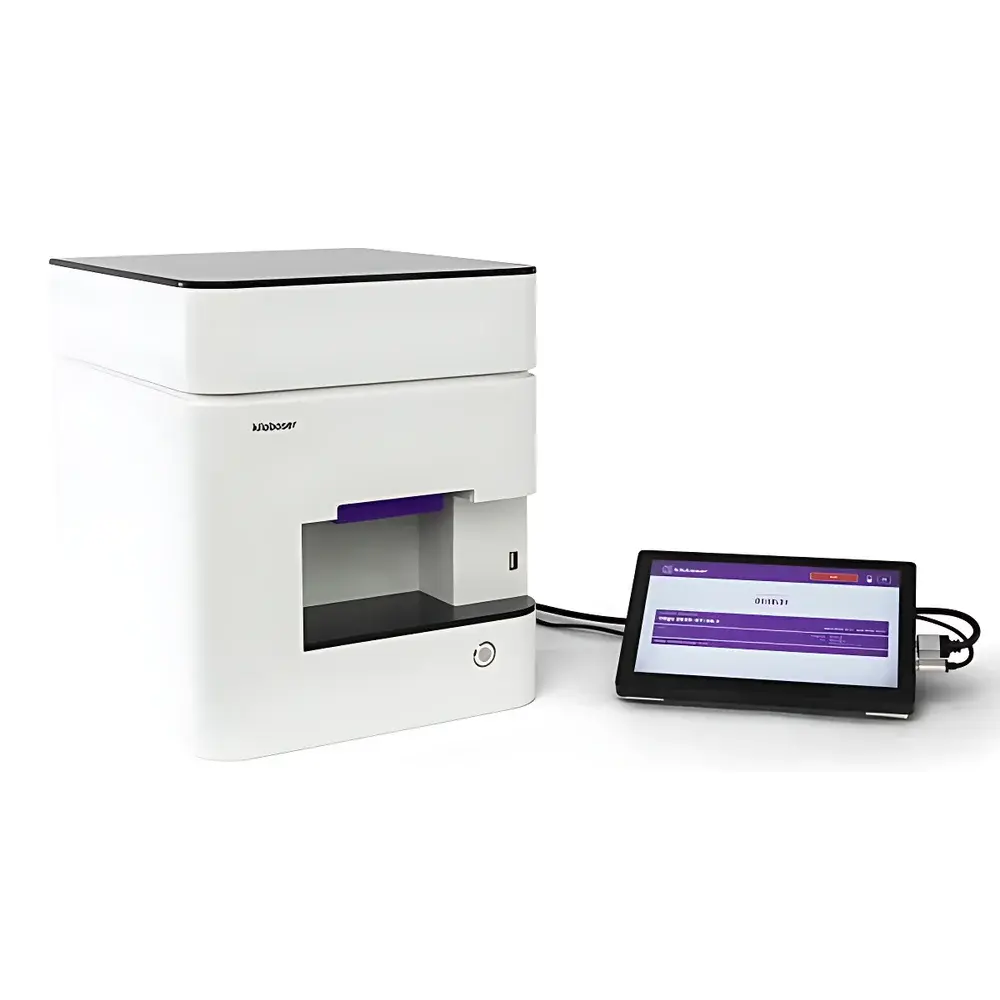
Kilobaser Desktop Microfluidic DNA Synthesizer
| Brand | Kilobaser |
|---|---|
| Origin | Austria |
| Model | Kilobaser |
| Synthesis Speed | 2.5 min/bp (chemistry only), ~40 min total cycle time including cleavage & deprotection |
| Max Oligo Length | ≤50 bases |
| Yield | ~300 pmol per synthesis |
| Throughput | 1 sequence per run |
| Reagent Cartridge Capacity | 200 nucleotide couplings |
| Shelf Life of Loaded Cartridge | Up to 2 weeks (unopened, ambient storage) |
| Offline Operation | Yes, fully functional without internet connectivity |
| Footprint | Benchtop |
| User Interface | Touchscreen + USB (U-disk) + PC software integration |
| Consumables | Single-use microfluidic synthesis chip + standard 200 µL PCR tube |
Overview
The Kilobaser Desktop Microfluidic DNA Synthesizer is an integrated, benchtop oligonucleotide synthesizer engineered for rapid, on-demand primer production in molecular biology laboratories. Unlike traditional phosphoramidite-based synthesizers relying on column-packed reactors and bulk reagent delivery, the Kilobaser employs a proprietary microfluidic architecture that precisely meters nanoliter-scale reagents across a monolithic silicon-glass chip. This enables highly efficient, low-waste coupling cycles with minimal dead volume and reduced risk of carryover contamination. The instrument implements standard solid-phase phosphoramidite chemistry—fully compatible with industry-standard protecting groups (e.g., DMTr, β-cyanoethyl) and common nucleoside phosphoramidites—ensuring sequence fidelity and downstream compatibility with PCR, sequencing, cloning, and CRISPR applications. Designed for autonomy and operational simplicity, it eliminates the need for centralized core facilities or dedicated synthesis technicians, allowing researchers to synthesize primers in-house within approximately two hours from sequence submission to purified product.
Key Features
- Microfluidic Precision Engineering: Monolithic chip-based fluidics deliver sub-microliter reagent volumes with high reproducibility and minimal cross-contamination between synthesis runs.
- Rapid Turnaround Time: Average coupling time of 2.5 minutes per base, with full synthesis, cleavage, and deprotection completed in under 40 minutes—significantly faster than conventional benchtop instruments requiring overnight protocols.
- Offline-First Architecture: Operates entirely offline; no cloud dependency, no mandatory firmware telemetry, and no external authentication required—ensuring data sovereignty and compliance with institutional IT security policies.
- Intuitive Human-Machine Interface: 7-inch capacitive touchscreen with graphical workflow guidance; supports direct sequence entry, USB import (FASTA, plain text), and optional PC-based control via USB-C or Ethernet.
- Low-Consumable Footprint: Uses disposable microfluidic chips and standard 200 µL PCR tubes as collection vessels—eliminating column maintenance, solvent recycling, or complex waste handling.
- Controlled Reagent Management: Integrated reagent cartridge holds up to 200 couplings (sufficient for ~4–6 typical 20–30mer primers); stability verified for ≥14 days at room temperature when sealed.
Sample Compatibility & Compliance
The Kilobaser synthesizes unmodified DNA oligonucleotides up to 50 nucleotides in length, supporting standard A/C/G/T phosphoramidites and common modifications including amino modifiers (C6-Amino, C12-Amino), biotin, fluorescein (6-FAM), and internal thiol linkers—when used with compatible third-party reagents loaded manually into the cartridge. All synthesis steps adhere to established solid-phase oligonucleotide synthesis (SPOS) principles defined in ISO 20387:2018 (Biobanking) and align with Good Laboratory Practice (GLP) documentation requirements. While not certified for GMP manufacturing, its audit-ready electronic logbook—including timestamped synthesis parameters, reagent lot tracking, user ID, and chip serial number—supports traceability for academic, diagnostic development, and preclinical research use. No hazardous gas lines or fume hood installation is required.
Software & Data Management
The embedded firmware provides a local SQLite database logging every synthesis event: sequence input, coupling efficiency estimates (via real-time trityl monitoring), reagent usage, chip ID, operator tag, and completion status. Data export is supported via USB in CSV and PDF report formats—compatible with LIMS integration through configurable REST API endpoints (available in v2.3+ firmware). Software updates are delivered via signed firmware packages loaded from encrypted USB drives, ensuring integrity verification prior to installation. The system maintains full audit trails compliant with FDA 21 CFR Part 11 requirements for electronic records and signatures when deployed with institutional identity management (e.g., LDAP binding enabled).
Applications
- Routine primer synthesis for PCR, qPCR, and RT-qPCR assay development
- On-demand probe synthesis for hybridization-based diagnostics
- CRISPR gRNA scaffold assembly and variant screening
- Teaching labs and undergraduate molecular biology courses requiring hands-on synthesis exposure
- Field-deployable or BSL-2-limited environments where centralized synthesis infrastructure is unavailable
- Iterative mutagenesis workflows requiring rapid turnaround of short oligos (<50 nt)
FAQ
Does the Kilobaser support RNA or modified backbone chemistries (e.g., LNA, PNA)?
No—currently limited to standard DNA phosphoramidite chemistry. RNA synthesis requires orthogonal protecting group strategies and is not supported.
Can I reuse the microfluidic chip?
No—chips are single-use, sterilized, and pre-aligned to ensure consistent fluidic resistance and coupling uniformity across runs.
What purification method is recommended post-synthesis?
Desalting is sufficient for most PCR applications; for higher purity (e.g., cloning, NGS), users typically perform ethanol precipitation or employ commercial spin-column desalting kits.
Is service and technical support available outside the EU?
Yes—Kilobaser provides global distributor-based support networks, with spare parts, remote diagnostics, and on-site service contracts available in North America, APAC, and EMEA regions.
How is calibration maintained over time?
The system performs automated baseline validation before each run using integrated photometric trityl detection; no user-performed hardware calibration is required.




