
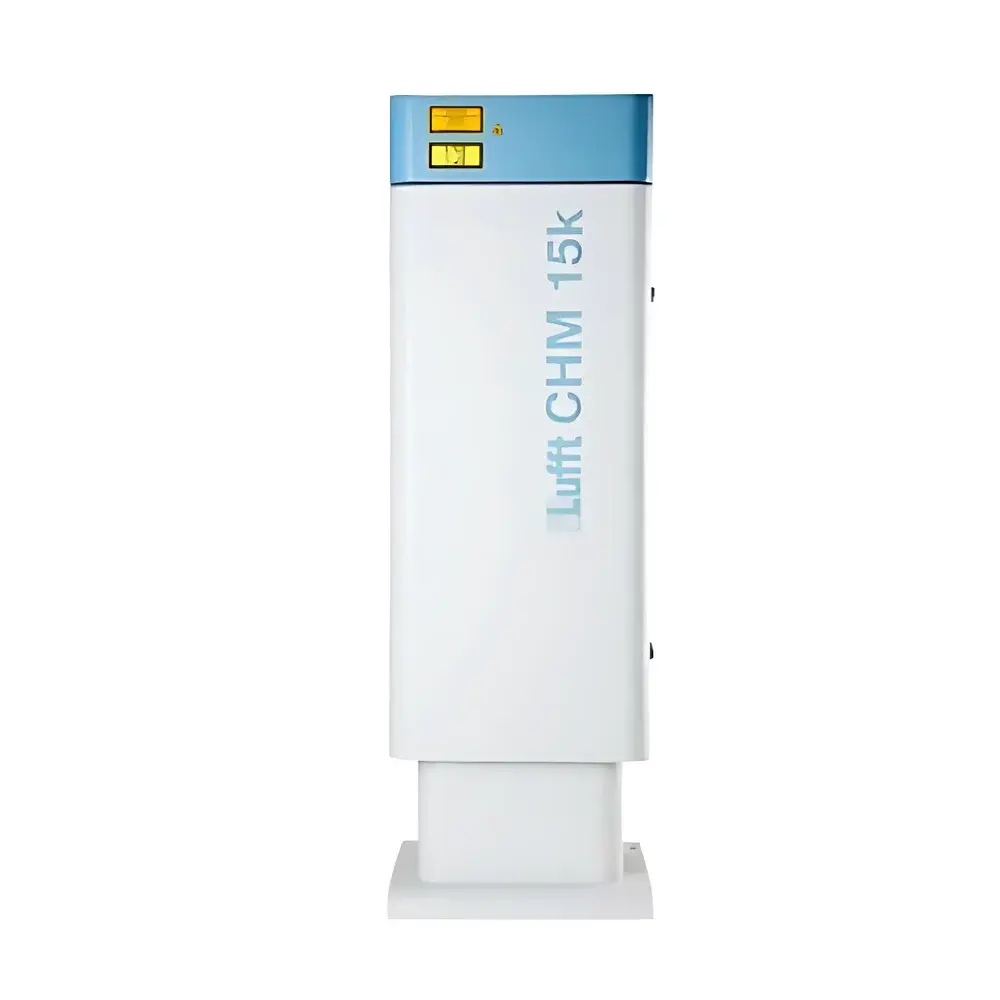
Kipp & Zonen CHM15K Ceilometer
| Brand | Kipp & Zonen |
|---|---|
| Origin | Germany |
| Model | CHM15K |
| Measurement Range | 5 m to 15,000 m |
| Laser Wavelength | 1064 nm |
| Laser Class | 1M (per DIN EN 60825-1:2007) |
| Power Supply | 230 VAC ±10%, 250 W (standard), 800 W (heating mode) |
| Operating Temperature | −40 °C to +50 °C |
| Enclosure Rating | IP65 |
| Dimensions | 500 × 500 × 1550 mm |
| Weight | 70 kg (130 kg with packaging) |
| Data Output Formats | NetCDF, ASCII, XML |
| Communication Interfaces | RS485, Ethernet (LAN), optional RS232 / modem |
| Sampling Frequency | 100 MHz |
| Vertical Resolution | 15 m (full range), 5 m (0–150 m) |
| Minimum Detection Height | 5 m |
| Pulse Repetition Rate | 5–7 kHz |
| Measurement Cycle | Adjustable from 2 s to 600 s |
| Safety Compliance | EN 61326-1, EN 61010-1, ISO 10109-11 |
Overview
The Kipp & Zonen CHM15K ceilometer is a high-performance, eye-safe, solid-state laser-based atmospheric profiling instrument engineered for continuous, unattended measurement of cloud base height (CBH), cloud layer structure, aerosol layer height, vertical visibility (VOR), atmospheric boundary layer (ABL) depth, and backscatter profiles. It operates on the principle of elastic lidar (Light Detection and Ranging), emitting short pulses of infrared light at 1064 nm from a robust diode-pumped Nd:YAG laser source. The system detects time-resolved backscattered signals from atmospheric constituents—such as cloud droplets, ice crystals, and aerosol particles—and converts time-of-flight data into precise vertical distance information. Its narrow-band optical filter and high-sensitivity photodetector ensure exceptional signal-to-noise ratio, even under challenging conditions including high humidity, solar glare, or low-contrast cloud layers. Designed for long-term deployment in operational meteorological networks, aviation weather systems, and environmental research infrastructures, the CHM15K delivers traceable, metrologically sound measurements compliant with WMO guidelines for ceilometer performance and calibration.
Key Features
- Solid-state 1064 nm Nd:YAG laser with Class 1M safety rating per DIN EN 60825-1:2007 — eliminates maintenance-intensive flashlamp systems and ensures stable output over extended service life
- Dual-lens optical architecture with overlap correction — mitigates near-field saturation caused by ground-level diffuse reflections, enabling accurate detection down to 5 m AGL
- Configurable pulse repetition rate (5–7 kHz) and adjustable measurement cycle (2–600 s) — supports high-temporal-resolution monitoring for fast-evolving cloud dynamics or energy-efficient long-interval profiling
- Integrated heating and cooling system within dual-wall enclosure — maintains internal thermal stability across −40 °C to +50 °C ambient operating range, ensuring consistent optical alignment and detector response
- Field-deployable calibration unit (optional) — enables on-site verification of system responsivity and range accuracy without disassembly or shipment to manufacturer, minimizing operational downtime
- IP65-rated housing with reinforced mechanical design — certified for continuous outdoor operation under wind loads up to 55 m/s and full exposure to rain, snow, and condensation
Sample Compatibility & Compliance
The CHM15K is optimized for real-time profiling of hydrometeors and submicron/micron-scale aerosols across diverse atmospheric regimes—from marine boundary layers to continental pollution plumes and high-altitude cirrus. Its 1064 nm wavelength provides strong sensitivity to liquid water clouds while maintaining reasonable penetration through optically thin ice clouds and dust layers. The instrument meets international regulatory and operational standards including ICAO Annex 3 requirements for airport automated weather observation systems (AWOS), WMO Guide to Meteorological Instruments and Methods of Observation (CIMO Guide), and EU Directive 2007/2/EC on INSPIRE-compliant environmental data infrastructure. Electrical safety and electromagnetic compatibility are certified to EN 61010-1 and EN 61326-1; laser safety conforms to ISO 10109-11 and DIN EN 60825-1:2007. All firmware and data handling routines support audit-trail logging for GLP/GMP-aligned deployments.
Software & Data Management
The CHM15K supports native data export in NetCDF-4 format—compliant with CF (Climate and Forecast) metadata conventions—enabling seamless integration with Python (netCDF4, xarray), MATLAB, and GIS platforms. Raw backscatter profiles (15 m vertical resolution, full 15 km range; 5 m resolution in near-field 0–150 m zone) and derived geophysical products—including up to nine cloud layers, two aerosol layers, cloud cover index, vertical visibility, and mixed-layer height—are accessible via embedded web server (HTTP/HTTPS) or FTP push to remote servers. Local configuration and diagnostics are managed through JO-DataClient software or standard terminal emulation over RS485. Optional DataViewer application provides interactive visualization of time-height cross-sections, animated backscatter movies, and statistical summaries aligned with synoptic reporting intervals. Firmware updates and parameter reconfiguration can be performed remotely without physical access.
Applications
- Meteorological observatories and national weather services requiring continuous, calibrated cloud and aerosol profiling for numerical weather prediction (NWP) model initialization and validation
- Civil and military airports implementing Category III precision approach systems, where real-time CBH and vertical visibility data feed into automated weather stations (AWOS) and ATIS broadcasts
- Environmental monitoring networks assessing boundary layer evolution, pollution transport, and haze formation in urban, industrial, and coastal zones
- Atmospheric science campaigns studying cloud microphysics, aerosol-cloud interactions, and radiative forcing using synchronized multi-instrument datasets
- Renewable energy operations supporting solar irradiance forecasting and wind turbine icing risk assessment through integrated sky condition analysis
- Maritime and polar research platforms operating under extreme thermal and mechanical stress, leveraging the instrument’s ruggedized design and autonomous operation capability
FAQ
What is the minimum detectable cloud base height?
The CHM15K achieves reliable cloud base detection starting at 5 meters above ground level, enabled by its dual-lens geometry and near-field overlap correction algorithm.
Does the CHM15K require annual factory recalibration?
No — an optional field calibration kit allows traceable verification of system gain and range offset without removal from the mounting site, reducing lifecycle calibration costs and operational gaps.
Can the CHM15K operate during precipitation?
Yes — its IP65 enclosure, heated optics, and signal processing algorithms are validated for continuous operation in rain, snow, and fog, with automatic attenuation compensation applied to raw backscatter profiles.
Is NetCDF output compatible with EUMETSAT or NOAA data ingestion pipelines?
Yes — all NetCDF files include CF-compliant metadata, time encoding in UTC, and georeferenced coordinate variables, satisfying EUMETCast Level 2 and NOAA IOOS metadata requirements.
How is laser safety ensured during routine maintenance?
The system incorporates interlocked access panels and automatic laser shutdown upon enclosure opening, fully complying with EN 60825-1:2007 Class 1M requirements for uncontrolled environments.
Related Products







