
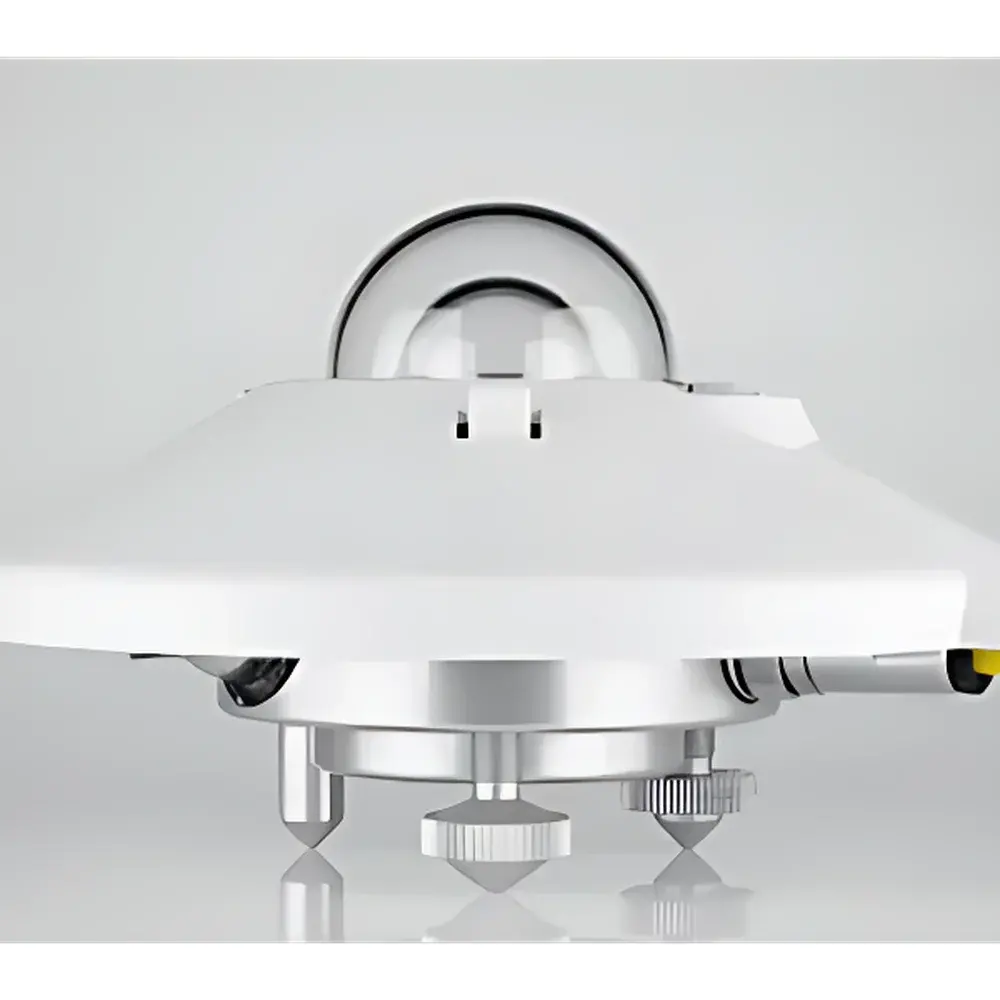
Kipp & Zonen CMP10 Secondary Standard Pyranometer
| Brand | Kipp & Zonen |
|---|---|
| Origin | Netherlands |
| Model | CMP10 |
| Spectral Range | 285–2800 nm |
| Sensitivity | 7–14 µV/W/m² |
| Response Time | < 5 s |
| Zero Offset A | < 7 W/m² |
| Zero Offset B | < 2 W/m² |
| Directional Error (up to 80°, 1000 W/m² beam) | < 10 W/m² |
| Temperature Dependence of Sensitivity (−10 °C to +40 °C) | < 1 % |
| Operating Temperature Range | −40 °C to +80 °C |
| Maximum Irradiance | 4000 W/m² |
| Field of View | 180° |
Overview
The Kipp & Zonen CMP10 is a secondary standard pyranometer engineered for high-accuracy, long-term solar irradiance measurement under demanding environmental conditions. It operates on the thermopile principle: incident solar radiation heats a blackened thermopile sensor mounted beneath a precision-ground, hemispherical quartz dome, generating a voltage proportional to the irradiance (W/m²) across the full solar spectrum. Its spectral response—spanning 285 nm to 2800 nm—covers >95% of total solar energy at sea level, making it suitable for broadband solar resource assessment, PV performance monitoring, and climate research applications requiring traceable calibration. Designed as a cost-optimized evolution of the CMP11 platform, the CMP10 retains metrological integrity while introducing structural and maintenance innovations that reduce lifecycle operational overhead without compromising ISO 9060:2018 classification as a Secondary Standard instrument.
Key Features
- Integrated desiccant chamber: Hermetically sealed dry box maintains internal humidity below dew point for ≥10 years without opening the housing—eliminating routine desiccant replacement and minimizing calibration drift from moisture ingress.
- CVF4 ventilation unit compatibility: Optional active dome ventilation reduces dust accumulation and dew/frost formation, extending cleaning intervals by up to 3× and improving data continuity in arid, coastal, or high-humidity sites.
- Thermally stable sensor design: Dual zero-offset compensation (Zero Offset A for thermal radiation imbalance; Zero Offset B for thermal gradient effects) ensures robust performance across diurnal and seasonal temperature swings (−40 °C to +80 °C).
- Low temperature dependence: <1% sensitivity variation over −10 °C to +40 °C enables reliable operation without real-time thermal correction in most terrestrial deployments.
- High irradiance tolerance: Rated for continuous exposure up to 4000 W/m²—exceeding typical global maxima—ensuring durability in high-albedo environments (e.g., snow-covered or desert sites).
Sample Compatibility & Compliance
The CMP10 is intended for outdoor, horizontal or tilted-plane measurement of global horizontal irradiance (GHI) and plane-of-array (POA) irradiance. It complies with ISO 9060:2018 (Secondary Standard classification), IEC 61724-1:2021 (photovoltaic system monitoring), and ASTM G173-03 (reference spectral irradiance). Its 180° field of view and cosine-corrected response meet WMO Guide to Meteorological Instruments and Methods of Observation (CIMO Guide, Chapter 7) requirements for solar radiation networks. No sample preparation or consumables are required; mounting follows ISO 9060-recommended leveling and shading protocols. The instrument is compatible with standard meteorological data loggers supporting mV-level analog output (7–14 µV/W/m²) and optional digital interfaces via Kipp & Zonen’s SMP series smart modules.
Software & Data Management
The CMP10 outputs an analog millivolt signal linearly proportional to irradiance. When integrated with Kipp & Zonen’s SMP12 or SMP22 smart sensors—or paired with third-party loggers (e.g., Campbell Scientific CR6, Delta-T DL6)—it supports automated data acquisition, timestamped logging, and remote diagnostics. Calibration certificates include NIST-traceable uncertainty budgets (k=2) and are valid for two years under normal use. Firmware-upgradable data loggers enable compliance with FDA 21 CFR Part 11 (via audit trail and electronic signature support) and GLP/GMP data integrity requirements when deployed in regulated solar farm commissioning or climatological observatories.
Applications
- Solar resource assessment for utility-scale photovoltaic plant feasibility studies and bankable energy yield modeling.
- Long-term climate monitoring in national meteorological networks (e.g., WMO GSN stations) where low-maintenance reliability is critical.
- Performance ratio (PR) and degradation rate analysis in operational PV power plants per IEC 61724-1.
- Albedo and surface reflectance studies when co-located with inverted pyranometers.
- Calibration transfer reference for field-deployed Class C pyranometers in quality assurance programs.
FAQ
What is the recommended recalibration interval for the CMP10?
Kipp & Zonen recommends recalibration every 2 years under typical outdoor exposure; extended intervals may be justified with documented stability checks per ISO/IEC 17025-accredited laboratories.
Can the CMP10 be used indoors or under artificial light sources?
No—it is optimized for natural solar spectra; spectral mismatch errors will occur under non-solar sources such as LEDs or halogen lamps.
Is the CVF4 ventilation unit included by default?
No—the CVF4 is an optional accessory; its integration requires separate mounting hardware and a 12–24 V DC power supply.
Does the CMP10 require a temperature sensor for post-processing correction?
Not for routine operation: its <1% thermal sensitivity drift eliminates the need for real-time temperature compensation in most applications; however, ambient temperature logging is advised for uncertainty budgeting in high-precision studies.
How does the desiccant chamber prevent condensation without user intervention?
The hermetically sealed chamber contains a high-capacity, self-indicating silica gel cartridge with 10-year rated absorption capacity—moisture diffusion through the housing seal is negligible under ISO-standard environmental stress profiles.
Related Products







