
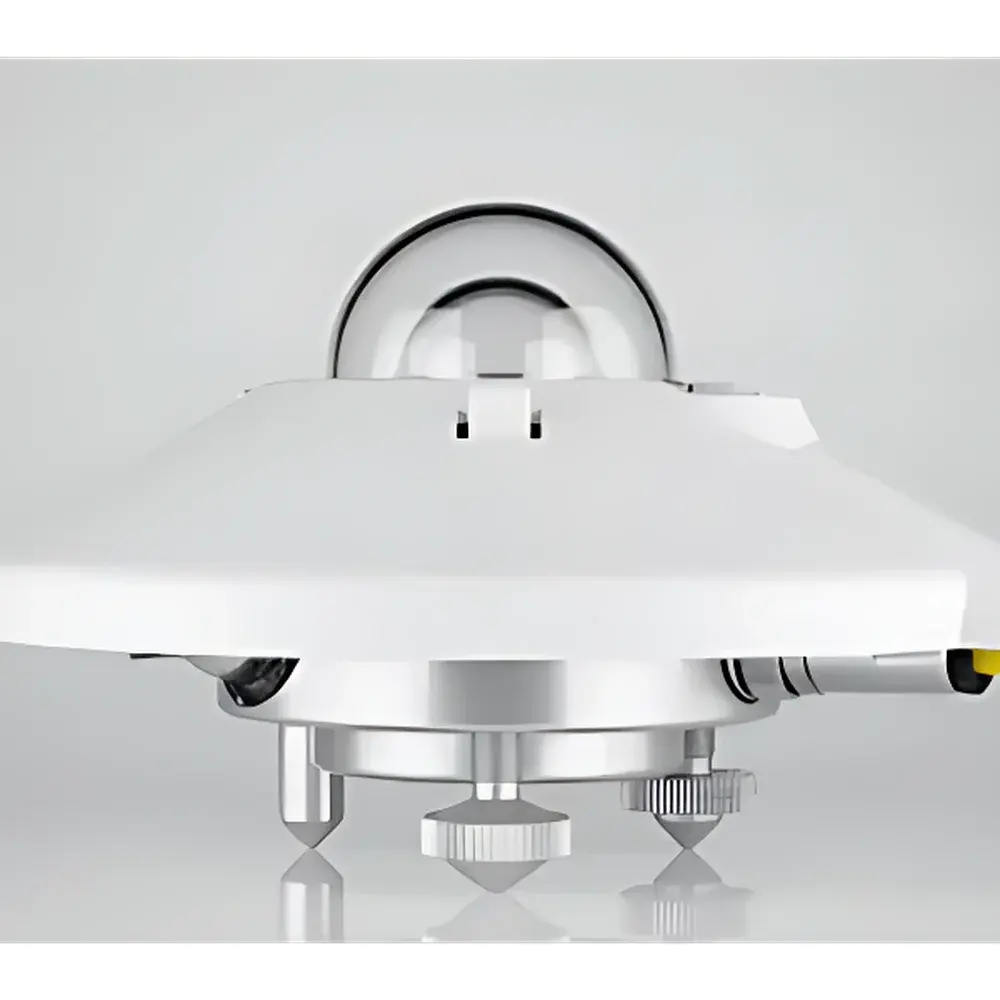
Kipp & Zonen CMP21 Pyranometer
| Brand | Kipp & Zonen |
|---|---|
| Origin | Netherlands |
| Model | CMP21 |
| Spectral Range | 285–2800 nm |
| Sensitivity | 7–14 µV/W/m² |
| Response Time | 5 s |
| Zero Offset A | < 7 W/m² |
| Zero Offset B | < 2 W/m² |
| Directional Error (up to 80°, 1000 W/m² beam) | < 10 W/m² |
| Temperature Dependence of Sensitivity (−20 °C to +50 °C) | < 1 % |
| Operating Temperature Range | −40 °C to +80 °C |
| Maximum Solar Irradiance | 4000 W/m² |
| Field of View | 180° |
| Output Signal | 0–20 mV (passive, no power required) |
Overview
The Kipp & Zonen CMP21 is a research-grade thermopile pyranometer engineered for high-accuracy measurement of global solar irradiance on a horizontal plane. It operates on the principle of thermal detection: incident solar radiation heats a blackened thermopile sensor, generating a proportional millivolt output via the Seebeck effect. Its design conforms rigorously to the Secondary Standard classification defined in ISO 9060:2018 (the updated revision of ISO 9060:1990), making it suitable for use in Baseline Surface Radiation Network (BSRN) stations operated under the World Meteorological Organization (WMO) and other high-integrity climate monitoring infrastructures. Unlike silicon-cell pyranometers, the CMP21 delivers spectrally flat response across its full 285–2800 nm range—covering >95% of terrestrial solar spectral irradiance—and maintains low thermal offset errors even under rapid ambient temperature fluctuations or varying sky conditions.
Key Features
- Thermopile-based detector with black-coated absorber and precision-ground quartz dome for optimal hemispherical transmission and minimal spectral distortion
- Dedicated temperature compensation circuitry optimized independently from the CMP11 platform, reducing thermal drift across −20 °C to +50 °C by <1% sensitivity variation
- Integrated Pt100 RTD sensor for continuous housing temperature monitoring—enabling post-acquisition thermal correction in compliance with ISO 9060:2018 Annex E
- Top-mounted bubble level visible without removing the redesigned snap-fit shadow band, ensuring rapid field-leveling while preserving IP67-rated connector integrity
- Screw-in desiccant cartridge with included replacement silica gel, minimizing internal condensation risk in high-humidity or sub-zero environments
- Passive operation: zero power requirement; outputs 0–20 mV signal linearly proportional to irradiance (W/m²)
- Factory-calibrated with individual cosine response and temperature dependence characterization reports supplied with each unit
Sample Compatibility & Compliance
The CMP21 is designed exclusively for outdoor, unshaded, horizontal mounting on stable platforms or meteorological masts. It measures total hemispherical irradiance—including direct beam and diffuse components—from the upper hemisphere (180° field of view). Its mechanical and optical construction meets IEC 61724-1:2021 requirements for photovoltaic system performance monitoring and satisfies data quality criteria for WMO BSRN, GCOS (Global Climate Observing System), and NOAA SURFRAD networks. The instrument complies with ISO 9060:2018 Secondary Standard specifications for directional response, spectral selectivity, temperature dependence, and long-term stability. Calibration traceability is maintained to the World Radiometric Reference (WRR) via Kipp & Zonen’s accredited calibration laboratory (ISO/IEC 17025 certified).
Software & Data Management
As a passive analog sensor, the CMP21 interfaces directly with any data logger supporting millivolt input (e.g., Campbell Scientific CR series, Delta-T DL6, or HOBO U30-NRC). For integration into regulated environments requiring audit trails and electronic signatures, pairing with the optional AMPBOX signal conditioner enables 4–20 mA current-loop output or amplified 0–5 V / 0–10 V signals—facilitating compatibility with SCADA systems compliant with FDA 21 CFR Part 11 and ICH GCP/GLP data integrity standards. Raw voltage readings are converted to irradiance using the unit-specific calibration factor (µV/W/m²) provided on the certificate. Post-processing may include thermal offset correction using concurrent RTD measurements and cosine error modeling per ISO 9060:2018 Annex D.
Applications
- Long-term solar resource assessment for utility-scale PV plant feasibility studies and bankable energy yield modeling
- Ground-truth validation of satellite-derived irradiance products (e.g., NASA POWER, CAMS, or Copernicus Atmosphere Monitoring Service)
- Climate change research within BSRN, GCOS, and regional flux tower networks
- Calibration reference for secondary-standard and first-class pyranometers in field intercomparisons
- Performance testing of solar concentrators and CPV systems under natural illumination
- Atmospheric science campaigns measuring aerosol optical depth, cloud radiative forcing, and surface albedo dynamics
FAQ
Does the CMP21 require external power?
No. It is a passive thermopile sensor and generates its own millivolt signal upon irradiation. No battery or supply voltage is needed.
Can the CMP21 be used indoors or under artificial light sources?
It is not recommended. Its calibration and spectral response are optimized for natural solar spectra. Artificial sources (e.g., halogen, LED, or fluorescent lamps) exhibit different spectral distributions and may introduce significant measurement bias.
What is the recommended recalibration interval?
Kipp & Zonen recommends recalibration every two years for research-critical applications and every three years for routine monitoring, aligned with WMO BSRN guidelines and ISO/IEC 17025 best practices.
Is the CMP21 compatible with shading devices such as shadow bands or sun trackers?
Yes—though its primary use is for global irradiance. When paired with a shading assembly or automated tracker, it can support diffuse-only or direct-normal irradiance (DNI) derivation via subtraction methods, provided geometric alignment and timing synchronization meet IEC 61724-1:2021 tolerances.
How is the directional (cosine) error characterized for this model?
Each unit undergoes individual cosine response testing at multiple zenith angles (0°–80°) under collimated light. The resulting error curve is supplied with the calibration certificate and supports application-specific correction algorithms per ISO 9060:2018 Annex D.







