
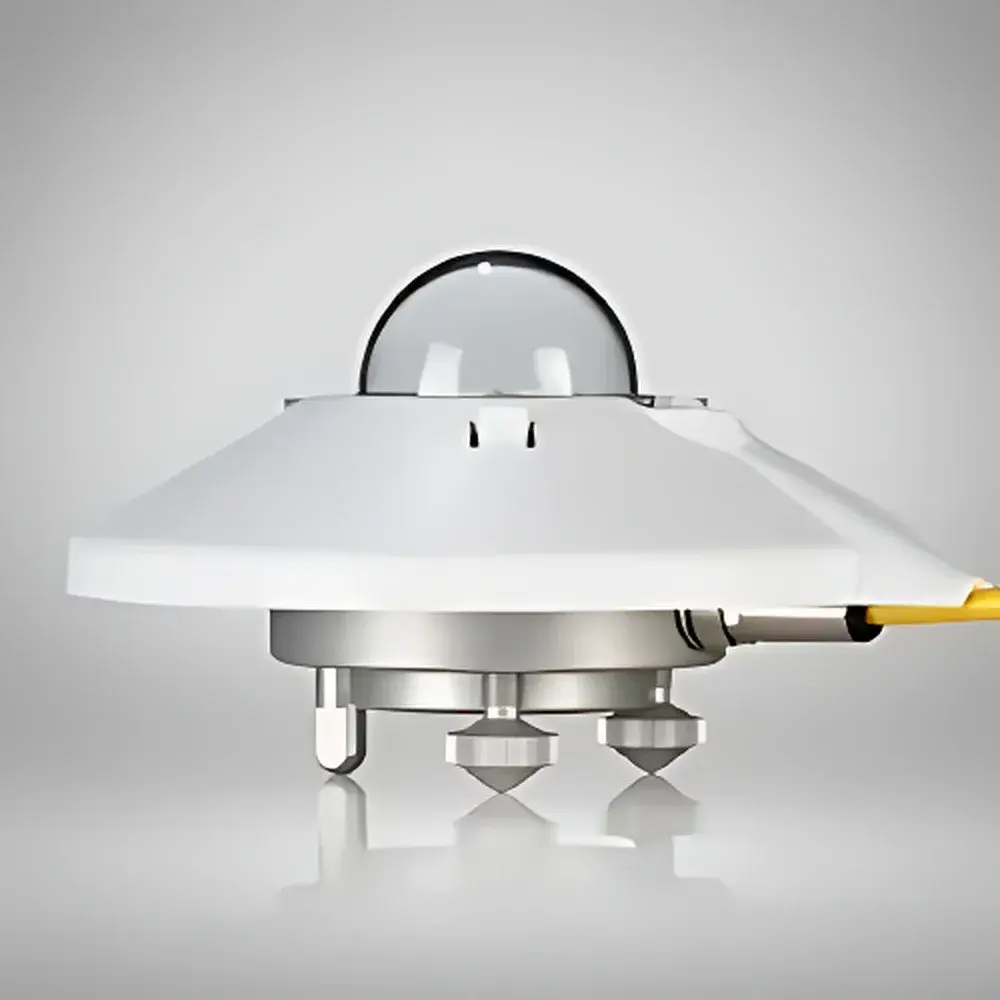

Kipp & Zonen SMP12 Smart Pyranometer
| Brand | Kipp & Zonen |
|---|---|
| Origin | Netherlands |
| Model | SMP12 |
| Accuracy Class | ISO 9060:2018 Class A |
| Spectral Range | 305–2800 nm |
| Response Time (95%) | < 0.5 s |
| Zero Offset (Thermal, 5 K/h) | < 3 W/m² |
| Tilt Dependency | < 1 % (0–90°) |
| Heating Power | 2 W (DC or AC) |
| Output Signal | Analog (0–1 V, 0–2.5 V, 0–5 V, 4–20 mA) + Digital (RS-485 Modbus RTU) |
| Operating Temperature | −40 to +80 °C |
| IP Rating | IP67 |
| Humidity Sensor | Integrated capacitive RH sensor (0–100 % RH, ±2 % RH accuracy) |
| Surge Protection | Enhanced 10 kA (8/20 µs) per IEC 61312 |
Overview
The Kipp & Zonen SMP12 Smart Pyranometer is an ISO 9060:2018 Class A thermopile-based solar irradiance sensor engineered for high-accuracy, long-term measurement of global horizontal irradiance (GHI). Unlike silicon photodiode sensors, the SMP12 employs a blackened thermopile detector with a precision-ground quartz dome and diffuser to ensure spectral flatness across the full solar spectrum (305–2800 nm), minimizing errors caused by atmospheric absorption bands and spectral mismatch—critical for PV performance ratio validation and climate-grade radiometric monitoring. Its solid-state heater operates continuously or on demand to suppress dew formation and frost accumulation on the dome surface, eliminating data gaps during early-morning or high-humidity conditions without introducing thermal offsets typical of resistive heating elements. The integrated capacitive relative humidity (RH) sensor provides real-time internal enclosure moisture status, enabling automated diagnostics and predictive maintenance alerts in unattended field deployments.
Key Features
- ISO 9060:2018 Class A certified performance — meets stringent requirements for spectral error, directional (cosine) response, temperature dependence, and stability.
- Sub-second thermal response (< 0.5 s to 95% step change), optimized for high-frequency irradiance variability analysis and cloud-edge detection in solar forecasting models.
- Active dome heating (2 W nominal) with low thermal mass design minimizes zero-offset drift during heating cycles — validated per ISO 9060 Annex E test protocols.
- Dual-output interface: analog voltage/current (user-selectable ranges) + digital RS-485 Modbus RTU for seamless integration into SCADA, DAQ, and IoT telemetry systems.
- Onboard tilt-angle estimation via integrated MEMS accelerometer — enables automatic correction of cosine response deviation and supports mounting verification logs.
- Robust IP67-rated aluminum housing with marine-grade anodized finish, qualified for continuous outdoor exposure in desert, coastal, and alpine environments.
Sample Compatibility & Compliance
The SMP12 is compatible with standard meteorological mounting hardware (e.g., CM11/CM12 leveling bases, solar tracker interfaces) and requires no external desiccant replacement. Its calibration traceability follows BIPM guidelines through Kipp & Zonen’s accredited ISO/IEC 17025 laboratory, with NIST-traceable reference instruments maintained under strict GLP conditions. The device complies with IEC 61724-1:2021 for PV system monitoring, EN 12464-1 for daylight factor assessment, and supports audit-ready data integrity per FDA 21 CFR Part 11 when paired with compliant data loggers (e.g., Campbell Scientific CR6, Delta-T DL6). All firmware updates are digitally signed and version-locked to prevent unauthorized modification.
Software & Data Management
Kipp & Zonen’s SunTracker Suite (v3.2+) provides native configuration, real-time diagnostics, and automated calibration certificate management for the SMP12. The embedded Modbus register map includes diagnostic registers for heater status, internal RH, dome temperature, tilt angle, and signal quality flags (e.g., “dome contamination warning”, “heater overtemperature”). Raw analog outputs support direct connection to programmable logic controllers (PLCs) and industrial DAS platforms without signal conditioning. Data timestamping is synchronized to UTC via optional GPS input or NTP-enabled gateways, ensuring traceable temporal alignment across distributed sensor networks.
Applications
- Meteorological Networks: Core GHI sensor in WMO-compliant national weather stations and ARM/NOAA atmospheric observatories.
- Photovoltaic Plant Performance Monitoring: Used in IEC 61724-1 Level 1–2 monitoring systems for PR calculation, soiling loss quantification, and inverter clipping analysis.
- Climatological Research: Long-term radiation trend analysis in GCOS and BSRN-certified sites, where spectral fidelity and thermal stability directly impact TOA flux modeling.
- Agricultural Microclimate Studies: Paired with net radiometers (e.g., CNR4) to derive energy balance components for evapotranspiration (ET₀) modeling under FAO-56 guidelines.
- Building Energy Modeling: Input for dynamic simulation tools (EnergyPlus, TRNSYS) requiring sub-minute GHI resolution for daylight harvesting control validation.
FAQ
Does the SMP12 require periodic recalibration?
Yes. Kipp & Zonen recommends recalibration every two years for Class A compliance; annual verification against a reference pyranometer is advised for critical applications.
Can the internal heater be controlled externally?
Yes — heater enable/disable and power level (low/medium/high) are configurable via Modbus register writes, allowing integration with site-specific dew-point prediction algorithms.
Is the tilt-angle output suitable for real-time cosine correction?
The onboard accelerometer provides tilt data at 1 Hz resolution with ±0.5° accuracy; however, real-time cosine correction must be applied in post-processing or by the connected data logger using the manufacturer-provided correction polynomial.
How does the SMP12 handle electrical surges in lightning-prone regions?
It incorporates dual-stage transient voltage suppression: gas discharge tube (GDT) at the terminal block and TVS diodes on the signal path, tested to IEC 61312-1 Level III (10 kA, 8/20 µs) with no degradation after 100 surge events.
What is the warranty coverage for the integrated humidity sensor?
The capacitive RH sensor carries a 24-month limited warranty; drift is typically < ±0.1 % RH/year under normal operating conditions and is monitored continuously via self-diagnostics.
Related Products







