
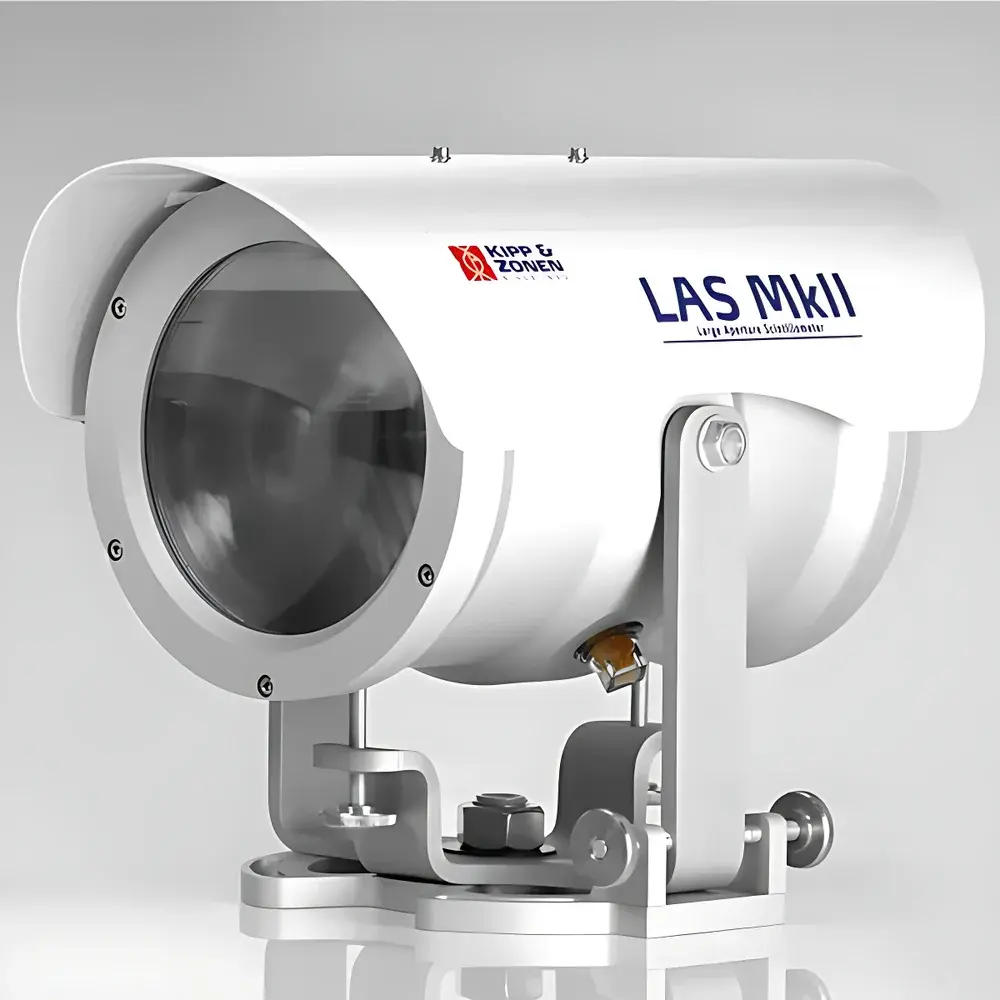
Kipp&Zonen LAS MkII Large Aperture Scintillometer
| Brand | Kipp&Zonen |
|---|---|
| Origin | Netherlands (manufactured in Delft) |
| Model | LAS MkII |
| Measurement Path Length | 100 m to 4.5 km |
| Integrated Data Logger | Yes |
| Onboard Digital Signal Processing | Yes |
| Cn² and Sensible Heat Flux Output | Standard (with optional meteorological sensor kit) |
| Power Supply | Low-power DC (solar-compatible, typically 12 V) |
| Display & Keypad | Built-in monochrome LCD with membrane keypad |
| Communication Interfaces | RS-232, RS-485, SDI-12, Analog Outputs (0–5 V or 4–20 mA) |
| Software | EVATION® v3.x (real-time visualization, post-processing, export to CSV/NetCDF) |
Overview
The Kipp&Zonen LAS MkII Large Aperture Scintillometer is a field-deployable, self-contained atmospheric turbulence measurement system engineered for long-path, non-intrusive quantification of the refractive index structure parameter (Cn²) and sensible heat flux (H) across horizontal paths ranging from 100 meters to 4.5 kilometers. Its operational principle relies on optical scintillation—the intensity fluctuations of a collimated near-infrared (850 nm) beam induced by turbulent eddies in the atmospheric boundary layer. As thermal gradients drive variations in air density and thus refractive index, the LAS MkII detects these microscale perturbations via high-sensitivity photodetector arrays in its receiver unit. Unlike point sensors or eddy covariance systems requiring complex co-location and coordinate rotation, the LAS MkII provides path-averaged turbulence statistics inherently representative of heterogeneous terrain—making it particularly suited for micrometeorological studies, evapotranspiration monitoring, and land–atmosphere exchange validation in agriculture, hydrology, and climate research.
Key Features
- Integrated digital signal processor enabling real-time computation of Cn², inner scale (l₀), and path-averaged sensible heat flux (H) when paired with the optional meteorological sensor kit
- Self-powered architecture optimized for remote operation: nominal power draw <1.2 W; compatible with standard 12 V solar-charged battery systems
- Built-in monochrome LCD display and tactile keypad allow full instrument configuration, diagnostics, and live data review without external computing hardware
- Onboard data logger stores up to 6 months of high-resolution (1 Hz) Cn² and auxiliary measurements (e.g., temperature, pressure, wind speed) at user-defined intervals
- Dual communication capability: serial interfaces (RS-232/RS-485) support command-based remote control and firmware updates; analog outputs (0–5 V / 4–20 mA) enable direct integration into legacy SCADA or Campbell Scientific CR-series dataloggers
- Ruggedized aluminum housing rated IP65, designed for continuous outdoor deployment under temperatures from −25 °C to +50 °C and relative humidity up to 95% non-condensing
Sample Compatibility & Compliance
The LAS MkII does not require physical sample collection or contact with the medium under investigation; it operates on line-of-sight optical transmission through ambient air. Its path-integrated measurement approach complies with foundational principles outlined in ISO 7726 (Ergonomics of the thermal environment — Instruments for measuring physical quantities) and aligns with best practices for surface energy balance estimation referenced in FAO Irrigation and Drainage Paper No. 56. When deployed alongside calibrated meteorological sensors (included in the optional kit), derived sensible heat flux values satisfy traceability requirements for eddy covariance intercomparison campaigns (e.g., FLUXNET protocols). The device meets CE marking directives for electromagnetic compatibility (2014/30/EU) and low-voltage safety (2014/35/EU). Firmware and EVATION® software support audit-trail logging for GLP-aligned field experiments.
Software & Data Management
EVATION® software (v3.2+, included as standard) provides native support for real-time telemetry via USB-serial or Ethernet-to-serial converters. It enables synchronized visualization of Cn² time series, heat flux trends, and diagnostic parameters (e.g., signal-to-noise ratio, beam alignment status). Post-acquisition processing includes automatic turbulence spectral analysis, Monin–Obukhov similarity corrections, and conversion to latent heat flux using the Bowen ratio method when complementary net radiation and soil heat flux data are imported. All datasets export in CF-compliant NetCDF format and comma-separated values (CSV) with ISO 8601 timestamps. EVATION® supports multi-instrument network management—up to 32 LAS MkII units can be centrally monitored and scheduled via TCP/IP.
Applications
- Surface energy balance closure assessment in flux tower networks
- Spatially distributed evapotranspiration (ET) estimation for irrigation scheduling and water resource modeling
- Validation of mesoscale atmospheric models (e.g., WRF, COSMO) over heterogeneous landscapes
- Long-term monitoring of boundary layer stability and mixing height evolution
- Calibration and cross-validation of satellite-derived land surface temperature and emissivity products
- Urban heat island intensity quantification across transects between built-up and vegetated zones
FAQ
What is the minimum and maximum effective path length for reliable Cn² measurement?
The LAS MkII is factory-calibrated for stable operation between 100 m and 4.5 km. Below 100 m, beam saturation and near-field turbulence effects degrade accuracy; beyond 4.5 km, atmospheric attenuation and pointing stability limitations reduce signal fidelity.
Can the LAS MkII operate unattended for extended periods?
Yes—its low-power design, integrated data logger, and solar-ready power interface enable autonomous deployment for ≥6 months without maintenance, contingent on local insolation and battery capacity.
Is the meteorological sensor kit required to compute sensible heat flux?
Yes. While Cn² is measured directly, conversion to H requires concurrent measurements of air temperature, pressure, and wind speed—provided only by the optional integrated sensor kit mounted inside the receiver housing.
Does EVATION® support automated data upload to cloud platforms?
EVATION® itself does not include native cloud API integration; however, its CSV/NetCDF exports are fully compatible with third-party ingestion pipelines (e.g., AWS IoT Core, ThingSpeak, or custom Python-based ETL workflows).
How is optical alignment maintained during thermal expansion or wind loading?
The transmitter and receiver housings incorporate passive thermal compensation mechanisms and rigid kinematic mounts. Field alignment verification is performed using the built-in alignment aid (crosshair reticle + LED indicator), with typical re-alignment intervals exceeding 12 months under stable mounting conditions.
Related Products







