
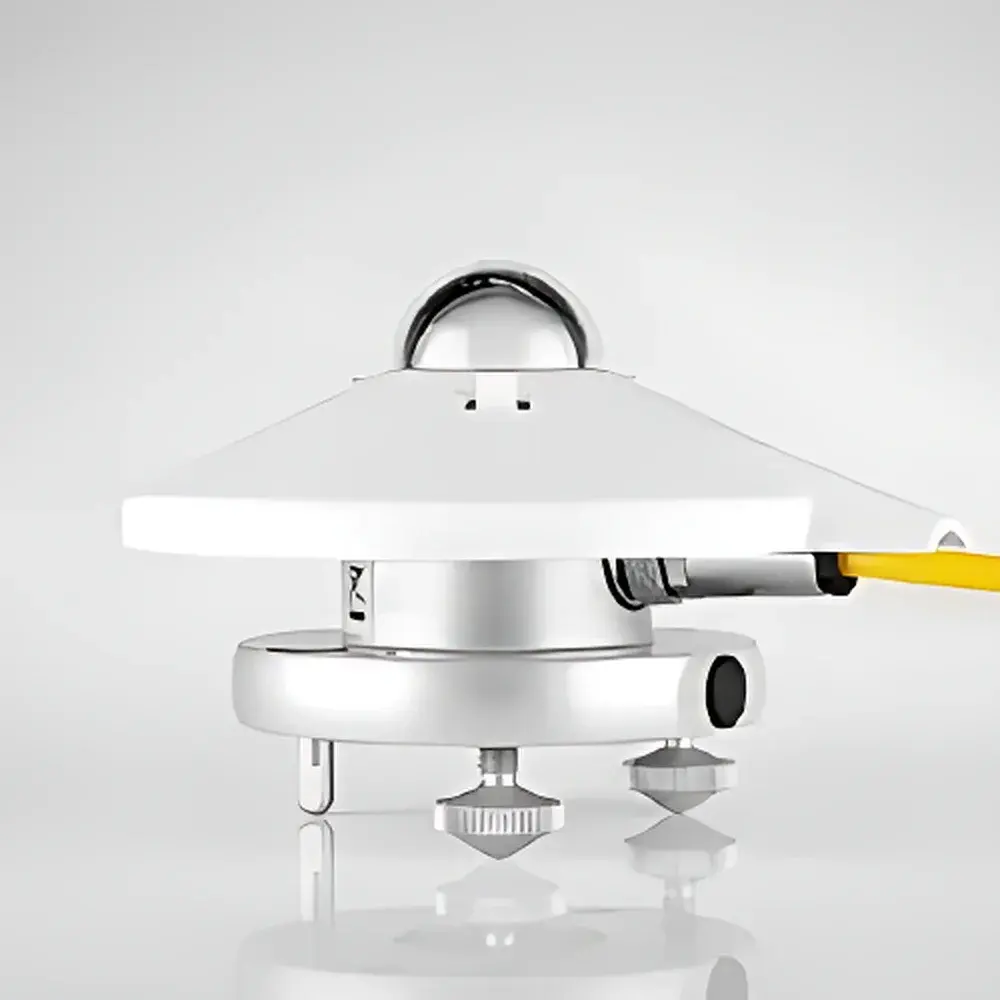
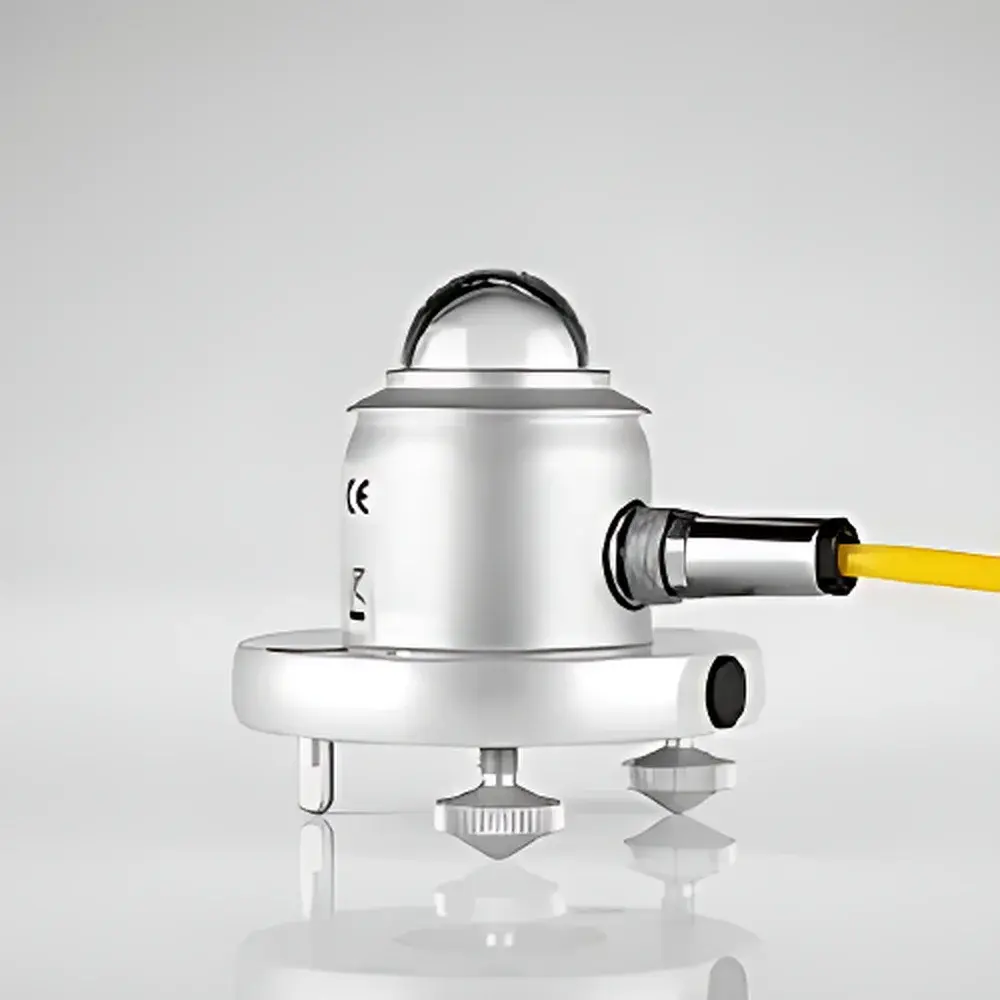
Kipp&Zonen SMP Smart Pyranometer
| Brand | Kipp&Zonen |
|---|---|
| Origin | Imported |
| Model | SMP |
| Power Supply | 5–30 VDC (with reverse polarity & overvoltage protection) |
| Output Interface | Modbus RTU over RS-485 |
| Maximum Devices per Network | 247 (via unique Modbus addressing) |
| Data Update Rate | ~1 Hz |
| Resolution | 24-bit differential analog-to-digital conversion |
| Temperature Compensation | Integrated thermistor + polynomial correction algorithm |
| Spectral Range | 305–2800 nm |
| Directional Response Compliance | ISO 9060:2018 Class A (Secondary Standard) |
| Calibration Traceability | NIST-traceable, with full calibration history stored onboard |
Overview
The Kipp&Zonen SMP Smart Pyranometer is a secondary-standard solar irradiance sensor engineered for high-accuracy, long-term measurement of global horizontal irradiance (GHI). It operates on the thermopile principle: incident solar radiation—spanning the spectral range from 305 nm to 2800 nm—is absorbed by a precisely blackened thermopile hot junction coated with a spectrally neutral, near-unity absorptance coating. This absorption converts radiant energy into heat, generating a temperature gradient across the thermopile’s junctions. The resulting Seebeck voltage is linearly proportional to irradiance (W/m²) and is measured with 24-bit differential resolution. Unlike traditional analog pyranometers, the SMP integrates an embedded microprocessor, non-volatile memory, and firmware that enable real-time signal processing, on-board temperature compensation, and digital data output—eliminating errors associated with external analog-to-digital conversion in industrial data acquisition systems.
Key Features
- Complies with ISO 9060:2018 classification as a Secondary Standard (Class A) pyranometer, meeting stringent requirements for spectral response, directional (cosine) error, temperature dependence, and stability.
- Integrated thermistor and polynomial-based temperature compensation algorithm corrects for thermal drift across –40 °C to +80 °C ambient operating range, significantly improving measurement fidelity under field conditions.
- Modbus RTU communication protocol over RS-485 enables direct integration with PLCs, SCADA systems, RTUs, and industrial controllers—no additional signal conditioning required.
- Smart addressing supports up to 247 uniquely identified SMP units on a single two-wire bus, reducing cabling complexity and enabling scalable solar monitoring networks.
- Onboard memory stores instrument serial number, firmware version, user-configurable settings, complete calibration history (including date, reference standard, and correction coefficients), and real-time status diagnostics.
- Wide 5–30 VDC supply range with built-in reverse-polarity and overvoltage protection ensures robust operation in unregulated solar or battery-backed power environments.
- Feed-forward signal processing architecture reduces thermal time constant versus legacy CMP-series analog sensors, achieving <1 s response time (95 %) under standard test conditions.
Sample Compatibility & Compliance
The SMP is designed for outdoor deployment in unshaded, level, and obstruction-free locations—typically mounted on meteorological masts or solar tracker platforms. Its quartz dome and blackened thermopile assembly are compatible with natural exposure to UV, rain, dust, and thermal cycling. The instrument meets IEC 61215 and IEC 61724-1 requirements for PV system performance monitoring and is widely deployed in national weather services (e.g., NOAA, DWD, Met Office), BSRN (Baseline Surface Radiation Network), and commercial solar asset management programs. Calibration certificates are traceable to WRR (World Radiometric Reference) via PMOD/WRC and include uncertainty budgets aligned with ISO/IEC 17025 accredited practices.
Software & Data Management
Data output includes instantaneous irradiance (W/m²), internal sensor temperature (°C), status flags (e.g., dome contamination warning, heater activation), and diagnostic registers—all accessible via standard Modbus function codes (e.g., Read Holding Registers). Kipp&Zonen’s free SMP Configuration Utility (Windows/macOS) allows users to read/write configuration parameters, trigger self-tests, and export calibration metadata. When integrated into enterprise SCADA or cloud-based O&M platforms (e.g., SolarLog, PowerTrack, or custom MQTT/OPC UA architectures), the SMP supports audit-ready data lineage—including timestamped firmware updates, calibration events, and configuration changes—aligning with GLP and IEC 62443-3-3 cybersecurity guidelines for industrial instrumentation.
Applications
- Solar resource assessment and bankable yield modeling for utility-scale PV plant development
- Real-time GHI monitoring in operational solar farms for performance ratio (PR) analysis and anomaly detection
- Climate research networks requiring long-term, intercomparable radiometric time series (e.g., GCOS, BSRN)
- Calibration transfer stations supporting regional pyranometer maintenance and verification labs
- Building-integrated photovoltaics (BIPV) and smart grid demand-response studies requiring sub-minute irradiance resolution
- Validation of satellite-derived surface irradiance products (e.g., CAMS, NSRDB, SolCast)
FAQ
What is the difference between the SMP and the CMP series?
The SMP retains the optical and thermal design heritage of the CMP line but replaces analog output with a digital Modbus interface, embeds firmware-driven temperature compensation, and adds non-volatile memory for calibration and configuration storage.
Does the SMP require external temperature compensation?
No—temperature sensing and polynomial correction are fully integrated; no external thermistor or lookup table is needed.
Can the SMP be used with existing data loggers that only accept analog inputs?
Not natively; it requires a Modbus-capable controller or gateway. Analog output is not supported.
Is the SMP suitable for tilted-plane irradiance measurements?
Yes—when mounted on a fixed tilt or solar tracker, it measures plane-of-array (POA) irradiance; cosine response error remains within ISO 9060:2018 Class A limits up to 80° zenith angle.
How often does the SMP require recalibration?
Kipp&Zonen recommends recalibration every two years for critical applications, or annually under high-UV/dusty conditions; onboard calibration history simplifies traceability and interval planning.







