
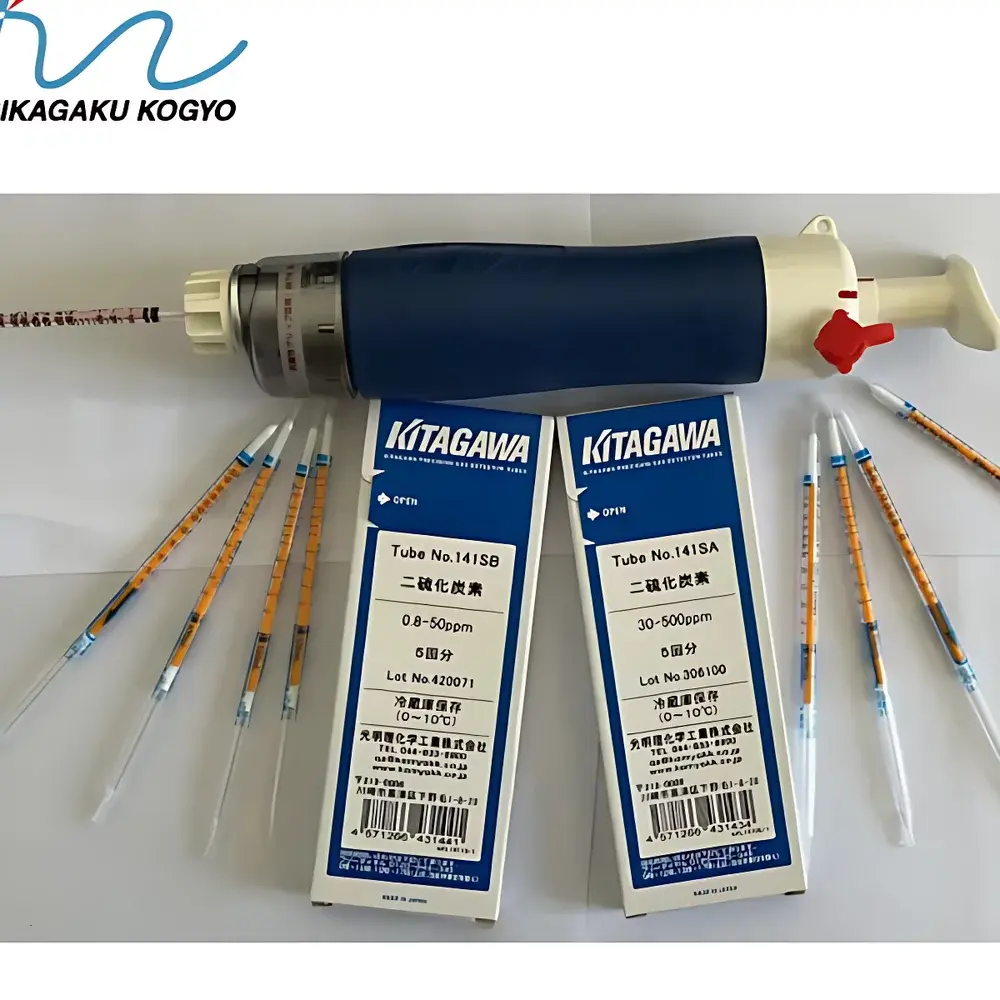
Kitaoka CS₂ Quick-Test Gas Detection Tubes (Model 141SA, 141SB, 141SC)
| Brand | Meiko Rikka |
|---|---|
| Origin | Japan |
| Manufacturer Type | Authorized Distributor |
| Origin Category | Imported |
| Models | 141SA, 141SB, 141SC |
| Detection Range (CS₂) | 0.1–500 ppm |
| Sample Volume | 100–400 mL |
| Analysis Time | 2 min per 100 mL |
| LOD | 0.3 ppm (at 400 mL) |
| Color Change | Pink → Yellow |
| Reaction Chemistry | CS₂ + CrO₃ + H₂SO₄ → SO₂ |
| Operating Temperature | 0–40 °C (with temperature correction) |
| Relative Humidity Effect | None |
| Interferents | SO₂ (positive bias), H₂S (positive bias), Cl₂ (positive bias) |
| Unit Conversion | 1 ppm CS₂ = 3.17 mg/m³ (at 25 °C, 101.3 kPa) |
Overview
The Kitaoka CS₂ Quick-Test Gas Detection Tubes are calibrated, single-use colorimetric devices engineered for on-site, real-time quantification of carbon disulfide (CS₂) vapor in ambient or workplace air. Based on the well-established length-of-stain principle—where a fixed volume of sampled air is drawn through a glass tube containing a chemically impregnated reagent bed—the system relies on stoichiometric oxidation of CS₂ by acidified chromium trioxide (CrO₃), generating sulfur dioxide (SO₂), which subsequently reacts with sodium hydroxide to yield a visible color front. The distance traveled by the color boundary along the pre-calibrated scale is directly proportional to the CS₂ concentration in parts per million (ppm). This method complies with ISO 8519:2018 (Workplace air — Determination of gases and vapours — Use of detector tubes) and serves as a validated screening tool under OSHA and NIOSH guidance for short-term exposure evaluation. No power supply, ignition source, or laboratory infrastructure is required—making it ideal for rapid hazard assessment in chemical manufacturing, viscose rayon production, solvent recovery units, and emergency response scenarios.
Key Features
- Three dedicated tube models (141SA, 141SB, 141SC) covering five non-overlapping concentration ranges: 0.1–3.0 ppm, 0.2–6.4 ppm, 2–50 ppm, 3–500 ppm, and 30–500 ppm—enabling precise selection based on expected exposure levels.
- High specificity for CS₂ with documented interference profiles: SO₂, H₂S, and Cl₂ cause positive bias; no humidity dependence across 10–95% RH ensures field reliability in diverse climatic conditions.
- Integrated calibration traceability to JIS Z 8808 and NIST-traceable reference standards; each batch undergoes lot-specific verification per ISO/IEC 17025-accredited procedures.
- Compatible exclusively with the AP-20 dual-stroke hand pump (sold separately), delivering consistent 100 mL strokes with tactile and visual confirmation (red indicator pop-out) for accurate volumetric sampling.
- Temperature-corrected concentration readout supported by an embedded correction table (0–40 °C, referenced to 20 °C); barometric pressure adjustment formula included for high-altitude or low-pressure environments.
Sample Compatibility & Compliance
These detection tubes are validated for use in undiluted ambient air, stack effluent dilutions, and confined-space breathing zone samples. They meet ASTM D5402-19 (Standard Practice for Determining Volatile Organic Compounds in Air Using Detector Tubes) and are referenced in Japanese Industrial Standard JIS K 0107:2021 (Method for Determination of Carbon Disulfide in Workplace Air). While not intended for regulatory compliance reporting without confirmatory GC-FID analysis, they satisfy initial screening requirements under OSHA 1910.1200 (Hazard Communication) and EU REACH Annex XVII restrictions on CS₂. All tubes are manufactured in Japan under ISO 9001-certified quality management systems and shipped with batch-specific expiration dates (typically 24 months from production).
Software & Data Management
As a passive, analog measurement system, the Kitaoka CS₂ detection tubes require no software, firmware, or digital interface. However, quantitative results are fully compatible with laboratory information management systems (LIMS) and electronic health & safety records when manually entered. Each tube includes a unique lot number enabling full traceability to raw material certificates, stability test reports, and inter-laboratory validation data. For organizations operating under GLP or GMP frameworks, the AP-20 pump can be maintained with documented calibration logs (per ISO/IEC 17025), and all readings support audit-ready documentation—including operator ID, sampling location, time/date stamp, environmental parameters (T, P), and corrected concentration values.
Applications
- Routine monitoring of CS₂ emissions near carbon disulfide storage tanks, transfer points, and loading bays in chemical distribution facilities.
- Worker exposure assessment during maintenance of viscose spinning equipment where residual CS₂ off-gassing may occur.
- First-responder triage during transportation incidents involving CS₂ cargo—rapid identification of hazardous concentration thresholds (TLV-TWA = 10 ppm; STEL = 20 ppm).
- Verification of local exhaust ventilation (LEV) effectiveness prior to entry into reaction vessels or scrubber chambers.
- Educational demonstrations of gas-phase redox chemistry and occupational hygiene principles in university industrial hygiene labs.
FAQ
How is the measured ppm value corrected for temperature?
A standardized correction table (provided with each tube box) adjusts the observed stain length reading based on ambient temperature (0–40 °C), referenced to 20 °C. For example, a reading of 500 ppm at 0 °C corresponds to a true concentration of 450 ppm.
Can these tubes be reused after sampling?
No. Each tube is a single-use, sealed device. Reuse compromises reagent integrity, calibration accuracy, and introduces cross-contamination risk.
What is the minimum detectable concentration?
The limit of detection is 0.3 ppm when sampling 400 mL of air—achieved by repeating the 100 mL stroke four times using the AP-20 pump.
Do I need to calibrate the AP-20 pump regularly?
Yes. Per ISO 8519:2018, the AP-20 pump must be verified quarterly using a calibrated flowmeter or soap-bubble meter to ensure ±5% volumetric accuracy at 100 mL/stroke.
Are there any storage requirements for unopened tubes?
Store at 5–25 °C in original packaging, away from direct sunlight and oxidizing agents. Do not freeze. Discard after the printed expiration date—even if unopened.







