
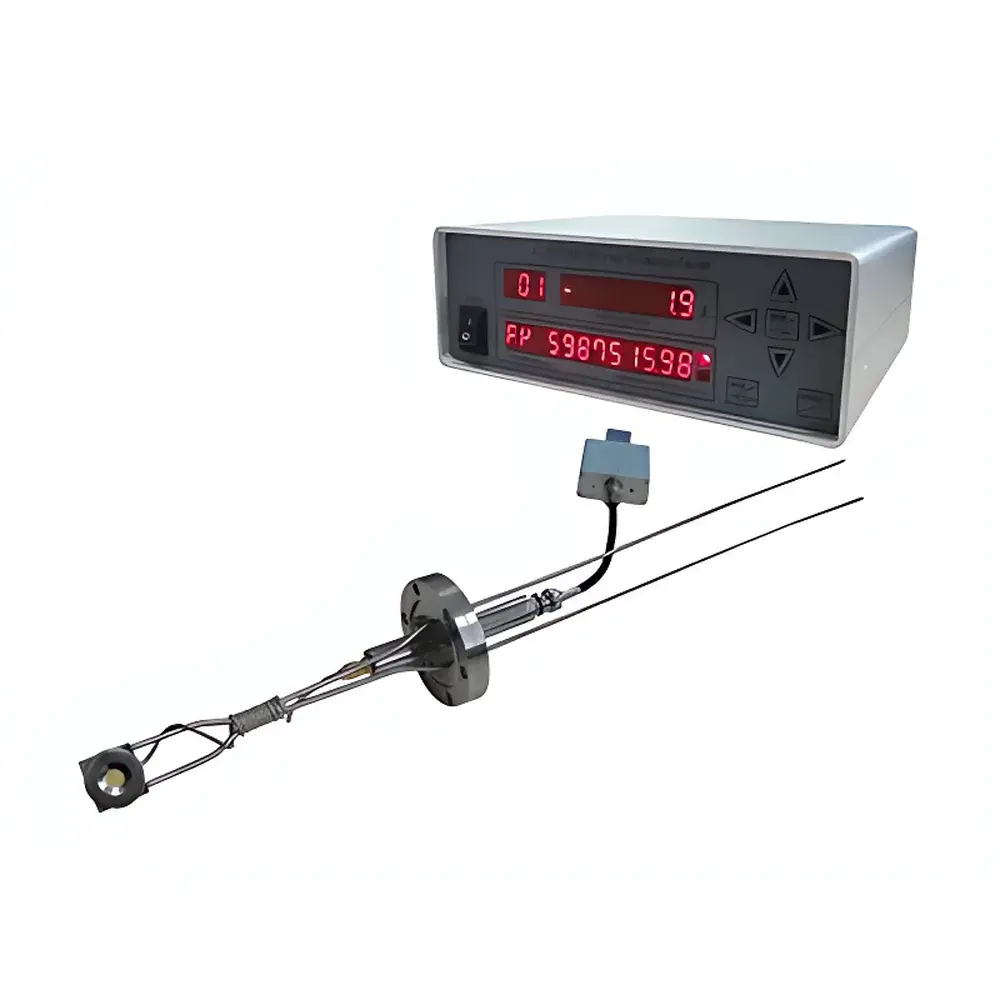
KJ GROUP EQ-TM106 Quartz Crystal Microbalance (QCM) Thin-Film Thickness Monitor
| Brand | KJ GROUP |
|---|---|
| Origin | Liaoning, China |
| Manufacturer Type | Authorized Distributor |
| Country of Origin | China |
| Model | EQ-TM106 |
| Pricing | Upon Request |
| Power Supply (Monitor Unit) | DC 5V ±10%, max. 400 mA |
| Frequency Resolution | ±0.03 Hz |
| Thickness Resolution (Al) | 0.0136 Å |
| Thickness Accuracy | ±0.5% (process-dependent |
| Measurement Interval | 100 ms – 1 s (user-configurable) |
| Max. Measurable Thickness (Al) | 500,000 Å |
| Standard Crystal Frequency | 6 MHz |
| Communication Interface | RS-232/RS-485 (configurable baud rates: 1200–38400 bps |
| Analog Output | 8-bit PWM (open-collector or internal 5 V sourcing) |
| Operating Environment | 0–50 °C, 5–85% RH (non-condensing) |
| Monitor Dimensions | 90 × 50 × 18 mm |
| Display Unit Input | AC 220 V ±10% |
| Display Unit Output | DC 5 V / 3 A |
| Display | 12×2 numeric LED display with status LEDs |
| Display Unit Dimensions | 182 × 65 × 160 mm |
| Sensor Probe | 6 MHz AT-cut quartz crystal, Ø14 mm active area |
| Flange | CF35 |
| Cooling Water Inlet | Ø3 mm, lengths available: 300 / 500 / 1000 mm |
| Max. Coolant Pressure | <0.3 MPa |
| Pneumatic Shutter Line | Ø3 mm, operating air pressure: 0.5–0.8 MPa |
| Bake Temperature Limit | <200 °C (with water flow), <100 °C (flange only, no coolant) |
Overview
The KJ GROUP EQ-TM106 Quartz Crystal Microbalance (QCM) Thin-Film Thickness Monitor is an engineered solution for real-time, in-situ monitoring of thin-film deposition processes. It operates on the fundamental principle of piezoelectric resonance shift: as mass accumulates on the surface of a precisely calibrated 6 MHz AT-cut quartz crystal sensor, the resonant frequency decreases linearly with deposited mass per unit area—governed by the Sauerbrey equation. This enables quantitative, non-destructive tracking of both instantaneous deposition rate (Å/s) and cumulative film thickness (Å) during physical vapor deposition (PVD) techniques including molecular beam epitaxy (MBE), thermal evaporation (OLED fabrication), and magnetron sputtering. The system comprises three modular components: the compact EQ-TM106-1 monitoring electronics unit, the EQ-TM106-2 local display and power interface, and the vacuum-compatible EQ-TM106-3 sensor probe with CF35 flange mounting and integrated cooling and shutter actuation interfaces. Its design prioritizes integration into high-vacuum and UHV environments while maintaining high temporal resolution (down to 100 ms per measurement) and sub-angstrom-level thickness resolution for aluminum.
Key Features
- High-stability 6 MHz quartz crystal sensing platform compliant with ASTM E2271–22 for QCM-based mass measurement calibration protocols
- User-configurable measurement interval (100 ms to 1 s) to balance temporal resolution with signal averaging requirements
- Dual-mode analog output: 8-bit PWM signal (open-collector or internally sourced 5 V) for direct integration with commercial evaporator controllers and PID rate regulators
- Local LED display unit featuring 12×2 digit numeric readout and dedicated status LEDs for thickness, rate, frequency, and PWM output percentage
- Full parameter configurability via front-panel buttons or serial command protocol—including gate time, material density, Sauerbrey constant scaling, output range mapping, and communication settings
- Compact form factor: monitor electronics unit measures only 90 × 50 × 18 mm, minimizing footprint in space-constrained vacuum chambers and glovebox systems
- Robust environmental rating: operational up to 50 °C ambient and 85% RH (non-condensing), with thermal management provisions for sensor bake-out up to 200 °C under active water cooling
Sample Compatibility & Compliance
The EQ-TM106 is optimized for conductive and semi-conductive thin films deposited under vacuum conditions (10−6–10−10 mbar). It supports standard 14 mm diameter quartz crystals compatible with common QCM holders and is validated for use with metals (e.g., Al, Au, Cr, Ni), metal oxides (e.g., ITO, SiO2, TiO2), and organic small-molecule layers (e.g., NPB, Alq3). While the Sauerbrey relationship assumes rigid, uniformly adhered, thin films (<5% of crystal thickness), the system’s ±0.5% accuracy specification reflects typical performance under controlled MBE and thermal evaporation conditions where temperature gradients, interfacial stress, and columnar growth effects are minimized. The probe assembly meets ISO-KF/CF vacuum interface standards (CF35 flange), and its pneumatic shutter and water-cooling lines conform to industrial vacuum component safety guidelines. All electrical interfaces comply with IEC 61000-6-2 (immunity) and IEC 61000-6-4 (emission) for laboratory instrumentation.
Software & Data Management
The EQ-TM106 supports ASCII-based serial communication over RS-232 or RS-485, enabling seamless integration with LabVIEW, Python (PySerial), MATLAB, or custom SCADA systems. A documented command set allows remote interrogation of real-time values (thickness, rate, frequency, PWM %) and full configuration of operational parameters. Data logging is supported natively through the display unit’s built-in functionality: all measured parameters can be timestamped and exported to comma-separated values (CSV) format compatible with Microsoft Excel or statistical analysis tools. For regulated environments, the system supports manual audit trails—though it does not implement FDA 21 CFR Part 11 electronic signature or automated audit logging. When deployed in GLP/GMP-aligned R&D labs, users may configure external software to enforce data integrity protocols, including checksummed transmission and write-once archival storage.
Applications
- Real-time closed-loop rate control in thermal evaporation systems for OLED display manufacturing
- In-situ thickness verification during MBE growth of III–V semiconductor heterostructures (e.g., GaAs/AlGaAs quantum wells)
- Process development and endpoint detection in reactive sputtering of transparent conductive oxides (TCOs)
- Calibration reference for optical monitoring systems (e.g., in-situ ellipsometry or reflectometry)
- Quantitative mass uptake studies in thin-film sensor research (e.g., gas adsorption on functionalized surfaces)
- Teaching laboratories for hands-on instruction in vacuum science, thin-film physics, and piezoelectric transduction principles
FAQ
What vacuum compatibility level does the EQ-TM106 probe support?
The EQ-TM106-3 probe uses a CF35 conflat flange and is rated for continuous operation in high vacuum (HV) and ultra-high vacuum (UHV) environments down to 10−10 mbar, provided proper bake-out procedures are followed.
Can the system measure non-metallic or polymer films accurately?
Yes—provided the film adheres uniformly to the crystal surface and remains mechanically rigid during deposition. For viscoelastic or soft films (e.g., polymers, biomolecules), the Sauerbrey model introduces systematic error; supplementary dissipation monitoring (not supported by EQ-TM106) is recommended.
Is firmware upgrade capability available?
Firmware updates are performed via RS-232 using proprietary KJ GROUP utility software; version history and release notes are provided upon request to authorized distributors.
Does the system include NIST-traceable calibration documentation?
Each quartz crystal sensor is supplied with individual frequency calibration data at 25 °C; full NIST-traceable calibration certificates are available as an optional service through KJ GROUP’s metrology lab.
How is temperature drift compensated during long-duration depositions?
The EQ-TM106 does not include active temperature compensation. Users are advised to stabilize chamber temperature, mount the sensor away from radiant heat sources, and apply empirical drift correction if operating beyond ±2 °C of calibration temperature.



