
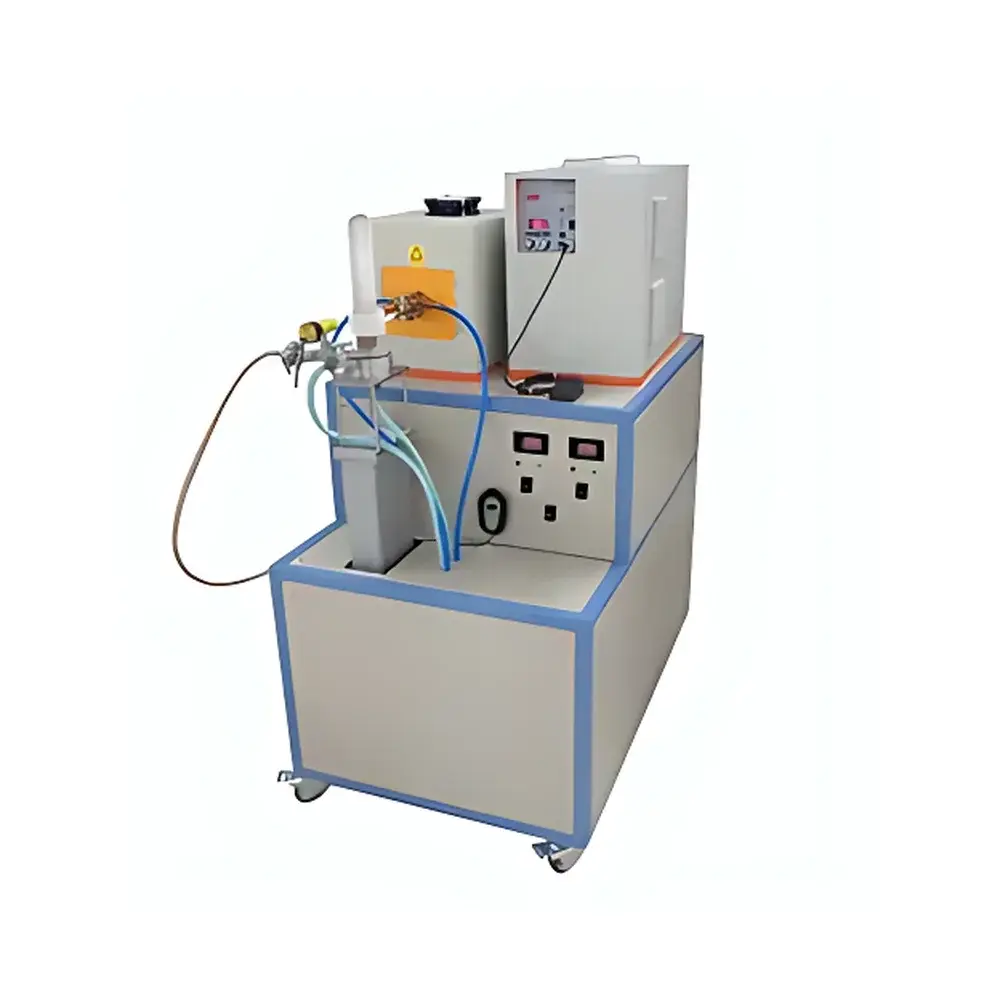
KJ GROUP FMF-40 Electromagnetic Levitation Vacuum Melting Furnace
| Brand | KJ GROUP |
|---|---|
| Origin | Liaoning, China |
| Manufacturer Type | Authorized Distributor |
| Country of Origin | China |
| Model | FMF-40 |
| Pricing | Available Upon Request |
| Vacuum Level | 1×10⁻² Torr (Mechanical Pump), 1×10⁻⁴ Torr (Turbo Molecular Pump) |
| Max Induction Power | 40 kW |
| Frequency Range | 50–200 kHz |
| Copper Crucible ID/OD | 23 mm / 38 mm, Capacity: 3 mL, Max Load: 20 g (Fe-based alloys) |
| Cooling Water Flow | ≥16 L/min (inductor), 40 L/min (crucible), 58 L/min (chiller) |
| Chiller Temp Range | 5–35 °C |
| Dimensions (W×D×H) | 1200×800×1654 mm |
| Weight | 260 kg |
| Argon Purity Required | ≥99.99% |
| Electrical Supply | 380 V / 460 V, 3-phase, 50/60 Hz, 63 A breaker |
| Ambient Conditions | Altitude ≤1000 m, Temp 10–40 °C, RH 45–65% |
| Working Table | ≥1500×600×700 mm, ≥200 kg load capacity |
Overview
The KJ GROUP FMF-40 Electromagnetic Levitation Vacuum Melting Furnace is a specialized high-purity metallurgical synthesis system engineered for containerless processing of ferromagnetic alloys under controlled inert and ultra-high vacuum environments. It employs high-frequency induction heating (50–200 kHz) combined with precisely configured electromagnetic fields to levitate molten samples—eliminating crucible contact and minimizing contamination from refractory materials or thermal gradients. This principle enables true undercooling studies, metastable phase formation, rapid solidification kinetics analysis, and preparation of high-purity Fe-, Co-, Ni-, and rare-earth-based alloys for advanced magnetic, soft-magnetic, or amorphous alloy research. The furnace integrates a water-cooled copper crucible (23 mm ID, 38 mm OD, 12-segmented design), a 40 kW RF generator, dual-stage vacuum pumping (mechanical + turbo molecular), and an automated bottom-flange actuation system for reproducible sample loading and positioning.
Key Features
- Electromagnetic levitation capability optimized for ferromagnetic metals and alloys—enabling stable suspension during melting and solidification without physical containment
- Dual-vacuum configuration: base pressure down to 1×10⁻⁴ Torr with turbo molecular pump; 1×10⁻² Torr achievable with mechanical pump only
- Automated vertical translation of the bottom flange via precision linear actuator—facilitating safe, repeatable sample insertion and removal under vacuum or inert gas conditions
- Segmented water-cooled copper crucible with integrated high-velocity cooling (≥40 L/min) to sustain thermal stability during repeated 40 kW operation
- Integrated closed-loop chiller (2100 W max input, 5–35 °C setpoint control, 58 L/min flow) using deionized or purified water—ensuring consistent thermal management across inductor, crucible, and feedthroughs
- Quartz reaction tube (Ø50 × 300 mm) compatible with argon backfilling (≥99.99% purity) and optional oxygen/moisture monitoring interfaces
- Industrial-grade 3-phase power interface (380/460 V, 63 A circuit breaker required) with dedicated grounding per IEC 61000-6-3 EMC standards
Sample Compatibility & Compliance
The FMF-40 is validated for processing ferromagnetic elemental metals (e.g., Fe, Co, Ni) and their binary/ternary alloys—including Fe–Si, Fe–B–Nb–Cu, Co–Fe–P–B, and Nd–Fe–B precursors—within mass limits up to 20 g. Non-ferromagnetic materials (e.g., Al, Ti, Cu) cannot be stably levitated and are not supported. All wetted components—including quartz tubes, copper crucibles, stainless-steel flanges (CF-63 standard), and O-rings—are compliant with ASTM F2020 (vacuum compatibility) and ISO 10101-2 (elastomer outgassing classification). The system supports GLP-aligned operation when paired with external data loggers and audit-trail-enabled process recording software. While not FDA 21 CFR Part 11 certified out-of-the-box, its analog/digital I/O architecture permits integration with validated SCADA systems meeting GMP documentation requirements.
Software & Data Management
The FMF-40 operates via a local industrial HMI panel with real-time display of vacuum pressure (capacitance manometer + Pirani gauge), RF power output (% and kW), coil current (A), chiller temperature (°C), and water flow rate (L/min). Optional RS-485/Modbus RTU or Ethernet/IP communication modules enable integration into LabVIEW, MATLAB, or custom Python-based control platforms for synchronized acquisition of thermal history (via optional pyrometer input), levitation stability metrics, and vacuum ramp profiles. All operational parameters are timestamped and exportable as CSV files. No proprietary cloud service or vendor-hosted platform is included; data sovereignty remains fully under user control.
Applications
- Containerless melting and rapid solidification of Fe-based soft magnetic alloys for domain structure and coercivity optimization
- Undercooling behavior quantification of intermetallic compounds (e.g., Fe₃Al, Ni₃Al) using high-speed pyrometry and acoustic emission monitoring
- Synthesis of metastable phases inaccessible via conventional casting—such as amorphous ribbons or nano-crystalline composites
- Thermophysical property measurement (density, surface tension, viscosity) via oscillating drop method under microgravity-simulated conditions
- Process development for additive manufacturing feedstock pre-alloying—especially for high-saturation magnetization powders requiring minimal oxide inclusion
- Fundamental studies of magnetic field–molten metal interaction dynamics at elevated temperatures (>1500 °C)
FAQ
Can the FMF-40 melt non-ferromagnetic metals such as aluminum or titanium?
No. Electromagnetic levitation in this system relies on induced eddy currents interacting with applied magnetic fields—a mechanism effective only for electrically conductive and ferromagnetic materials. Non-ferromagnetic metals lack sufficient magnetic susceptibility for stable suspension.
Is the quartz tube reusable, and what is its typical lifetime?
Yes, provided thermal shock is minimized and surface etching from repeated alloy reactions is monitored. Typical service life ranges from 20–50 melts depending on alloy composition and peak temperature; visual inspection for devitrification or microcracking is recommended before each use.
What vacuum certifications or calibration documents are supplied?
The system ships with factory-assembled vacuum leak test report (helium mass spectrometry, ≤1×10⁻⁹ mbar·L/s), pressure gauge calibration certificates traceable to NIST-equivalent national standards, and electrical safety compliance documentation per GB/T 19001–2016 (ISO 9001).
Does the system support inert gas partial pressure control during melting?
Yes. The chamber includes a calibrated mass flow controller (MFC) port and manual needle valve for precise argon backfilling. Pressure stabilization between 10⁻³ and 10² Torr is achievable; dynamic regulation requires optional MFC integration.
Is remote operation or monitoring possible?
Local HMI-only operation is standard. Remote access requires user-provided secure network infrastructure and optional communication modules (RS-485/Ethernet); no built-in VNC, SSH, or web server functionality is included for cybersecurity compliance.



