
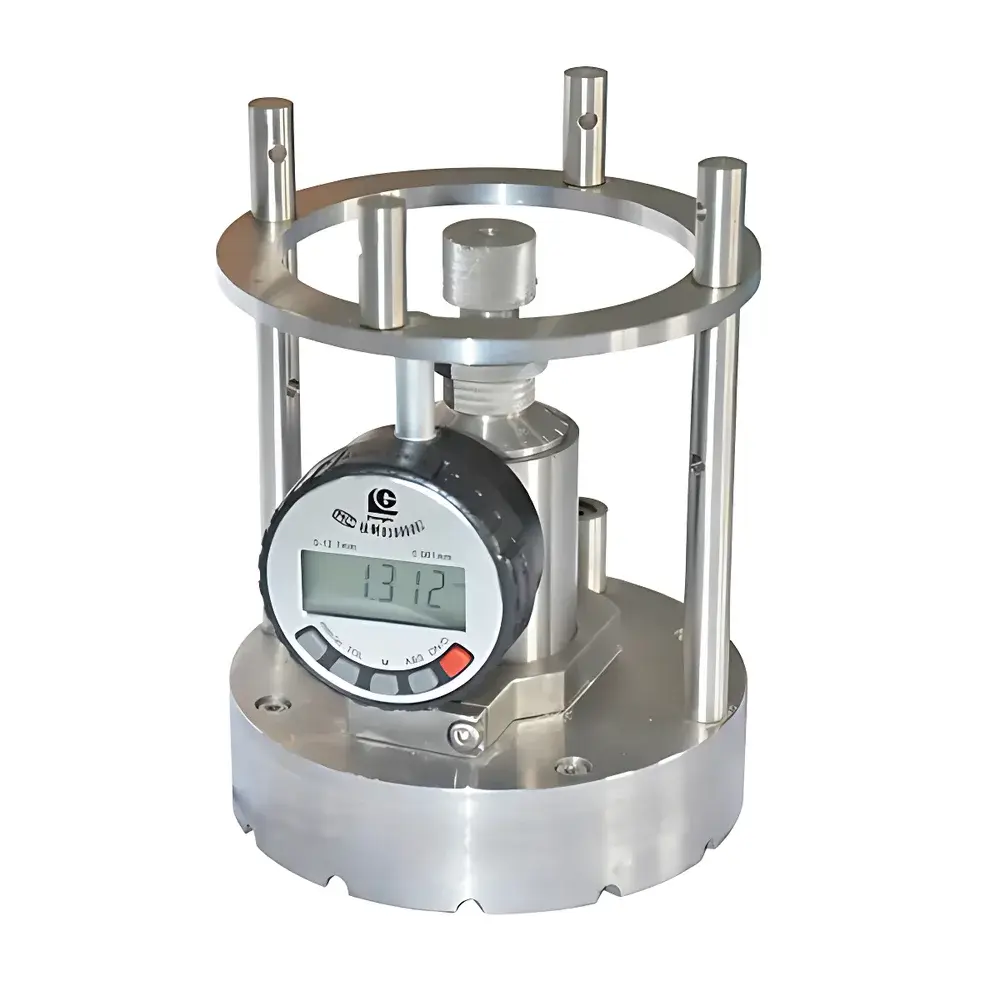
KJ GROUP GPC-80A Precision Lapping & Polishing Control Fixture
| Brand | KJ GROUP |
|---|---|
| Origin | Liaoning, China |
| Manufacturer Type | Authorized Distributor |
| Country of Origin | China |
| Model | GPC-80A |
| Pricing | Upon Request |
| Sample Holder Diameter | Ø80 mm |
| Axial Travel Range | 9 mm (0.025 mm per graduation) |
| Digital Indicator Resolution | 0.001 mm |
| Empty Holder Load | 750 g |
| Max Sample Dimensions | Ø ≤ 80 mm, Thickness ≤ 9 mm |
| Overall Dimensions | Ø117 mm × 155 mm (without counterweight), Ø117 mm × 204 mm (with counterweight) |
| Operating Environment | Altitude < 1000 m, Temperature 25 °C ± 15 °C, Relative Humidity 55 %RH ± 10 %RH |
| Water Supply Required | Yes |
| Power Supply | Not required |
| Pneumatic Supply | Not required |
| Ventilation | Required |
| Optional Accessory | Counterweights (50–200 g) |
Overview
The KJ GROUP GPC-80A Precision Lapping & Polishing Control Fixture is a mechanically actuated, manually operated metrological fixture engineered to ensure high-fidelity control of sample surface flatness and parallelism during precision lapping and polishing operations. Designed for integration with UNIPOL-1202 and UNIPOL-802 precision lapping and polishing systems, the GPC-80A functions as a calibrated mechanical interface between the machine’s platen and the specimen—translating rotational motion and axial loading into repeatable, quantifiable material removal. Its operation relies on a precision-machined threaded adjustment mechanism that converts discrete angular rotations of a micrometer-style nut into linear displacement of the sample carrier stage with a resolution of 0.025 mm per graduation. This deterministic mechanical linkage eliminates reliance on electronic actuators or closed-loop feedback, delivering inherent stability and long-term repeatability under variable environmental conditions. The fixture is particularly suited for applications demanding strict dimensional tolerance control—such as geological thin-section preparation, where final thickness uniformity, inter-surface parallelism (< 1 µm deviation across Ø80 mm), and minimal subsurface damage are critical for optical transmission and petrographic analysis.
Key Features
- Mechanically precise axial positioning system with 0.025 mm per graduation resolution and 9 mm total travel range
- Digital indicator with 0.001 mm resolution for real-time monitoring of cumulative material removal
- Stainless steel construction ensuring corrosion resistance, dimensional stability, and compatibility with aqueous and mild abrasive slurries
- Modular sample mounting via threaded carrier block; specimens affixed using epoxy or low-viscosity adhesive bonding
- Optimized load distribution: 750 g nominal empty-stage preload ensures consistent contact pressure without requiring external pneumatic or hydraulic assistance
- Integrated ventilation-compatible housing design to dissipate heat generated during extended lapping cycles
- Interchangeable counterweight set (50–200 g) enabling fine-tuning of applied normal force for varied material hardness and slurry viscosity conditions
Sample Compatibility & Compliance
The GPC-80A accommodates circular specimens up to Ø80 mm in diameter and 9 mm in thickness, making it compatible with standard geological thin-section blanks (e.g., 27 mm × 46 mm rectangular sections mounted on Ø80 mm carriers), metallurgical cross-sections, ceramic substrates, and semiconductor wafers requiring manual pre-polish conditioning. Its mechanical architecture complies with ISO 14644-1 Class 8 cleanroom handling requirements when used with appropriate glove protocols. While the fixture itself contains no active electronics or software, its dimensional stability and traceable mechanical calibration support adherence to ASTM E1558 (Standard Guide for Preparation of Metallographic Specimens) and ISO 16331-1 (Geological thin section preparation). When paired with a validated digital thickness gauge (e.g., Mitutoyo ID-C112X), the system supports GLP-compliant documentation of thickness reduction profiles across multiple lapping iterations.
Software & Data Management
The GPC-80A operates independently of software control. All adjustments are performed manually, and measurement data from the integrated digital indicator must be recorded externally—either via manual transcription or by interfacing with third-party digital caliper loggers supporting RS-232 or USB HID protocols. For laboratories operating under FDA 21 CFR Part 11 or ISO/IEC 17025 frameworks, users are advised to implement controlled paper-based or validated electronic lab notebook (ELN) workflows to capture operator identity, timestamped readings, and environmental parameters (temperature, humidity) at start and conclusion of each lapping session. No firmware, embedded memory, or audit trail functionality is present within the device.
Applications
- Preparation of petrographic thin sections for transmitted-light microscopy and electron microprobe analysis
- Thickness-controlled lapping of brittle materials including quartz, feldspar, basalt, and shale prior to final polishing
- Calibration reference setup for evaluating platen flatness and rotational runout on UNIPOL-series lapping machines
- Process development for low-stress material removal in academic and industrial R&D labs focused on geoscience, materials science, and failure analysis
- Reproducible fabrication of optical-grade substrates where surface parallelism directly impacts interferometric measurement accuracy
FAQ
Does the GPC-80A require electrical power or compressed air?
No. It is a fully passive mechanical fixture with no electrical, pneumatic, or hydraulic components.
Can the GPC-80A be used with lapping machines other than UNIPOL-1202/802?
It is dimensionally and kinematically optimized for UNIPOL systems; adaptation to other platforms requires custom mounting interface verification and may compromise axial alignment fidelity.
What is the maximum recommended sample thickness for optimal flatness control?
For best results in geological thin-section preparation, samples ≤ 6 mm thick are recommended to minimize edge roll and thermal distortion during prolonged lapping.
Is the digital indicator calibrated and traceable to national standards?
The indicator is factory-calibrated; users must perform periodic verification using NIST-traceable gauge blocks and document calibration status per internal QA procedures.
How is environmental conditioning addressed during operation?
Ventilation is required to maintain ambient temperature stability; operation outside the specified 10–40 °C range may affect stainless steel thermal expansion and indicator linearity.
Related Products



