
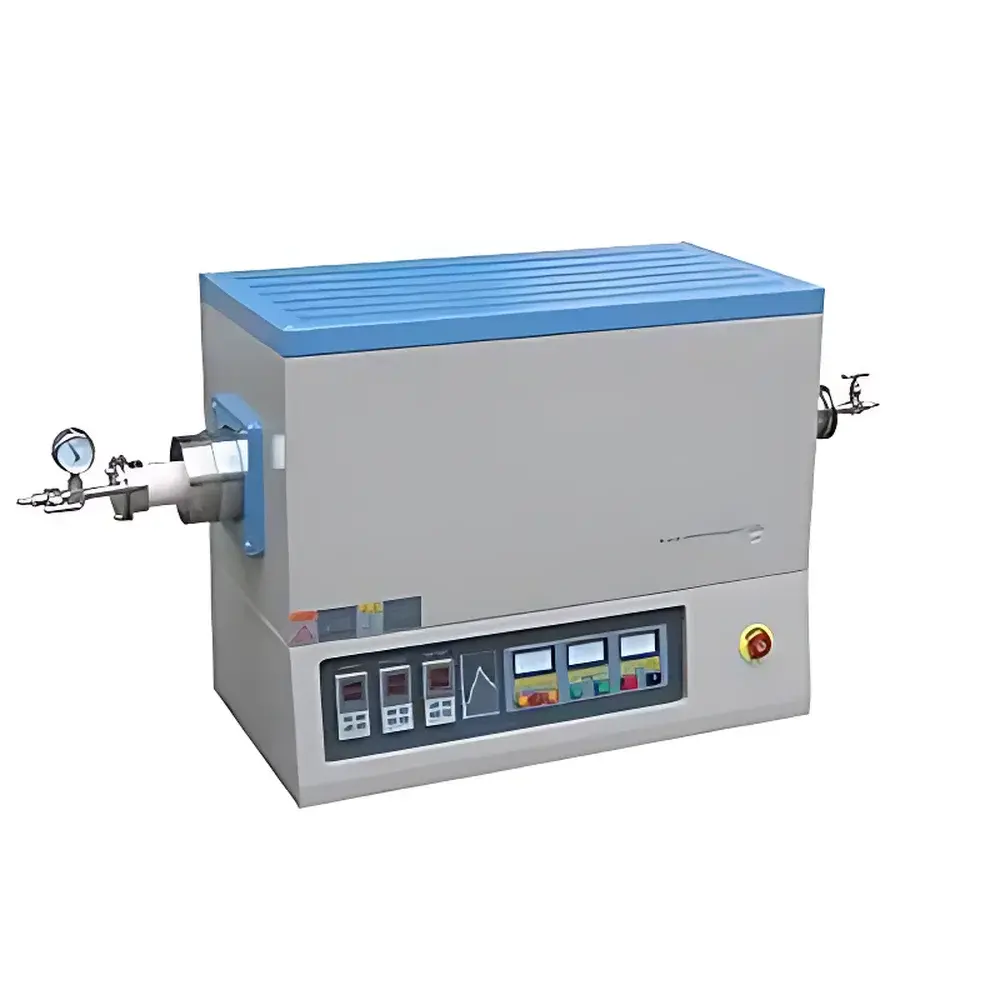
KJ GROUP GSL-1700X-III Triple-Zone High-Temperature Vacuum Tube Furnace
| Brand | KJ GROUP |
|---|---|
| Origin | Anhui, China |
| Manufacturer Type | Authorized Distributor |
| Country of Origin | China |
| Model | GSL-1700X-III |
| Power Supply | AC 220 V, 50/60 Hz, 9 kW (requires 75 A circuit breaker) |
| Max Operating Temperature | 1700 °C (central zone), 1400 °C (side zones) |
| Heating Zones | 3 independent PID-controlled zones |
| Programmable Ramp/Soak | 30-segment |
| Tube Dimensions | Φ60 mm OD × Φ54 mm ID × 1200 mm L |
| Hot Zone Length | 630 mm (Zone I: 190 mm |
| Zone II | 250 mm |
| Zone III | 190 mm) |
| Heating Elements | Zone I & III — U-shaped SiC rods (4 each) |
| Thermocouples | 1 × B-type, 2 × S-type |
| Temperature Uniformity | ±1 °C |
| Max Ramp Rate | 20 °C/min (Zones I & III), 10 °C/min (Zone II) |
| Chamber Material | High-purity alumina fiber |
| Insulation | Dual-layer shell with forced-air cooling |
| Surface Temp | <60 °C |
| Certifications | CE compliant |
| Dimensions (W×D×H) | 860 × 460 × 720 mm |
| Weight | 150 kg |
Overview
The KJ GROUP GSL-1700X-III is a precision-engineered triple-zone high-temperature vacuum tube furnace designed for advanced materials synthesis under controlled thermal and atmospheric conditions. It operates on the principle of resistive heating via high-stability ceramic-based heating elements—silicon carbide (SiC) rods in the two outer zones and molybdenum disilicide (MoSi₂) rods in the central zone—enabling stable, uniform heating up to 1700 °C in the core region while maintaining precise thermal gradients across the 1200 mm quartz or alumina tube. Its architecture supports both isothermal processing and programmable multi-step thermal profiles, making it suitable for solid-state reaction studies, crystal growth, annealing of functional ceramics, and chemical vapor deposition (CVD) processes requiring axial temperature differentials. The furnace integrates dual-shell construction with high-purity alumina fiber insulation and an active air-cooling system, ensuring external surface temperatures remain below 60 °C during continuous operation at maximum setpoints—a critical safety and energy-efficiency feature for laboratory environments.
Key Features
- Three independently controllable heating zones with dedicated PID temperature controllers, each supporting up to 30 programmable ramp-and-soak segments for complex thermal protocols.
- Optimized thermal zoning: Central zone (Zone II) equipped with six U-shaped MoSi₂ heating elements rated for sustained operation up to 1700 °C; outer zones (I & III) utilize four U-shaped SiC rods each, rated to 1400 °C—enabling reproducible axial temperature gradients essential for directional solidification and CVD precursor decomposition profiling.
- High-integrity hot zone design: Total heated length of 630 mm (190–250–190 mm per zone) within a 1200 mm-long Φ54 mm ID alumina tube, ensuring spatially resolved thermal treatment with minimal radial deviation.
- Dual thermocouple configuration: One B-type thermocouple (for Zone II, 0–1820 °C range) and two S-type thermocouples (for Zones I & III, 0–1600 °C range) provide redundant, NIST-traceable temperature feedback with ±1 °C control accuracy.
- Robust mechanical and thermal containment: Double-walled stainless steel housing with high-purity alumina fiber insulation and integrated forced-air cooling fans; external surface temperature maintained below 60 °C even at full power—compliant with IEC 61000-3-2 harmonic emission limits and workplace thermal safety guidelines.
- CE-marked design with built-in safety interlocks including over-temperature cutoff, thermocouple break detection, and automatic shutdown upon vacuum loss or cooling failure.
Sample Compatibility & Compliance
The GSL-1700X-III accommodates standard high-purity alumina or quartz tubes (Φ60 mm OD / Φ54 mm ID), compatible with inert, reducing, or low-pressure reactive atmospheres (down to 10⁻³ mbar with optional vacuum pumping). Its modular flange interface (standard SS304 KF25-compatible) supports integration with mass flow controllers, residual gas analyzers, and cold traps for GMP-aligned CVD process development. The furnace meets CE conformity requirements under Directive 2014/35/EU (Low Voltage Directive) and 2014/30/EU (EMC Directive). While not inherently 21 CFR Part 11-compliant, its digital controller logs timestamped setpoint and actual temperature data—readily exportable for GLP/GMP audit trails when paired with validated third-party data acquisition software. All internal coatings use US-sourced alumina-based refractory sealants certified for high-temperature stability and low outgassing (<10⁻⁹ mbar·L/s·cm² at 1000 °C), minimizing contamination during thin-film epitaxy or battery cathode synthesis.
Software & Data Management
The integrated digital PID controllers feature RS485 Modbus RTU communication ports, enabling remote monitoring and parameter adjustment via industry-standard SCADA platforms (e.g., LabVIEW, Ignition, or custom Python-based DAQ systems). Temperature profiles—including segment number, target temperature, ramp rate, dwell time, and direction—are stored in non-volatile memory and can be exported as CSV files for post-process analysis. Optional vacuum gauges (e.g., digital Pirani/cold cathode combinations) integrate seamlessly via analog 0–10 V or 4–20 mA outputs. Firmware supports firmware revision logging and user-defined alarm thresholds, facilitating compliance with ISO/IEC 17025 calibration record requirements when used in accredited testing laboratories.
Applications
- Chemical vapor deposition (CVD) of graphene, transition metal dichalcogenides (TMDs), and perovskite thin films requiring precise axial thermal gradients.
- Synthesis and annealing of oxide ceramics (e.g., LiCoO₂, NMC, YBCO) under controlled oxygen partial pressure.
- Thermal treatment of carbon nanomaterials, including graphitization of carbon fibers and activation of porous carbons.
- Crystal growth via traveling heater method (THM) or vertical Bridgman techniques for semiconductor-grade selenides and tellurides.
- High-temperature aging studies of nuclear fuel matrix materials (e.g., UO₂–ZrO₂ composites) under simulated reactor conditions.
- Calibration of high-temperature reference materials traceable to NPL or NIST standards.
FAQ
What vacuum level can the GSL-1700X-III achieve with standard configuration?
The base system includes a KF25 vacuum flange but no pump; with a typical two-stage rotary vane pump, ultimate pressure reaches ~10⁻² mbar. For high-vacuum applications (≤10⁻⁵ mbar), a turbomolecular pumping station with appropriate foreline trap is required.
Is the furnace compatible with hydrogen or ammonia atmospheres?
Yes—when operated with appropriate gas-handling accessories (stainless steel tubing, VCR fittings, leak-tested manifolds) and verified oxygen sensors, the system supports reducing atmospheres up to 5% H₂ in Ar or pure NH₃ at ≤1 atm, provided proper ventilation and explosion-proof electrical routing are implemented per NFPA 55 and local AHJ requirements.
Can the three zones be operated at significantly different temperatures simultaneously?
Yes—the independent PID loops allow stable differential operation (e.g., 1200 °C / 1650 °C / 1100 °C) with thermal gradient resolution better than ±2 °C over the 630 mm hot zone, validated per ASTM E220 for thermocouple system accuracy.
What maintenance intervals are recommended for heating elements?
MoSi₂ rods typically last >2000 hours at 1700 °C in clean inert atmospheres; SiC rods exceed 5000 hours at ≤1400 °C. Visual inspection and resistance measurement every 500 operational hours are advised per manufacturer service bulletin KJ-FUR-MAINT-2023.
Does the unit include vacuum sealing gaskets and O-rings?
Standard delivery includes one set of fluorosilicone O-rings rated to 200 °C; high-temperature metal C-seals (for >400 °C vacuum integrity) are available as optional accessories (part #GSL-KF25-MC).



