
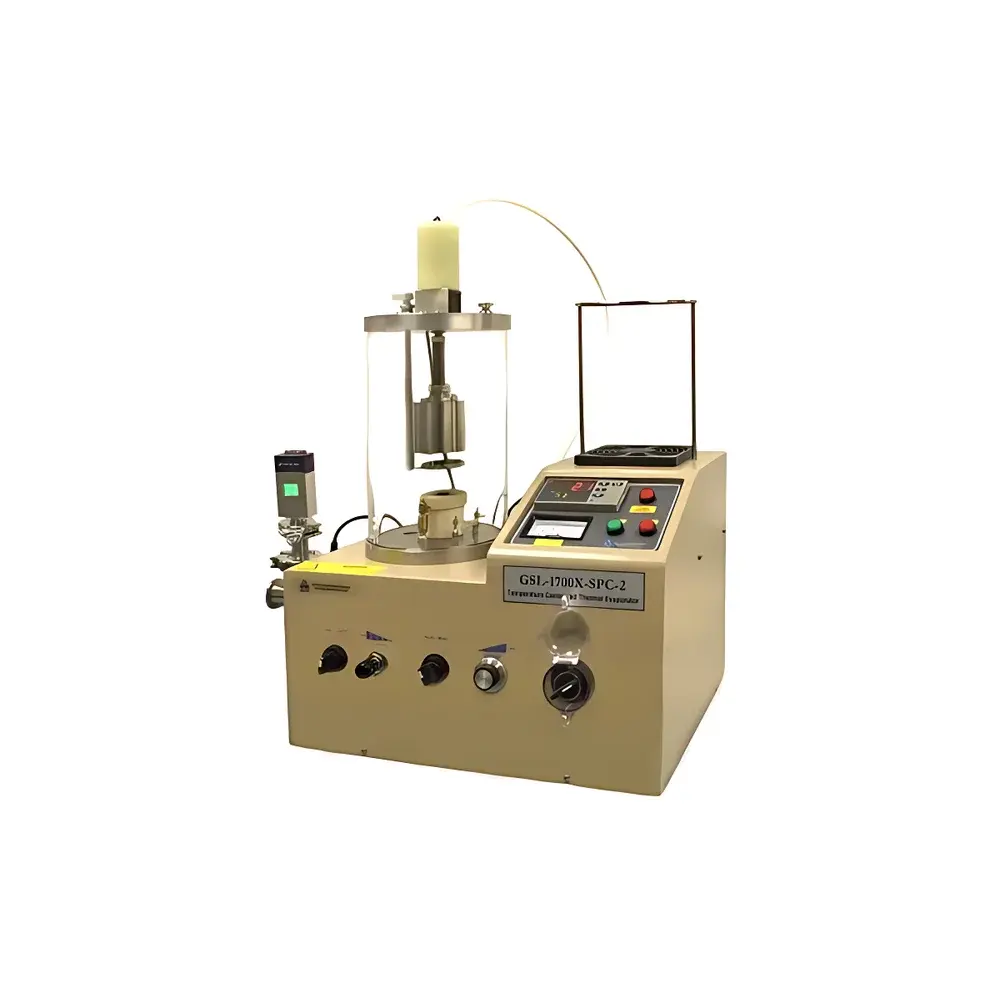
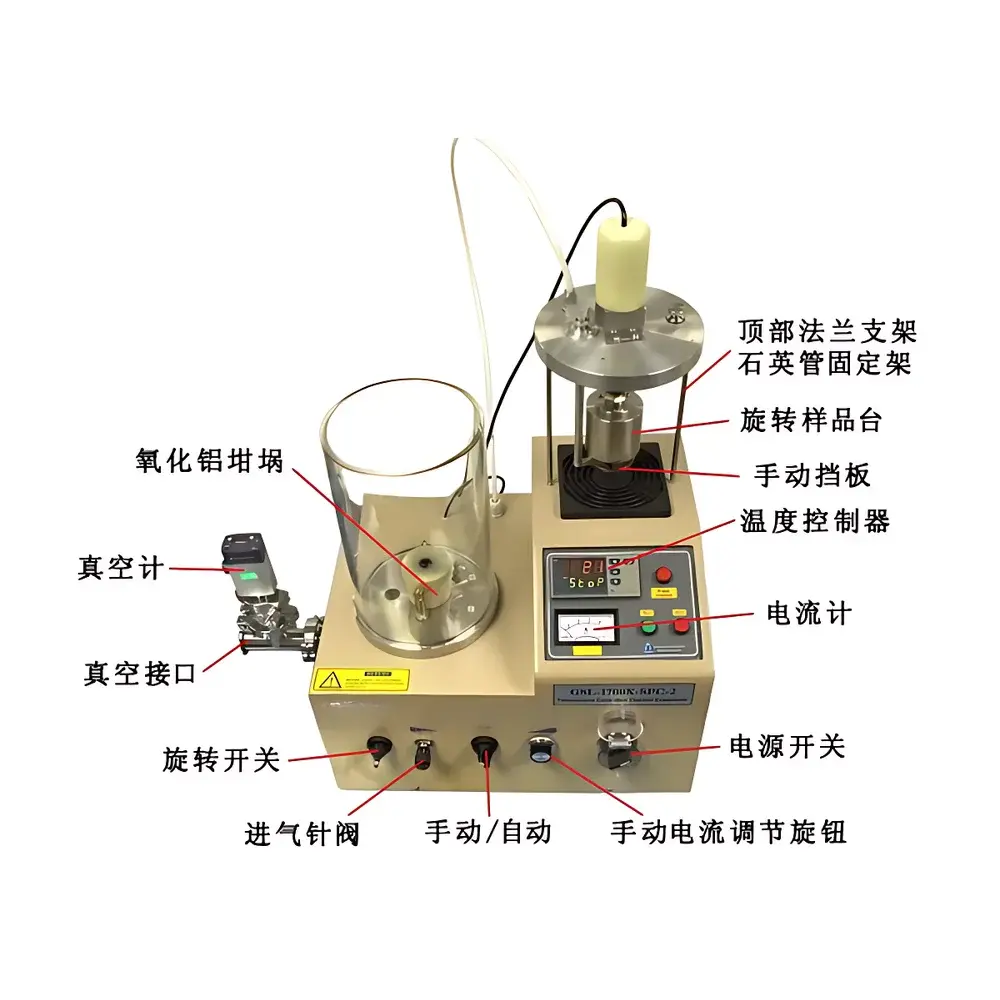
KJ GROUP GSL-1700X-SPC-2 Small-Scale Programmable Temperature-Controlled Thermal Evaporation Coater
| Brand | KJ GROUP |
|---|---|
| Origin | Liaoning, China |
| Manufacturer Type | Authorized Distributor |
| Country of Origin | China |
| Model | GSL-1700X-SPC-2 |
| Voltage | AC 208–220 V, 50/60 Hz, Single-Phase |
| Max Power | 500 W, 30 A |
| Chamber | Quartz, Ø6" |
| Sample Stage | Ø50 mm, Rotatable at 5 rpm, Source-to-Stage Distance Adjustable (60–100 mm) |
| Max Temp | 1700 °C |
| Thermocouple | S-type (200–1500 °C), Optional B-type (1200–1700 °C) |
| Temp Control Accuracy | ±1 °C |
| Programmable Ramp/Soak | 30-Step Profile |
| Evaporation Source | Dual Tungsten Filament Baskets |
| Vacuum Gauge | PCG554 Digital Pirani/Cold Cathode Gauge (3.8×10⁻⁵–1125 Torr) |
| Vacuum Port | KF40 |
| Inlet Port | 1/4" NPS with Needle Valve |
| Dimensions (W×D×H) | 440 × 330 × 630 mm |
Overview
The KJ GROUP GSL-1700X-SPC-2 is a compact, benchtop thermal evaporation coater engineered for precise, programmable resistive-heating deposition under controlled vacuum conditions. It operates on the principle of resistive thermal evaporation—where electric current passes through high-melting-point tungsten filaments to generate localized heating, vaporizing source materials (metals, oxides, or organic compounds) that subsequently condense as thin films on substrates. Designed for laboratories requiring reproducible, small-area (<2-inch diameter) film fabrication, the system supports both standard thermal evaporation and reactive evaporation modes via controlled gas introduction. Its quartz vacuum chamber ensures optical transparency for in-situ visual monitoring, low outgassing, and chemical inertness—critical for minimizing contamination during deposition of sensitive materials such as OLED emissive layers or electrochemical electrode coatings.
Key Features
- Programmable temperature control with 30-segment ramp-and-soak capability, enabling precise thermal profiling from 200 °C to 1700 °C (S-type thermocouple standard; B-type optional for >1200 °C operation)
- Rotating sample stage (5 rpm) with adjustable vertical positioning (60–100 mm from evaporation source), enhancing thickness uniformity across Ø50 mm substrates
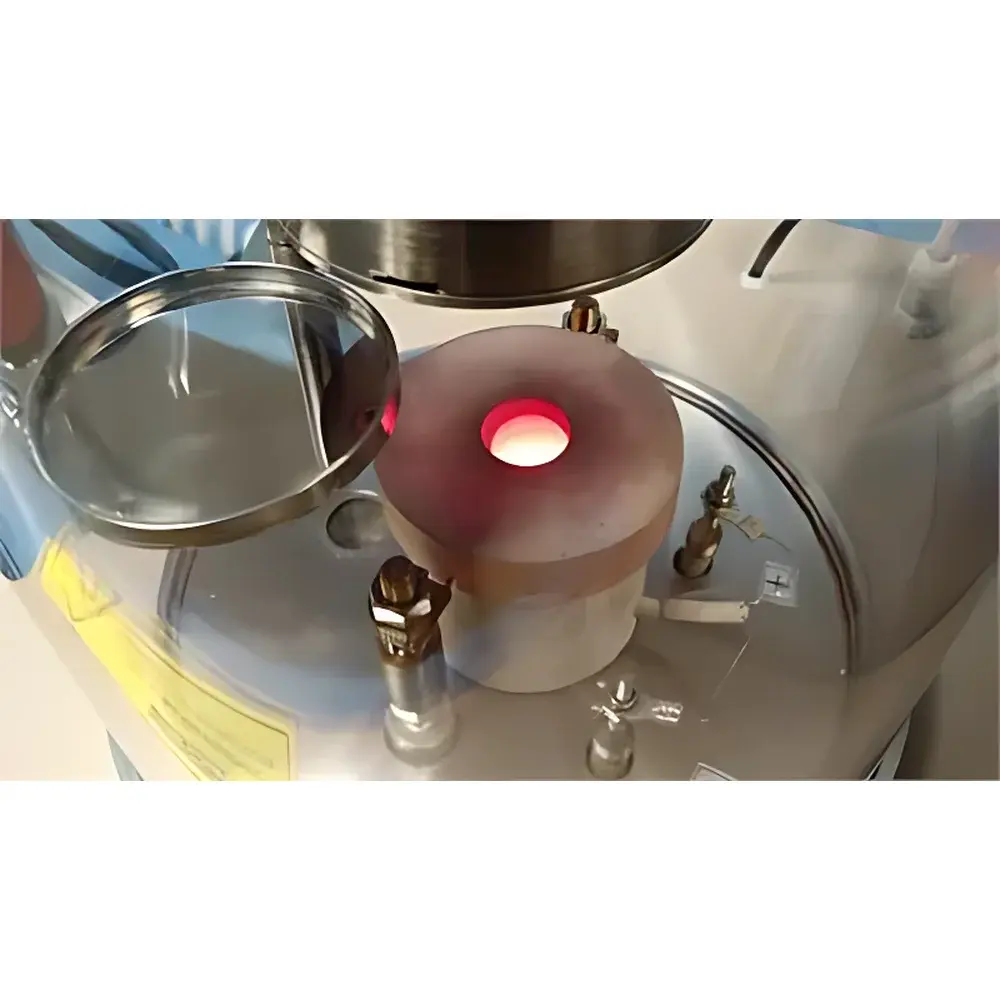
- Dual tungsten filament baskets—rated for continuous operation up to 1700 °C; compatible with alumina crucibles for temperatures ≤1600 °C or direct placement of high-volatility sources (e.g., carbon) onto tungsten mesh at ≥1600 °C
- Integrated S-type thermocouple mounted directly beneath the crucible base for real-time, closed-loop temperature feedback and ±1 °C stability
- Manual current-control mode (thermocouple bypassed) allows open-loop operation up to 2000 °C—suitable for carbon evaporation and other high-temperature non-feedback applications
- Gas inlet port (1/4″ NPS) with precision needle valve enables controlled introduction of inert (Ar, N₂) or reactive (O₂, NH₃) gases for sputter-free reactive evaporation or chamber purging
- KF40 vacuum flange interface, compatible with standard roughing and high-vacuum pumping configurations including mechanical pumps (≤10⁻² Torr) and turbomolecular pumps (≤10⁻⁵ Torr)
Sample Compatibility & Compliance
The GSL-1700X-SPC-2 accommodates a broad range of evaporants—including Au, Ag, Al, Cr, Ni, Ti, Mg, Li, ITO precursors, and small-molecule organics (e.g., Alq₃, NPB)—subject to vapor pressure constraints at operational temperatures. Substrate compatibility includes silicon wafers, glass slides, ITO-coated PET, quartz, and flexible polymer foils. The quartz chamber complies with ISO 14644-1 Class 5 cleanroom handling standards when operated in conjunction with oil-free pumping systems. CE marking confirms conformity with EU Machinery Directive 2006/42/EC and Electromagnetic Compatibility Directive 2014/30/EU. For regulated environments (e.g., academic GLP studies or preclinical device prototyping), the system supports traceable process logging when integrated with external data acquisition hardware compliant with FDA 21 CFR Part 11 requirements.
Software & Data Management
While the GSL-1700X-SPC-2 utilizes a standalone digital temperature controller (no embedded PC or proprietary software), its analog voltage output (0–5 V) and RS485 communication port enable integration with third-party SCADA platforms (e.g., LabVIEW, MATLAB, or Ignition) for automated recipe execution, real-time parameter logging, and audit-trail generation. All temperature profiles, dwell times, and current setpoints are stored internally with timestamping. When paired with optional vacuum controllers (e.g., MKS 974B) or mass flow controllers, full process documentation—including chamber pressure, gas flow rate, and thermal history—can be archived in CSV or TDMS format for QA/QC review and regulatory submission.
Applications
- Preparation of transparent conductive electrodes (e.g., thin-film Ag or ITO) for flexible optoelectronics
- Deposition of metal cathodes (Ca, Al, Mg:Ag alloys) and organic emissive layers in OLED and PeLED research
- Fabrication of model catalyst films (Pt, Pd, Ni) for surface science and electrocatalysis studies
- Carbon coating of TEM grids and SEM stubs for charge dissipation and imaging fidelity
- Reactive evaporation of metal oxides (e.g., TiO₂, ZnO) using O₂ co-flow for photoelectrode development
- Low-temperature organic evaporation (e.g., pentacene, C₆₀) for organic field-effect transistor (OFET) prototyping
FAQ
What vacuum level is required for high-quality metal film deposition?
For noble metals (Au, Ag), a base pressure ≤5×10⁻³ Torr is sufficient with a mechanical pump. For oxidation-prone metals (Al, Mg, Li), a base pressure ≤1×10⁻⁵ Torr—achievable with a turbomolecular pump—is recommended to suppress oxide formation.
Can the system deposit multilayer structures sequentially?
Yes—by loading multiple tungsten baskets with different materials and performing discrete evaporation cycles under independent temperature programs, users can fabricate bilayer or trilayer stacks without breaking vacuum.
Is the quartz chamber resistant to halogen-based precursors?
Quartz exhibits limited resistance to fluorinated or chlorinated vapors at elevated temperatures; for such chemistries, stainless-steel chamber upgrades or quartz-lined alternatives are advised.
How is film thickness monitored during evaporation?
The system does not include an integrated quartz crystal microbalance (QCM); however, the KF40 port supports aftermarket QCM modules (e.g., Inficon XTM/2) for real-time thickness control and rate feedback.
Does the rotation mechanism support variable speed control?
No—the stage rotates at a fixed 5 rpm. For applications demanding tunable rotation rates, external motorized stages with vacuum feedthroughs may be integrated via custom flange adapters.



