
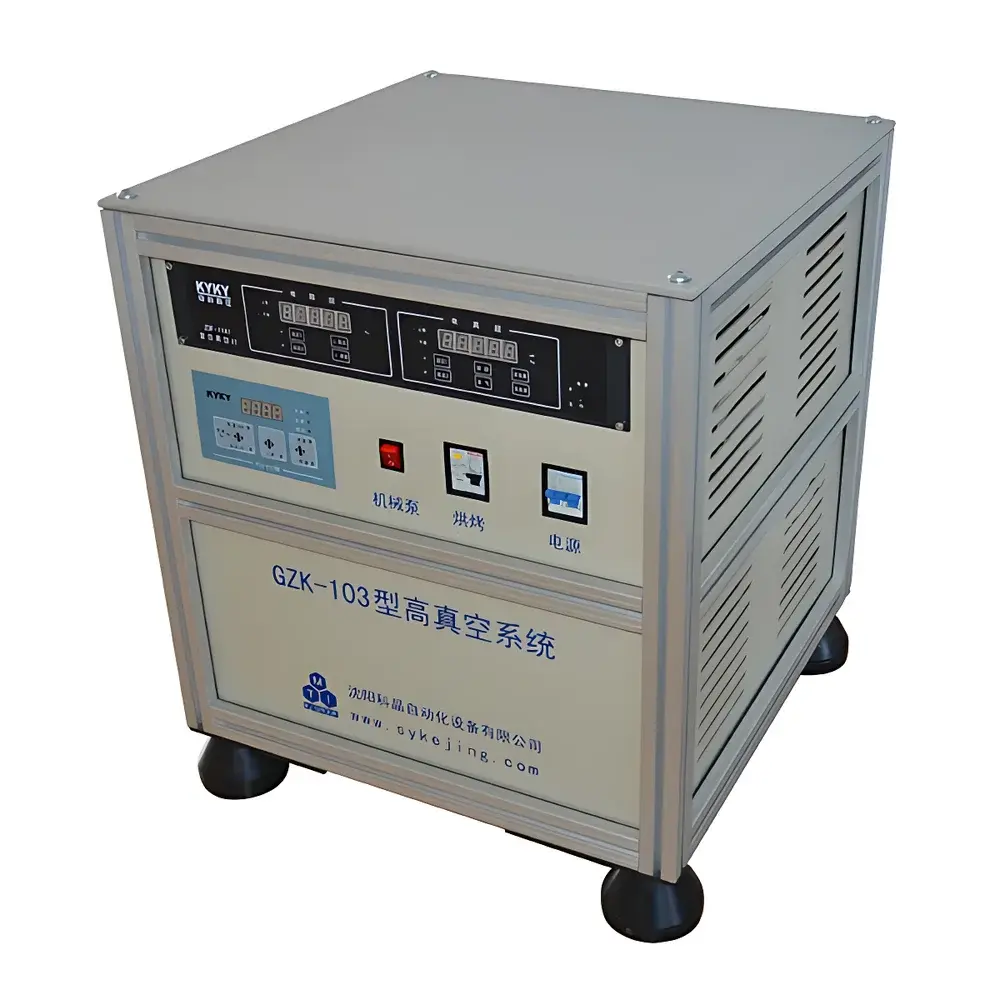
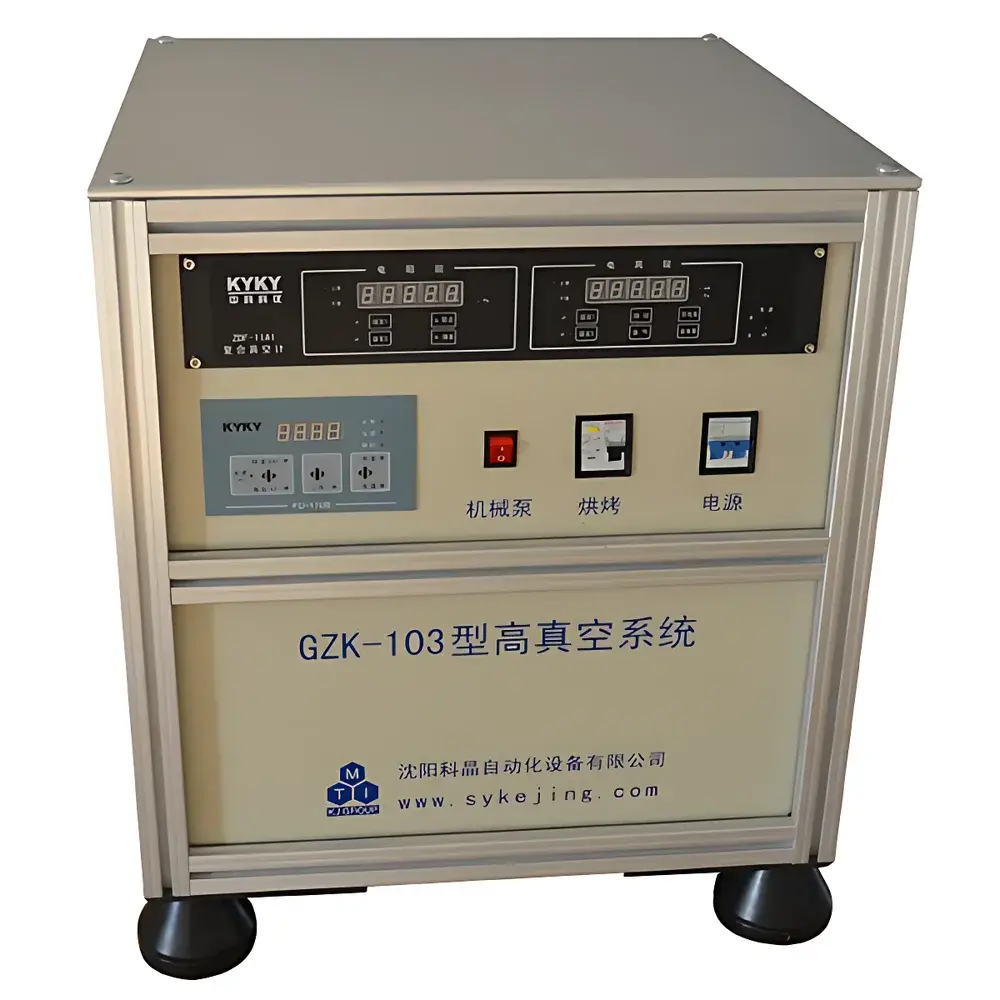
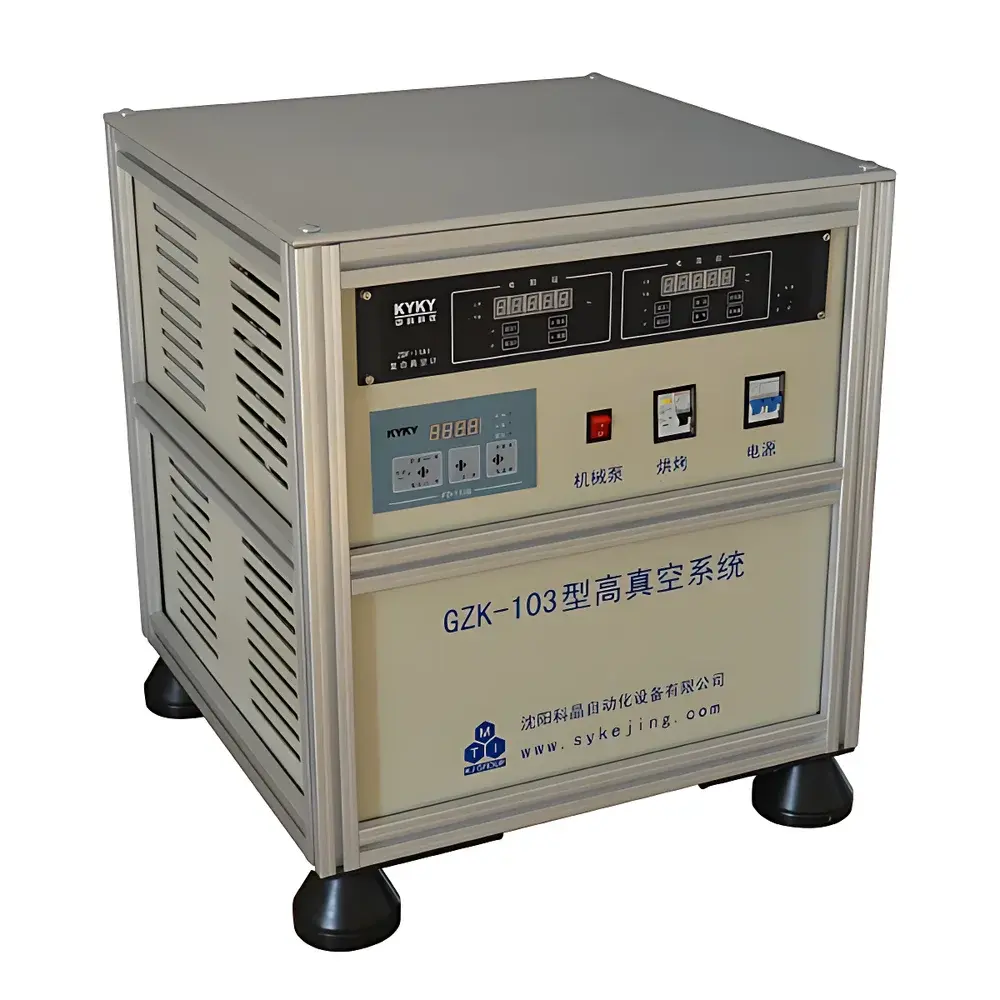
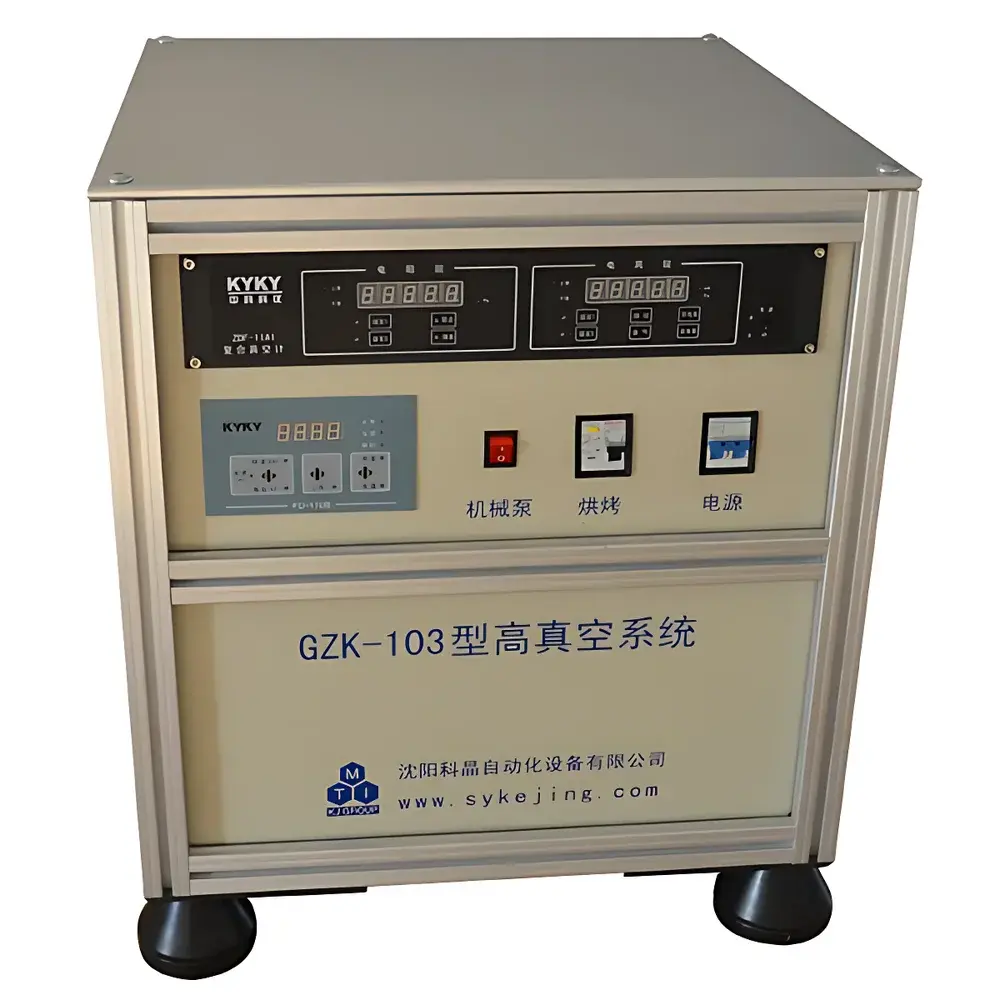
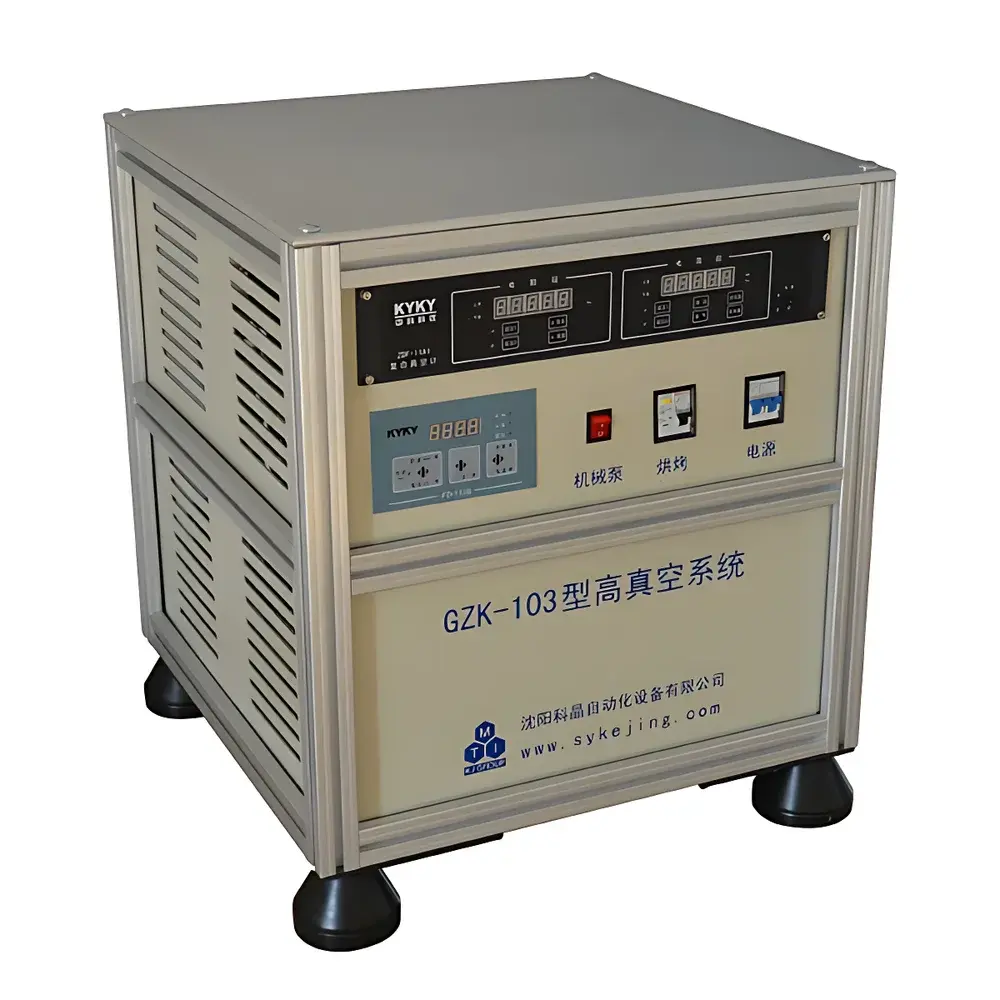
KJ GROUP GZK-103GS High-Vacuum System
| Brand | KJ GROUP |
|---|---|
| Origin | Liaoning, China |
| Manufacturer Type | Authorized Distributor |
| Country of Origin | China |
| Model | GZK-103GS |
| Quotation | Upon Request |
| Ambient Temperature | 5–32 °C |
| Relative Humidity | ≤80% |
| Input Voltage | 220 V ±10%, 50–60 Hz |
| Power Consumption | 1 kW |
| Ultimate System Vacuum | 1.0 × 10⁻⁴ Pa |
| Dimensions (W × D × H) | 600 × 600 × 750 mm |
| Mechanical Pump | 4 L/s pumping speed, 400 W motor, ultimate pressure 6 × 10⁻² Pa |
| Turbo Molecular Pump (F-100/110) | 100 L/s nominal pumping speed, ultimate pressure 6 × 10⁻⁶ Pa, startup time <2 min, rated speed 4300 rpm, air/water cooling |
| Turbo Pump Power Supply | 200–240 V input, 250 W output, acceleration time 3 min, output frequencies: high-speed 704 Hz ±10%, low-speed 430 Hz ±10% |
| ZDF-III Composite Vacuum Gauge | 220 V, 50–60 Hz |
| High-Vacuum Manual Isolation Valve | fluorocarbon elastomer (FKM) seal, quick-release CF flange, leak rate ≤5 × 10⁻⁹ Pa·m³/s |
| Stainless Steel Tubing & Fittings | electropolished 304/316 SS, welded joints with leak rate <1 × 10⁻⁹ Pa·m³/s |
Overview
The KJ GROUP GZK-103GS High-Vacuum System is a fully integrated, touch-screen controlled vacuum platform engineered for reproducible ultra-low-pressure environments in research and industrial thin-film, surface science, and materials processing applications. It operates on a two-stage pumping architecture: a primary rotary vane mechanical pump establishes rough vacuum (down to 6 × 10⁻² Pa), followed by a high-speed F-100/110 turbo molecular pump that achieves base pressures as low as 6 × 10⁻⁶ Pa at the pump inlet—and 1.0 × 10⁻⁴ Pa at the system chamber—under clean, bake-out–compatible conditions. The system’s core vacuum chamber, valves, and interconnects are constructed entirely from electropolished stainless steel (AISI 304/316), minimizing outgassing and enabling compatibility with UHV-compatible procedures such as thermal baking, plasma cleaning, or residual gas analysis. Its modular design adheres to ISO-KF and CF flange standards, facilitating straightforward integration into sputtering, evaporation, or CVD platforms.
Key Features
- Intuitive 7-inch capacitive touchscreen HMI displaying real-time pressure curves, pump status (rotational speed, temperature, vibration), valve positions, and alarm history—with one-touch start/stop sequencing.
- F-100/110 turbo molecular pump with dual-frequency control (430 Hz / 704 Hz) for optimized acceleration and stable operation across varying gas loads and backing pressures.
- ZDF-III composite vacuum gauge featuring simultaneous Pirani (10⁵–10⁻¹ Pa) and hot-cathode ionization (10²–10⁻⁵ Pa) measurement channels, with automatic range switching and overpressure protection (>10 Pa) to prevent filament damage.
- High-integrity sealing architecture: all static seals utilize FKM (fluoroelastomer) O-rings rated for continuous service up to 200 °C; dynamic seals meet ASTM F209 helium leak test specifications (≤5 × 10⁻⁹ Pa·m³/s).
- Electropolished stainless-steel piping and weldments certified to leak rates <1 × 10⁻⁹ Pa·m³/s per joint—verified per ISO 20483 and EN 1591-2 protocols—ensuring long-term vacuum integrity and minimal hydrocarbon contamination.
- Compact footprint (600 × 600 × 750 mm) with integrated power distribution, EMI-filtered AC inputs, and internal thermal management for stable operation within ambient ranges of 5–32 °C and ≤80% RH (non-condensing).
Sample Compatibility & Compliance
The GZK-103GS is designed for use with standard vacuum-compatible sample holders, substrate stages, and process tool interfaces (e.g., magnetron sputter sources, e-beam evaporators). Its chamber interface supports ISO-KF 40/50 and CF 63 flanges, permitting direct coupling to deposition systems requiring ≤10⁻⁴ Pa operating pressure. All wetted materials—including valves, gauges, and pump internals—comply with ASTM F519 hydrogen embrittlement requirements and meet RoHS Directive 2011/65/EU restrictions on hazardous substances. While not certified for medical device manufacturing under FDA 21 CFR Part 11, its logging-capable controller supports GLP-compliant audit trails when paired with external data acquisition software meeting ISO/IEC 17025 traceability requirements.
Software & Data Management
The embedded controller firmware records timestamped pressure, pump speed, temperature, and fault codes to internal flash memory (≥10,000 event capacity). Data export is supported via USB 2.0 (CSV format) for post-processing in MATLAB, Python (Pandas), or LabVIEW. Optional RS-485 Modbus RTU interface enables integration into SCADA or MES environments for centralized vacuum monitoring and preventive maintenance scheduling. No proprietary drivers or cloud dependencies are required; configuration and diagnostics are accessible solely through the local HMI or terminal-based serial commands (baud rate 9600, 8N1).
Applications
- Thin-film deposition (DC/RF sputtering, thermal/e-beam evaporation) requiring stable base pressures <5 × 10⁻⁴ Pa to minimize oxide formation and improve film stoichiometry.
- Surface analysis techniques including XPS, AES, and LEED, where hydrocarbon-free vacuum environments and low partial pressures of H₂O/O₂ are critical for spectral fidelity.
- Materials characterization under controlled vacuum: TGA-MS coupling, outgassing rate quantification per ASTM E595, and getter activation studies.
- R&D-scale vacuum metallurgy, including arc melting and directional solidification experiments requiring repeatable low-partial-pressure inert gas purging sequences.
- Calibration laboratories performing vacuum gauge intercomparison per ISO 3567 and JCGM 100:2008 (GUM) uncertainty propagation frameworks.
FAQ
What is the recommended maintenance interval for the F-100/110 turbo pump?
Under continuous operation at ≤30% duty cycle and clean gas loads, the manufacturer recommends inspection every 12 months—including bearing vibration analysis, rotor balance verification, and FKM seal replacement if exposed to aggressive vapors.
Can the system be upgraded to achieve UHV (<10⁻⁷ Pa)?
Yes—by adding a titanium sublimation pump (TSP) or non-evaporable getter (NEG) cartridge, implementing all-metal gate valves, and performing a full system bake-out at 150 °C for ≥24 hours, the GZK-103GS can reach base pressures approaching 2 × 10⁻⁷ Pa after stabilization.
Is the ZDF-III gauge compatible with data acquisition software like LabVIEW or Python?
The gauge itself provides analog 0–10 V outputs for each sensor channel; digital communication requires the optional RS-232 expansion module, which supports ASCII command sets documented in the ZDF-III Technical Manual Rev. 3.2.
Does the system include validation documentation for IQ/OQ protocols?
Factory-assembled units ship with a Certificate of Conformance (CoC) listing material certifications, leak test reports, and functional test logs. Full IQ/OQ documentation packages—including protocol templates and executed test records—are available as an add-on service upon order placement.
What electrical safety standards does the control cabinet meet?
The main distribution unit complies with IEC 61000-6-2 (immunity) and IEC 61000-6-4 (emission), and carries CE marking per Machinery Directive 2006/42/EC and Low Voltage Directive 2014/35/EU. Internal wiring follows UL 508A Class 1, Division 2 guidelines for industrial control panels.



