
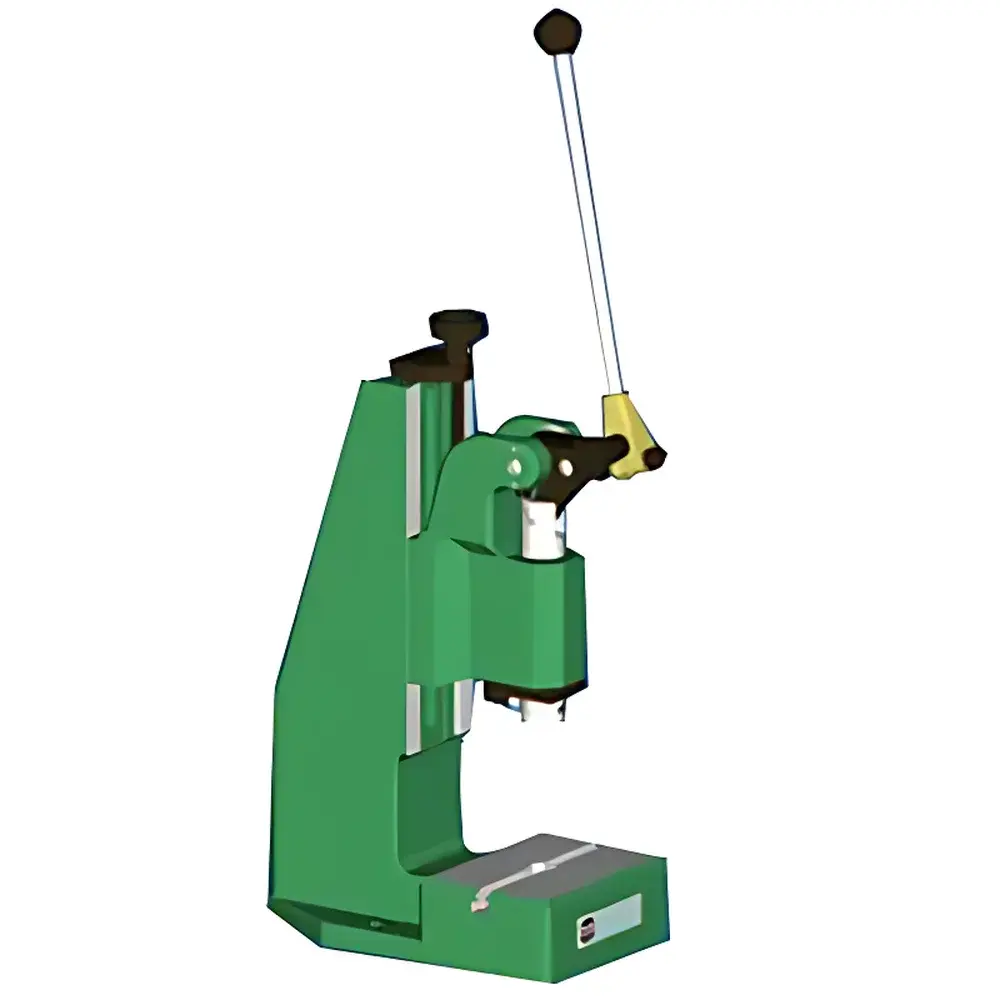
KJ GROUP HPM-12 Manual Hydraulic Pellet Press
| Brand | KJ GROUP |
|---|---|
| Origin | Liaoning, China |
| Manufacturer Type | Authorized Distributor |
| Country of Origin | China |
| Model | HPM-12 |
| Instrument Type | Manual Hydraulic Pellet Press |
| Max Force | 12,000 N |
| Stroke Range | 0–45 mm |
| Platen Dimensions | 150 mm × 110 mm |
| Platen Bore Diameter | Ø20H7 |
| Mounting Hole Diameter | Ø10H7 |
| Adjustable Height Range | 80–210 mm |
| Overall Dimensions (W×D×H) | 250 mm × 150 mm × 600 mm |
| Net Weight | 23 kg |
Overview
The KJ GROUP HPM-12 Manual Hydraulic Pellet Press is a compact, benchtop-scale hydraulic compaction system engineered for reproducible sample densification in analytical and materials science laboratories. It operates on a manually actuated hydraulic principle: user-applied force on the lever amplifies pressure via an integrated oil-filled cylinder, delivering precise, stepwise load application up to 12,000 N (equivalent to ~1.22 metric tons of force). Unlike purely mechanical screw presses, this design eliminates thread wear and provides smooth, controllable force ramping—critical for preparing uniform pellets from powders with varying compressibility (e.g., ceramic precursors, pharmaceutical blends, or spectroscopic standards). Its fixed-stroke architecture (0–45 mm) ensures consistent sample thickness control when used with standardized die sets, while the rigid cast-iron frame and precision-ground platens minimize deflection under load, supporting high geometric fidelity in pressed discs.
Key Features
- Compact footprint (250 mm × 150 mm base) and lightweight construction (23 kg) enable flexible placement on fume hoods, glovebox entries, or shared instrumentation benches.
- Adjustable platen height (80–210 mm range) accommodates diverse die configurations—including standard 13 mm, 20 mm, and custom-diameter dies—without requiring auxiliary spacers or shims.
- Platen surface features a precision-machined Ø20H7 through-bore (tolerance class H7: +0.021/0 mm), ensuring coaxial alignment of punches and minimizing lateral stress during compression.
- Mounting holes (Ø10H7) conform to ISO 2768-mK general tolerances, facilitating secure fastening to vibration-dampened optical tables or modular lab frames.
- Ergonomic two-stage lever mechanism reduces operator effort by >60% compared to direct-screw systems, improving repeatability across sequential runs and reducing fatigue during high-throughput sample prep.
Sample Compatibility & Compliance
The HPM-12 is routinely deployed in preparation of pellets for FTIR, XRF, XRD, and SEM-EDS analysis, where homogeneity, density uniformity, and edge integrity directly impact spectral baseline stability and quantitative accuracy. It supports common die materials including hardened stainless steel (AISI 420), tungsten carbide, and borosilicate glass—compatible with both organic binders (e.g., KBr, polyethylene) and inorganic matrices (e.g., boric acid, cellulose). While not certified to ISO/IEC 17025 as a standalone measurement device, its mechanical consistency enables adherence to ASTM E1902 (Standard Practice for Preparing KBr Disks for Infrared Spectroscopy) and USP <1116> (Microbiological Evaluation of Compaction Processes) when integrated into validated SOPs. All structural components meet RoHS Directive 2011/65/EU material restrictions.
Software & Data Management
As a manual hydraulic press, the HPM-12 does not incorporate embedded electronics, sensors, or digital interfaces. This analog architecture ensures electromagnetic compatibility (EMC) in RF-sensitive environments (e.g., near NMR spectrometers or electron microscopes) and eliminates firmware validation requirements under FDA 21 CFR Part 11. Load application is verified externally using calibrated load cells (e.g., Omega LCM series) or pressure transducers mounted in-line with the hydraulic line—data from which may be logged via third-party DAQ systems compliant with GLP/GMP audit trails. KJ GROUP provides traceable calibration documentation for platen parallelism (≤5 µm deviation over 150 mm) and bore concentricity (≤0.015 mm TIR), supporting laboratory quality system documentation.
Applications
- Preparation of infrared-transparent KBr pellets for qualitative and quantitative FTIR analysis of polymers, APIs, and excipients.
- Densification of metal oxide powders (e.g., TiO₂, Al₂O₃) prior to sintering trials or thermal conductivity testing.
- Compaction of geological samples (soils, sediments, ores) into stable discs for handheld XRF field screening or lab-based quantification.
- Forming binder-free pellets of battery cathode materials (e.g., LiCoO₂, NMC) for electrochemical impedance spectroscopy (EIS) electrode characterization.
- Creating reference standards for wavelength calibration in UV-Vis spectrophotometry using dye-doped polymer matrices.
FAQ
What is the maximum recommended operating pressure for routine use?
The HPM-12 is rated for continuous operation at 12,000 N; however, for optimal long-term seal integrity and platen longevity, KJ GROUP recommends limiting sustained loads to ≤10,000 N during daily workflows.
Can the HPM-12 be used with heated dies?
No—the unit lacks integrated heating elements or temperature-rated seals. For thermally assisted pressing, external furnace-compatible dies must be pre-heated separately and loaded rapidly to avoid thermal gradient-induced cracking.
Is die alignment verification required before each use?
Yes. Users should confirm punch-to-bore concentricity using a dial indicator (±0.02 mm tolerance) prior to pressing critical samples, particularly when switching between die sizes or after transport.
Does KJ GROUP supply compatible die sets?
Yes—standard offerings include 13 mm, 20 mm, and 25 mm diameter stainless steel dies with matching upper/lower punches and ejection sleeves, all manufactured to ISO 8062-2 CT4 dimensional tolerances.
What maintenance intervals are specified for hydraulic fluid?
The mineral oil-based hydraulic fluid requires replacement every 24 months or after 500 operational cycles—whichever occurs first—to maintain viscosity stability and prevent valve stiction.



