
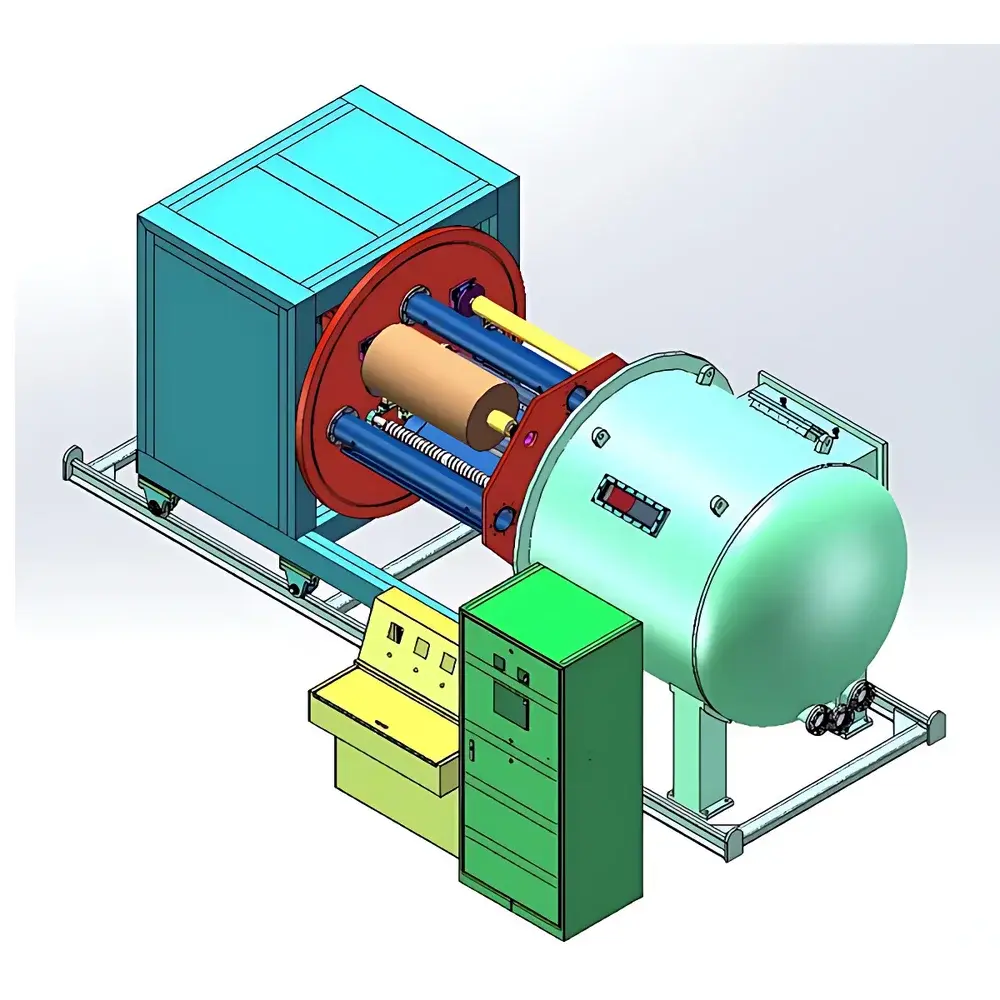
KJ GROUP KJ-MSR800 Magnetron Sputtering Roll-to-Roll Coater
| Brand | KJ GROUP |
|---|---|
| Origin | Liaoning, China |
| Manufacturer Type | Authorized Distributor |
| Country of Origin | China |
| Model | KJ-MSR800 |
| Coating Materials | PET, Nonwoven Fabric |
| Substrate Thickness | 125–300 µm |
| Effective Coating Width | ≤800 mm |
| Max Winding Diameter | Φ400 mm |
| Mandrel ID | 4 inches |
| Web Speed | 1–2 m/min |
| Web Tension Range | 30–200 N |
| Tension Control | AC Servo System |
| Sputtering Configuration | Single-Side |
| Base Vacuum (Empty, Clean) | ≤8×10⁻⁴ Pa |
| Pump-Down Time (10⁵ Pa → 5×10⁻³ Pa) | ≤60 min |
| System Leak Rate | ≤1.0×10⁻¹⁰ Pa·m³/s |
| Magnetron Cathodes | 3 units |
| Thickness Uniformity | ≤±10% |
Overview
The KJ GROUP KJ-MSR800 Magnetron Sputtering Roll-to-Roll Coater is an industrial-scale thin-film deposition system engineered for continuous, high-throughput vacuum coating of flexible substrates. It operates on the principle of magnetron sputtering—a plasma-based physical vapor deposition (PVD) technique in which energetic argon ions bombard a solid target material under controlled low-pressure conditions, ejecting atoms that subsequently condense as a uniform functional film on a moving web. Designed specifically for roll-to-roll (R2R) processing, the system integrates precision vacuum architecture, synchronized web handling, and multi-cathode magnetron configuration to enable reproducible deposition of conductive, magnetic, and dielectric layers on temperature-sensitive polymer and nonwoven substrates. Its modular design supports both DC and RF sputtering modes, accommodating conductive metals (Al, Cu), soft magnetic alloys (NiFe, CoFe), transparent conductive oxides (ITO analogs), and insulating dielectrics—making it suitable for R&D validation, pilot-line scaling, and low-volume production in flexible electronics, EMI shielding, smart packaging, and energy storage applications.
Key Features
- Triple-magnetron cathode configuration with independent power supplies—enabling co-sputtering, sequential layering, or process redundancy
- AC servo-driven tension control system with real-time feedback loop, maintaining stable web tension (30–200 N) across variable speeds (1–2 m/min)
- High-integrity UHV-compatible vacuum chamber with base pressure ≤8×10⁻⁴ Pa and leak rate ≤1.0×10⁻¹⁰ Pa·m³/s—verified per ISO 20483 and ASTM E595 outgassing protocols
- Optimized magnetic field geometry for enhanced plasma confinement and target utilization efficiency (>40%)—reducing material waste and operational cost
- 4-inch mandrel-compatible unwinding/rewinding stations with automatic edge-guidance and dancer-roll stabilization
- Single-side sputtering geometry with precisely aligned cathode-to-web distance and grounded shadow masking—ensuring minimal thermal load (<60 °C substrate temperature rise at 2 m/min)
Sample Compatibility & Compliance
The KJ-MSR800 accommodates standard flexible substrates including polyethylene terephthalate (PET) films (125–300 µm thickness) and nonwoven fabrics with surface roughness <5 µm Ra. Substrate compatibility has been validated per ISO 15184 (adhesion testing) and ASTM D3359 (cross-hatch tape test) for metallized layers. The system meets CE machinery directive requirements (2006/42/EC) and conforms to IEC 61000-6-2/6-4 for electromagnetic compatibility. Vacuum components comply with ASME B31.3 process piping standards, and all electrical interfaces adhere to UL 508A industrial control panel specifications. For regulated environments, optional audit trail logging and user-access controls support alignment with FDA 21 CFR Part 11 and EU Annex 11 documentation expectations.
Software & Data Management
The integrated control interface runs on a deterministic real-time OS with dual-channel data acquisition (1 kHz sampling). Process parameters—including voltage, current, pressure, web speed, tension, and cathode power—are logged synchronously with time-stamped metadata. Export formats include CSV, HDF5, and XML for traceable integration into LIMS or MES platforms. Optional software modules provide statistical process control (SPC) charts, layer-thickness prediction via in-situ optical monitoring (OES coupling ready), and recipe-based automation with version-controlled parameter sets. All system logs retain full GLP/GMP-compliant audit trails, including operator ID, timestamp, parameter changes, and alarm events.
Applications
- Manufacture of flexible transparent electrodes for touch sensors and OLED lighting substrates
- Deposition of soft magnetic shielding layers on nonwoven carriers for wearable EMI suppression
- R&D of bilayer and multilayer barrier stacks (e.g., Al + SiOx) for flexible food and pharmaceutical packaging
- Functionalization of medical-grade nonwovens with antimicrobial metallic coatings (Ag, Cu)
- Prototyping of thermoelectric or piezoresistive composite webs for IoT sensor integration
FAQ
What substrate widths and thicknesses are supported?
The system supports effective coating widths up to 800 mm and handles substrates from 125 µm to 300 µm thick, including PET, PI, and nonwoven materials with tensile modulus >150 MPa.
Can the system be upgraded for reactive sputtering (e.g., oxide or nitride deposition)?
Yes—optional mass flow controllers (MFCs) for O₂, N₂, or CH₄, along with process gas manifolds and plasma emission spectroscopy (OES) integration, are available as factory-installed upgrades.
Is remote diagnostics and service support available?
KJ GROUP provides secure remote access via encrypted VNC with prior authorization, enabling real-time troubleshooting and firmware updates compliant with ISO/IEC 27001 information security standards.
What vacuum pumping configuration is used?
The standard configuration includes a dry scroll backing pump paired with a turbomolecular pump (≥1200 L/s N₂ rating); cryogenic or oil-diffusion alternatives are available upon request.
How is film thickness uniformity verified and maintained?
Uniformity is validated using calibrated quartz crystal microbalances (QCMs) and confirmed post-deposition via XRF and four-point probe mapping; closed-loop correction is achievable via optional in-line ellipsometry integration.



