
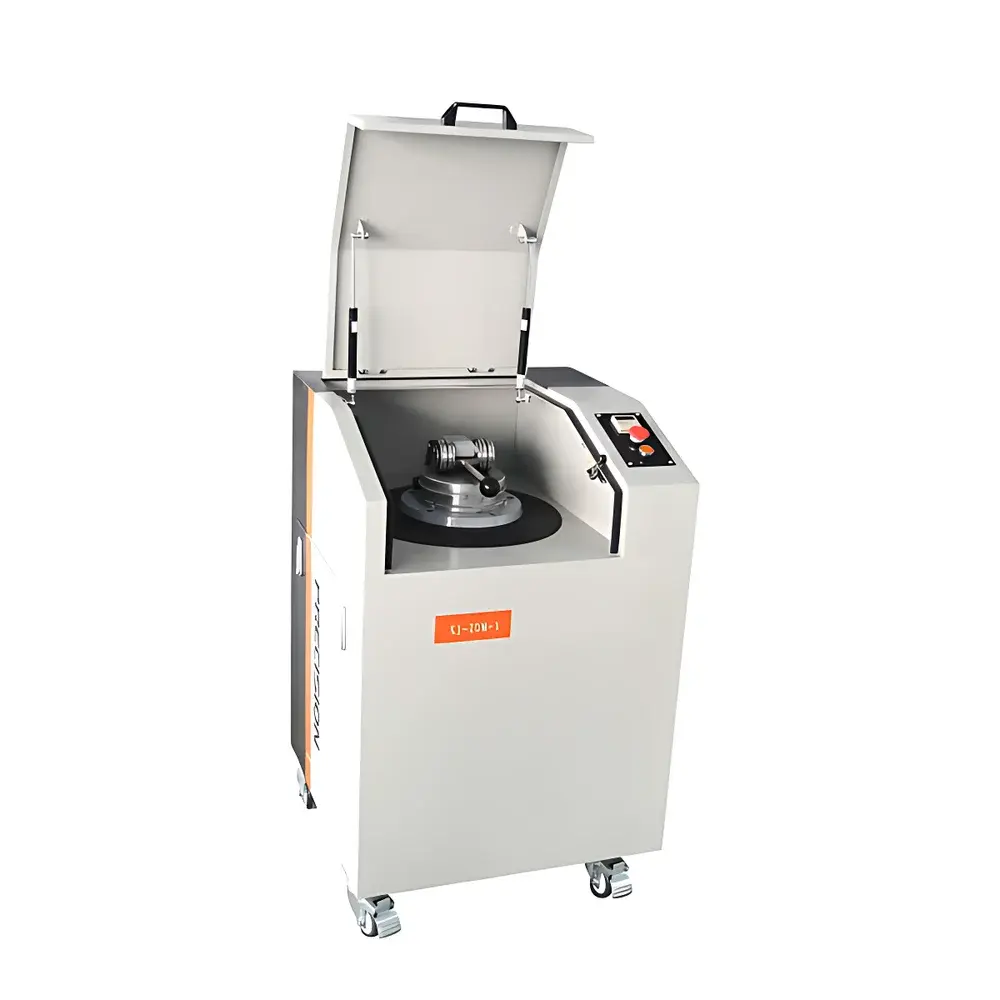
KJ GROUP KJ-ZDM-1 Vibratory Ball Mill
| Brand | KJ GROUP |
|---|---|
| Origin | Liaoning, China |
| Manufacturer Type | Authorized Distributor |
| Country of Origin | China |
| Model | KJ-ZDM-1 |
| Price | Upon Request |
| Power Supply | 3-phase 380 V AC |
| Rated Power | 1.5 kW |
| Grinding Chamber Material | Tungsten Carbide or Chromium Steel |
| Chamber Volume | > 2500 cm³ |
| Grinding Time Range | 0–999 s (adjustable) |
| Motor Speed | 1400 rpm |
| Max Feed Particle Size | ≤ 10 mm |
| Output Fineness | ≥ 50% passing through 200-mesh sieve (74 µm) |
| Dimensions (W×D×H) | 640 × 640 × 1000 mm |
| Net Weight | 200 kg |
Overview
The KJ GROUP KJ-ZDM-1 Vibratory Ball Mill is a high-efficiency, sealed mechanical comminution system engineered for reproducible sample preparation prior to X-ray fluorescence (XRF) spectroscopy and Fourier-transform infrared (FTIR) analysis. It operates on the principle of high-frequency vibrational energy transmission to grinding media—typically tungsten carbide or chromium steel balls—within a rigid, hermetically sealed chamber. This energy induces intense impact, shear, and attrition forces between the media and solid samples, enabling rapid size reduction of brittle, medium-hard materials. Designed for laboratory-scale homogenization and pulverization, the KJ-ZDM-1 delivers consistent particle size distribution without external dust extraction, making it suitable for regulated analytical workflows where operator exposure and cross-contamination must be minimized.
Key Features
- Hermetically sealed grinding chamber with dual-latch compression lid and integrated outer safety shroud—eliminates airborne particulate release and complies with OSHA 29 CFR 1910.1200 (Hazard Communication Standard) for handling fine powders.
- Multi-stage vibration isolation system—including rubber-damped base mounts and counterbalanced drive assembly—reduces operational noise to <72 dB(A) at 1 m distance and suppresses structural resonance during high-speed operation.
- Quick-release grinding pan mechanism enables tool-free chamber access in under 8 seconds, facilitating rapid cleaning, media replacement, or batch changeover.
- Pneumatically assisted clamping system ensures uniform sealing pressure across the chamber interface, preventing lid lift-off during 1400 rpm vibration cycles.
- Four lockable swivel casters with mechanical stoppers allow stable repositioning on standard lab flooring; no floor anchoring required, and lateral displacement is fully inhibited during active grinding.
- Digital timer with 1-second resolution (0–999 s) and automatic power cutoff provides precise process repeatability and supports SOP-driven operation in GLP-compliant environments.
Sample Compatibility & Compliance
The KJ-ZDM-1 accommodates feed materials up to 10 mm in maximum dimension and is optimized for brittle or moderately hard inorganic solids including ores, slag, cement clinker, ceramic raw materials, pharmaceutical excipients, coal ash, and geological core fragments. Its tungsten carbide or chromium steel grinding chamber resists abrasion and minimizes metallic contamination—critical for trace-element XRF quantification. The unit meets CE marking requirements for machinery safety (2006/42/EC), conforms to IEC 61000-6-3 (EMC emission limits), and supports compliance with ISO/IEC 17025:2017 Clause 6.4.3 regarding equipment suitability for intended analytical use. When operated per manufacturer instructions, it satisfies USP and ASTM C114-22 criteria for homogeneity and particle size control in reference material preparation.
Software & Data Management
The KJ-ZDM-1 is a standalone electromechanical instrument with no embedded microprocessor or digital interface. All operational parameters are set via front-panel rotary encoder and LED display. For auditability in regulated laboratories, users may integrate the mill into electronic lab notebook (ELN) systems via external time-stamped loggers or programmable logic controllers (PLCs). The timer’s fixed 1-second resolution enables full traceability of grinding duration, supporting 21 CFR Part 11-compliant data integrity when paired with validated electronic record systems. No firmware updates or software licensing is required.
Applications
- Preparation of pressed pellets for quantitative XRF analysis in metallurgical assay labs and mining QA/QC departments.
- Homogenization of heterogeneous mineral samples prior to FTIR spectral acquisition for phase identification.
- Routine pulverization of cement, limestone, and fly ash in construction materials testing per ASTM C114 and EN 196-2.
- Particle size conditioning of pharmaceutical tablet blends to meet USP fineness-of-grind specifications.
- Geological sample comminution for geochemical mapping, ensuring representative sub-sampling from bulk rock specimens.
- Research-grade powder synthesis support in materials science labs requiring controlled mechanical alloying or amorphization precursors.
FAQ
What grinding media are compatible with the KJ-ZDM-1?
Tungsten carbide and chromium steel balls (diameters 3–15 mm) are recommended; stainless steel media may be used for low-abrasion applications but are not advised for routine XRF sample prep due to potential Fe/Cr leaching.
Is the KJ-ZDM-1 suitable for wet grinding?
No—this model is designed exclusively for dry grinding. Introduction of solvents or slurries voids the seal integrity and violates operational safety protocols.
Can the grinding time be extended beyond 999 seconds?
No—the timer is hardware-limited to 999 s; longer durations require manual restart or integration with external sequencing controllers.
Does the unit include calibration documentation?
Factory calibration certificates for timer accuracy and motor speed verification are provided with each shipment; periodic verification against NIST-traceable tachometers and stopwatch standards is recommended annually.
What maintenance intervals are specified for the vibration isolation system?
Rubber damping elements should be inspected quarterly for cracking or compression set; replacement is advised every 24 months under continuous use or after 5000 operational cycles.



