
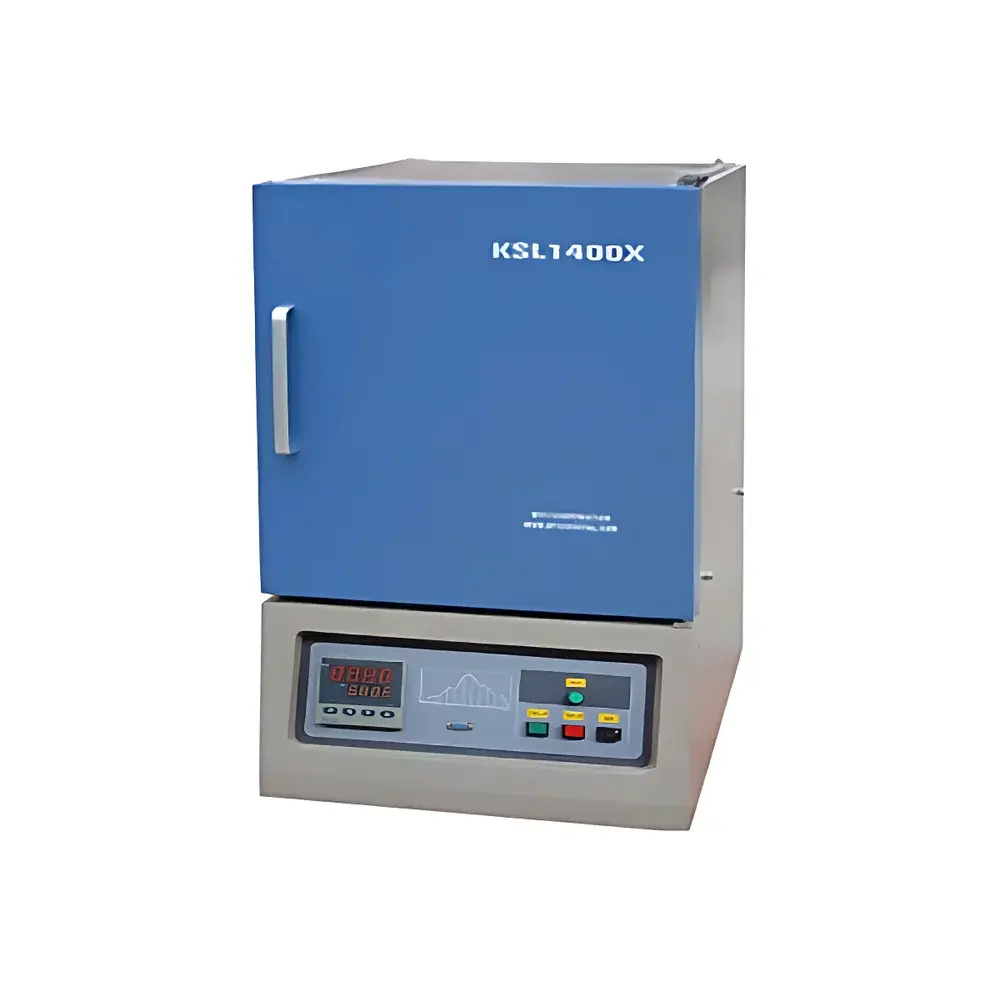
KJ GROUP KSL-1400X-A3 High-Temperature Box Furnace (19 L, 1400 °C)
| Brand | KJ GROUP |
|---|---|
| Origin | Anhui, China |
| Model | KSL-1400X-A3 |
| Maximum Temperature | 1400 °C (continuous operation ≤1300 °C) |
| Temperature Control Accuracy | ±1 °C |
| Power Supply | AC 220 V, 50 Hz, 9 kW |
| Heating Rate (to max temp) | 10 °C/min |
| Heating Element | Silicon Carbide (SiC) Rods |
| Internal Chamber Dimensions | 250 mm × 300 mm × 250 mm (19 L volume) |
| Chamber Lining | High-purity polycrystalline alumina fiber with US-imported alumina reflective coating |
| Temperature Sensor | Type S single-platinum/rhodium thermocouple |
| Controller | PID-based 30-segment programmable temperature controller |
| Certification | CE compliant |
| External Dimensions | 600 mm × 650 mm × 560 mm |
| Safety Design | Dual-layer steel housing with surface temperature <60 °C under full load |
Overview
The KJ GROUP KSL-1400X-A3 is a precision-engineered high-temperature box furnace designed for controlled thermal processing in research laboratories, materials science facilities, and quality control environments. Operating on the principle of resistive heating via silicon carbide (SiC) rod elements, it delivers stable, uniform, and repeatable thermal profiles up to 1400 °C — with continuous operation rated at ≤1300 °C to ensure long-term component reliability. The furnace integrates a Type S single-platinum/rhodium thermocouple for high-accuracy temperature sensing across its operational range, coupled with a microprocessor-based PID controller enabling precise closed-loop regulation. Its chamber employs high-purity polycrystalline alumina fiber insulation — a low-thermal-conductivity, high-temperature-stable material — combined with a proprietary US-sourced alumina reflective coating applied to interior surfaces. This dual-layer thermal architecture enhances radiant efficiency, reduces energy consumption during ramp-hold cycles, and extends service life under repeated thermal cycling.
Key Features
- Dual-shell steel construction with forced-air interstitial cooling, maintaining external surface temperature below 60 °C during sustained operation at 1300 °C — critical for lab safety and adjacent equipment protection.
- 30-segment programmable PID temperature controller supporting complex thermal protocols (e.g., multi-step sintering, controlled oxidation, annealing, and ashing), with real-time monitoring and manual override capability.
- Optimized chamber geometry (250 × 300 × 250 mm; 19 L usable volume) balances sample capacity with thermal homogeneity — validated per ASTM E220 for thermocouple calibration uniformity across the working zone.
- Silicon carbide heating elements mounted in protected lateral configurations ensure symmetrical heat distribution and minimize hot-spot formation — essential for reproducible ceramic sintering and metallurgical heat treatment.
- CE-marked design compliant with EN 61000-6-3 (EMC emission) and EN 61000-6-2 (immunity), meeting baseline electrical safety and electromagnetic compatibility requirements for EU laboratory deployment.
Sample Compatibility & Compliance
The KSL-1400X-A3 accommodates standard crucibles (alumina, quartz, graphite), ceramic substrates, metal powders, and oxide precursors. It is not rated for vacuum or inert-gas purging beyond ambient atmospheric pressure; therefore, operation with flammable, explosive, or highly corrosive atmospheres (e.g., H₂, NH₃, SO₂, Na vapor) requires prior consultation and optional chamber modifications — including specialized refractory coatings and gas-tight door seals. While not intrinsically explosion-proof, its open-atmosphere configuration aligns with OSHA 1910.1200 (Hazard Communication) and IEC 61000-4-30 power quality standards. For GLP/GMP-regulated workflows, the controller supports audit-trail-capable data logging when interfaced with third-party software (RS485 Modbus RTU protocol).
Software & Data Management
The integrated 518P-series intelligent temperature controller provides local setpoint programming, real-time temperature display, and alarm thresholds (over-temperature, thermocouple break). Though the base unit lacks embedded Ethernet or USB, it supports analog voltage output (0–5 V or 4–20 mA) and digital RS485 Modbus RTU communication for integration into centralized SCADA or LIMS platforms. Users may export time-stamped temperature logs via external data acquisition systems compliant with FDA 21 CFR Part 11 requirements — provided appropriate electronic signature and audit trail configurations are implemented at the host system level. Firmware updates are performed via proprietary serial interface; no cloud connectivity or remote firmware patching is supported.
Applications
- Ceramic sintering and densification studies (e.g., Al₂O₃, ZrO₂, SiC) requiring precise dwell control at 1200–1400 °C.
- Thermal gravimetric analysis (TGA) pre-conditioning and residue ashing per ISO 1171 and ASTM D3174.
- Heat treatment of metallic alloys and intermetallics, including stress-relief annealing and phase transformation studies.
- Electrode calcination for battery material R&D (e.g., LiCoO₂, NMC cathodes) under air or controlled O₂ flow.
- Calibration of secondary temperature sensors using fixed-point reference materials traceable to NIST SRMs.
FAQ
What is the recommended maximum ramp rate for extended heater life?
For optimal longevity of silicon carbide rods and insulation integrity, maintain heating and cooling rates at or below 10 °C/min — consistent with manufacturer-recommended thermal stress limits per IEC 60584-2.
Can this furnace be used under reducing or inert atmospheres?
The standard configuration is air-atmosphere only. Optional modifications — including gas inlet/outlet ports, flanged door seals, and alumina-coated chamber liners — are available upon request for N₂ or Ar purging; H₂ compatibility requires engineering review.
Is the temperature uniformity profile documented?
Yes — typical radial and axial uniformity within the central 75% of the chamber is ±5 °C at 1300 °C, verified using three-point thermocouple mapping per ASTM E220 Annex A3.
Does the unit support compliance with ISO/IEC 17025 calibration requirements?
While the furnace itself is not a calibrated instrument, its Type S thermocouple and controller are compatible with external calibration procedures traceable to national metrology institutes; users must perform periodic verification using certified reference thermocouples.



