
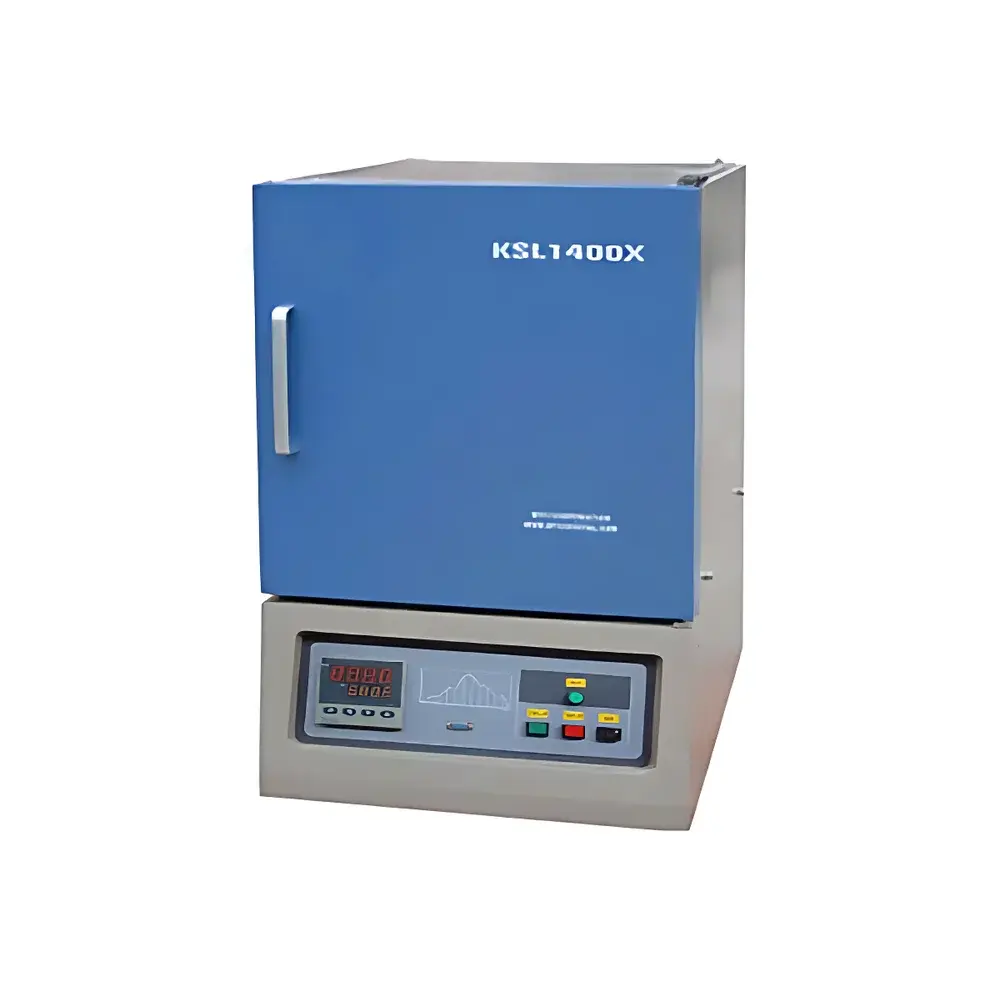
KJ GROUP KSL-1400X-A4 36L High-Temperature Box Furnace
| Brand | KJ GROUP |
|---|---|
| Origin | Anhui, China |
| Manufacturer Type | Authorized Distributor |
| Instrument Type | Box Furnace |
| Max Operating Temperature | 1400 °C (continuous use ≤1300 °C) |
| Temperature Uniformity | ±1 °C |
| Power Supply | AC 220 V, 50 Hz, 15 kW |
| Heating Rate (to max temp) | 10 °C/min |
| Heating Element | Silicon Carbide Rods |
| Chamber Dimensions | 300 mm × 400 mm × 300 mm (36 L) |
| External Dimensions | 650 mm × 760 mm × 1550 mm |
| Net Weight | 140 kg |
| Thermal Insulation | High-Purity Alumina Microfiber + Imported Al₂O₃ Reflective Coating |
| Control System | PID-Based 30-Stage Programmable Controller |
| Thermocouple | Type S (Platinum-Rhodium/Platinum) |
| Safety Certification | CE compliant |
| Cooling Method | Forced-air dual-shell cooling |
| Surface Temperature | <60 °C at ambient conditions |
Overview
The KJ GROUP KSL-1400X-A4 is a precision-engineered 36 L high-temperature box furnace designed for rigorous laboratory and R&D applications requiring stable thermal environments up to 1400 °C. Built upon a robust dual-layer steel housing with forced-air interstitial cooling, the furnace maintains external surface temperatures below 60 °C during continuous operation — a critical safety feature in shared lab spaces. Its chamber is lined with high-purity alumina microcrystalline fiber insulation, offering low thermal conductivity and exceptional resistance to thermal shock. A proprietary U.S.-sourced alumina reflective coating applied to the inner furnace wall enhances infrared reflectivity, improves heating efficiency by minimizing radiant heat loss, and extends structural integrity over repeated thermal cycles. Temperature measurement and regulation rely on a calibrated Type S (Platinum–10% Rhodium / Platinum) thermocouple — the international standard for high-temperature metrology above 1000 °C — interfaced with a microprocessor-based PID controller capable of executing up to 30 programmable ramp-hold segments. This architecture ensures reproducible thermal profiles essential for sintering, annealing, ashing, and ceramic phase transformation studies.
Key Features
- Dual-shell construction with active air-gap cooling ensures operator safety and minimizes ambient heat load in laboratory environments.
- High-density alumina microfiber insulation (≥99.7% Al₂O₃) provides superior thermal retention and long-term dimensional stability at elevated temperatures.
- Internally coated furnace chamber with imported alumina reflective layer increases radiant efficiency and mitigates localized hot spots.
- 30-stage programmable PID temperature controller enables precise thermal profiling — including controlled ramp rates, dwell times, and multi-step cooling sequences.
- Silicon carbide (SiC) heating elements deliver uniform radiant heating across the full chamber volume and exhibit excellent longevity under cyclic thermal stress.
- CE-marked design complies with EU Machinery Directive 2006/42/EC and Low Voltage Directive 2014/35/EU for safe integration into regulated research infrastructure.
Sample Compatibility & Compliance
The KSL-1400X-A4 accommodates standard ceramic crucibles (alumina, zirconia), graphite boats, and metal sample holders within its 300 × 400 × 300 mm chamber. It is compatible with inert (N₂, Ar), reducing (H₂/N₂ mixtures), and weakly oxidizing atmospheres; however, it is not rated for vacuum or explosive gas environments. Users intending to introduce corrosive gases (e.g., SO₂, H₂S, Na vapor) must consult technical support prior to operation — optional alumina-enhanced chamber treatments are available upon request. The furnace meets GLP-aligned documentation requirements: all temperature setpoints, actual readings, and program logs can be timestamped and exported via RS485 interface for audit-ready recordkeeping. While not intrinsically compliant with FDA 21 CFR Part 11, its data output supports integration into validated LIMS or ELN platforms when paired with compliant acquisition software.
Software & Data Management
The integrated controller supports real-time temperature monitoring and manual override via front-panel keypad and LED display. For advanced data handling, an RS485 serial port enables bidirectional communication with third-party SCADA systems or custom Python/LabVIEW scripts. Optional USB-to-RS485 adapters facilitate direct PC connection for automated logging using open-source tools (e.g., Modbus RTU polling). All thermal programs are stored non-volatily; power interruption recovery retains the last executed segment. Firmware updates are performed via secure UART protocol — no cloud dependency or proprietary software installation required. Raw thermocouple voltage outputs (mV) and digital PID parameters (KP, TI, TD) remain accessible for metrological traceability and calibration verification per ISO/IEC 17025 guidelines.
Applications
- Ceramic and powder metallurgy: densification sintering of oxides (Al₂O₃, ZrO₂), nitrides (Si₃N₄), and carbides (SiC).
- Materials science: phase diagram validation, grain growth kinetics, and thermal stability assessment of battery cathode precursors (e.g., NMC, LFP).
- Geological research: simulated metamorphic conditions for mineral dehydration reactions and silicate melt equilibria.
- Environmental testing: quantitative ash content determination in ASTM D3174-compliant coal and biomass analysis.
- Quality control labs: heat treatment validation for aerospace alloys and medical-grade stainless steels per AMS 2750E pyrometry requirements.
FAQ
What is the maximum recommended continuous operating temperature?
Continuous operation is rated at ≤1300 °C to ensure optimal heating element service life and thermal stability. Short-term excursions to 1400 °C are permissible for process qualification but should not exceed 30 minutes per cycle.
Can this furnace be used under vacuum or with reactive gases?
No. The KSL-1400X-A4 lacks vacuum sealing and gas-tight flanges. It is unsuitable for hydrogen embrittlement studies or pyrolysis under reducing atmospheres without supplementary engineering modifications.
How often does the furnace require recalibration?
Annual verification against NIST-traceable reference standards is recommended. The Type S thermocouple should be inspected visually for grain growth or contamination before each high-temperature campaign.
Is the chamber coating repairable if cracked?
Yes. Minor microcracking in the alumina reflective layer is normal after thermal cycling and does not impair performance. Repainting with KJ GROUP’s certified alumina suspension (Cat. No. AL-COAT-1400) restores emissivity and protects underlying fiber insulation.
Does the unit include data export capability for regulatory submissions?
Raw temperature logs (CSV format) and program execution reports can be exported via RS485. When integrated with 21 CFR Part 11-compliant acquisition software, full electronic signature and audit trail functionality is achievable.



