
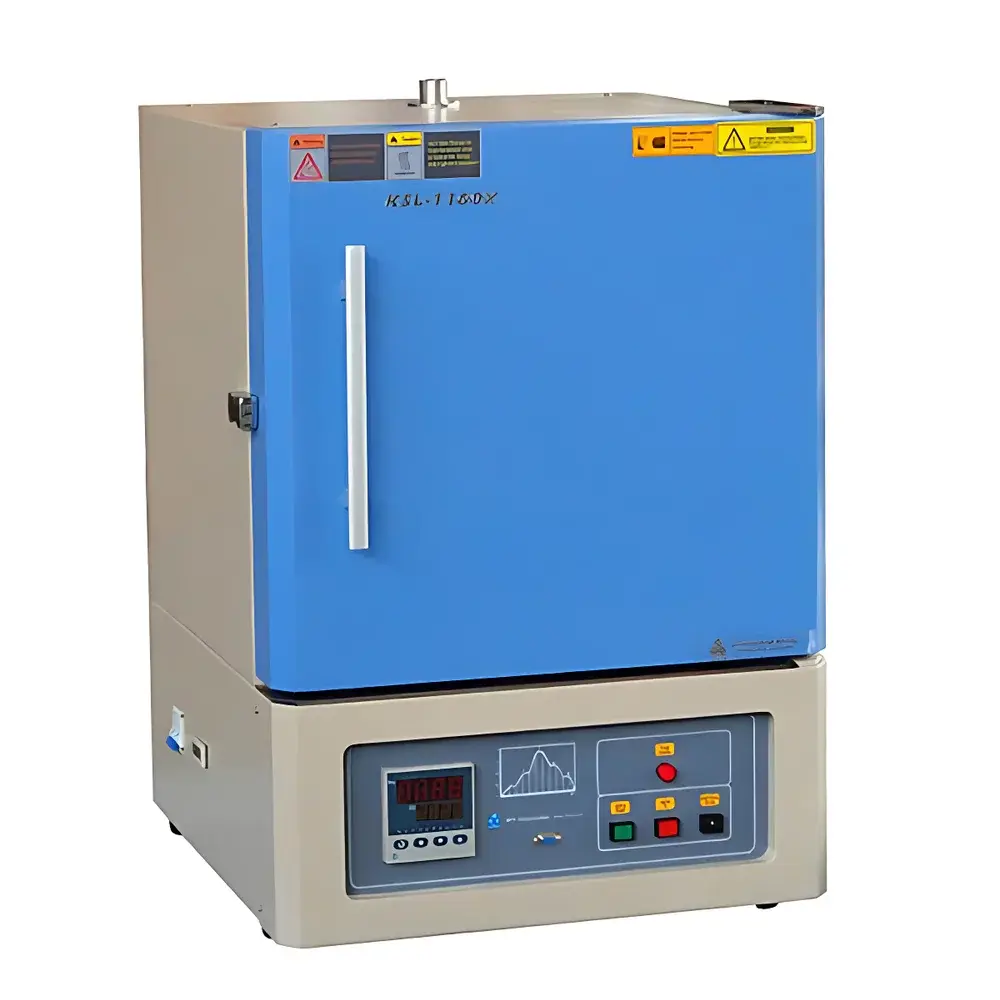
KJ GROUP KSL-1700X-S 1.8L High-Temperature Box Furnace (1700°C)
| Brand | KJ GROUP |
|---|---|
| Origin | Anhui, China |
| Model | KSL-1700X-S |
| Maximum Operating Temperature | ≤1700°C continuous, 1650°C rated |
| Temperature Uniformity | ±1°C |
| Power Supply | AC 220V, 50 Hz, 2 kW |
| Heating Rate | 10°C/min (to max temperature) |
| Heating Element | Silicon Molybdenum (MoSi₂) Rods |
| Chamber Dimensions | 120 mm × 120 mm × 120 mm (1.728 L ≈ 1.8 L nominal) |
| Thermocouple Type | Type B (PtRh30/PtRh6) Dual-Element |
| Control System | PID-Based 30-Stage Programmable Controller |
| Certification | CE Marked |
| External Dimensions | 480 mm × 480 mm × 790 mm |
| Net Weight | 70 kg |
Overview
The KJ GROUP KSL-1700X-S is a compact, high-temperature box furnace engineered for precision thermal processing in research laboratories and quality control environments. Designed around the fundamental principles of resistive heating via silicon molybdenum (MoSi₂) elements and calibrated thermometric feedback using dual-element Type B platinum-rhodium thermocouples, this furnace delivers stable, repeatable operation up to 1700°C under continuous duty conditions. Its 1.8-liter chamber—defined by internal dimensions of 120 mm × 120 mm × 120 mm—provides sufficient volume for small-scale sintering, annealing, ashing, calcination, and heat treatment of ceramics, metals, and advanced functional materials. The downward-opening door facilitates ergonomic sample loading and minimizes thermal loss during access. Integrated gas inlet/outlet ports (optional configuration) allow controlled atmosphere operation—including oxidizing (air/O₂), inert (N₂, Ar), or reducing (H₂/N₂ mixtures)—subject to user-supplied gas handling systems and safety interlocks. The furnace’s structural integrity is reinforced by a multi-layer insulation system, including high-purity alumina fiber board and an inner lining coated with U.S.-sourced alumina reflective coating, which enhances radiant efficiency and extends refractory life.
Key Features
- High-stability MoSi₂ heating elements with low aging rate and excellent oxidation resistance above 1500°C
- PID-controlled 30-segment programmable temperature profile capability for complex thermal cycles (e.g., ramp-hold-cool sequences)
- Dual-element Type B thermocouple with redundancy for improved measurement reliability and drift compensation
- CE-compliant electrical architecture meeting EN 61000-6-3 (EMC) and EN 61000-6-2 (immunity) standards
- Alumina-coated interior surface enhancing infrared reflectivity and minimizing energy consumption
- Robust mechanical design with reinforced steel casing and ceramic fiber insulation rated for >1700°C service
- Front-panel digital controller with real-time temperature display, setpoint adjustment, and alarm indicators (over-temperature, thermocouple break)
Sample Compatibility & Compliance
The KSL-1700X-S accommodates standard crucibles (alumina, zirconia, graphite, or quartz depending on atmosphere and temperature), small ingots, powder compacts, thin films on substrates, and micro-components used in electronic ceramics or battery material synthesis. It supports ASTM C1271 (high-temperature flexural testing), ISO 5660-1 (fire reaction calorimetry pre-conditioning), and USP heavy metal residue ashing protocols when operated within validated temperature ranges. While not vacuum-rated, it is compatible with positive-pressure inert or oxidizing atmospheres per ISO 8501-1 surface preparation standards. Users must implement external gas flow controllers, pressure relief valves, and leak detection per local occupational safety regulations (OSHA 1910.101, EU Directive 2014/34/EU ATEX for optional gas configurations). Corrosive gases (e.g., H₂S, Cl₂, Na vapor) require prior consultation for custom alumina-zirconia composite lining upgrades.
Software & Data Management
The integrated controller supports RS485 Modbus RTU communication for integration into centralized lab automation platforms (e.g., LabVIEW, SCADA, or LIMS). Optional USB data logging enables timestamped temperature acquisition at user-defined intervals (1–60 sec resolution), generating CSV files compliant with GLP audit requirements. Firmware supports configurable alarm thresholds, password-protected parameter editing, and event logging (start/stop, program completion, fault codes) with retention for ≥10,000 entries. All firmware updates are delivered via signed binary packages traceable to KJ GROUP’s ISO 9001:2015 certified development process. Data export meets FDA 21 CFR Part 11 requirements when paired with validated third-party software implementing electronic signatures and audit trail functionality.
Applications
- Sintering of oxide and non-oxide ceramics (Al₂O₃, ZrO₂, SiC, Si₃N₄)
- Heat treatment of refractory metal alloys (Mo, W, Nb) and high-entropy alloys
- Thermal decomposition studies of precursors in solid-state battery cathode synthesis
- Ashing of biological or polymer samples for elemental analysis (ICP-OES/MS)
- Calibration of high-temperature sensors and reference materials
- Pre-firing of LTCC/HTCC substrates in microelectronics packaging R&D
- Controlled oxidation of graphene oxide or transition metal dichalcogenides
FAQ
What is the recommended maximum heating and cooling rate for long-term stability?
For optimal element longevity and thermal shock mitigation, KJ GROUP recommends limiting ramp rates to ≤10°C/min for both heating and cooling phases.
Can this furnace be used under vacuum conditions?
No—the KSL-1700X-S lacks vacuum-tight seals and is not rated for sub-atmospheric operation. Vacuum compatibility requires alternative models with flanged construction and O-ring sealing.
Is the alumina coating repairable if damaged during use?
Yes; minor surface cracks in the coating do not impair performance and can be refurbished using KJ GROUP’s OEM alumina slurry (Part No. KSL-ALC-REFIT), applied per provided technical bulletin.
Are corrosion-resistant modifications available for sulfur-containing atmospheres?
Yes—upon request and subject to engineering review, the furnace chamber can be upgraded with a stabilized zirconia-alumina composite liner and modified gas port seals to accommodate H₂S or SO₂ service.
Does the unit include documentation required for IQ/OQ validation?
Standard delivery includes Factory Acceptance Test (FAT) report, CE Declaration of Conformity, and calibration certificate for the installed Type B thermocouple. Full GMP-compliant IQ/OQ protocol templates are available upon request for qualified customers.
Related Products



