
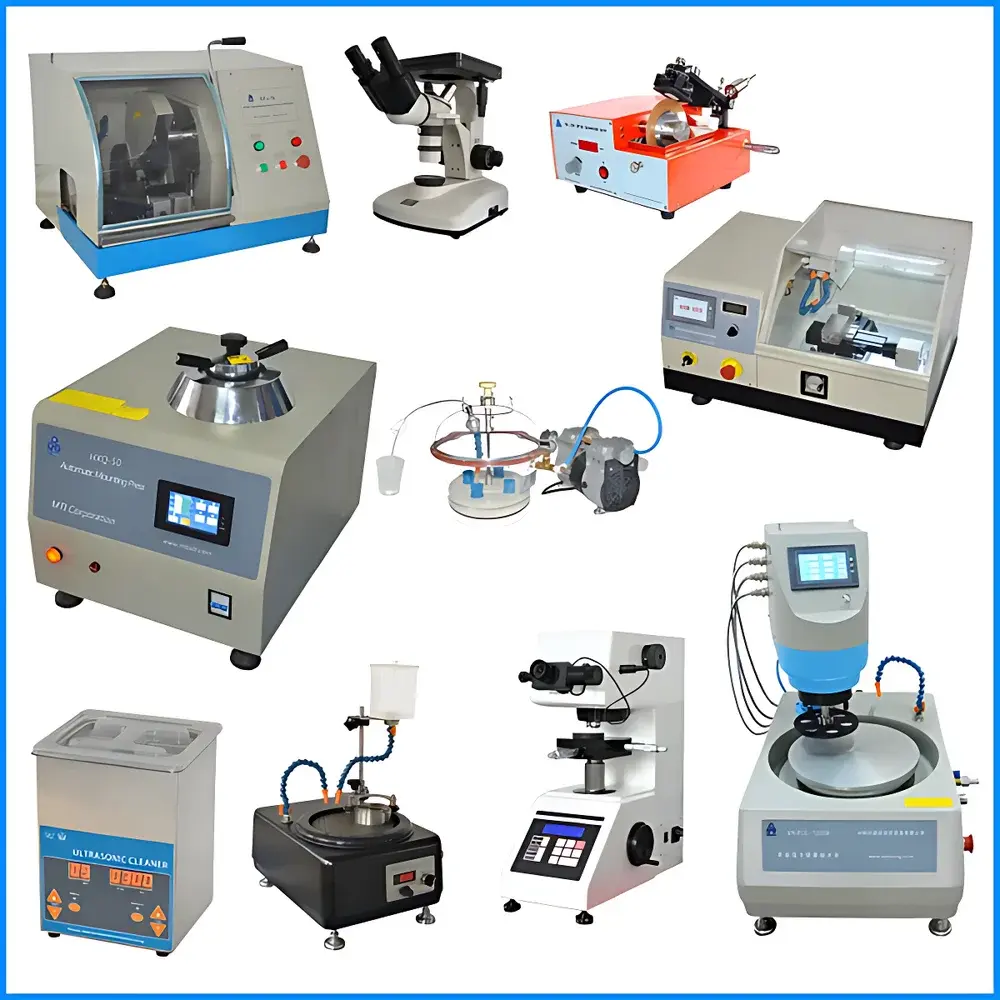
KJ GROUP Metallographic Preparation System – Practical Series
| Brand | KJ GROUP |
|---|---|
| Origin | Liaoning, China |
| Manufacturer Type | Authorized Distributor |
| Country of Origin | China |
| Model | Metallographic Preparation System – Practical Series |
| Pricing | Available Upon Request |
Overview
The KJ GROUP Metallographic Preparation System – Practical Series is an integrated, workflow-optimized solution engineered for reliable and reproducible metallographic specimen preparation in academic laboratories, quality control departments, and industrial R&D facilities. This system implements standardized ASTM E3, ISO 14978, and GB/T 13298–2015-compliant procedures across all critical stages: sectioning, mounting, grinding & polishing, ultrasonic cleaning, microstructural analysis, and hardness evaluation. Unlike modular or single-function instruments, this series ensures process continuity through mechanical and dimensional compatibility among subsystems—e.g., standardized sample diameters (25 mm and 30 mm), consistent chuck interfaces, and synchronized rotational speed ranges—minimizing operator-induced variability and enabling GLP-aligned documentation pathways.
Key Features
- Multi-stage integration: Fully coordinated hardware suite covering sectioning (high-precision low-speed diamond saws and precision abrasive cutters), cold/hot mounting (vacuum-assisted cold embedding and programmable hot compression), planarization (dual-mode grinding/polishing with adjustable pressure and rotational control), ultrasonic cleaning (frequency-stabilized 40 kHz transducers), and microhardness/microstructural characterization.
- Process traceability support: All major instruments—including the HX-1000TM automatic turret Vickers hardness tester and UNIPOL-1200M automated grinder-polisher—feature RS-232/USB connectivity for external data logging and optional integration with LIMS-compatible software environments.
- Operator safety and consistency: SYJ-series cutters incorporate transparent safety shields, emergency stop circuits, and coolant recirculation; CXQ-2500 cold mounting station includes vacuum integrity monitoring and temperature-compensated resin dispensing; HXQ-50 hot press offers PID-controlled heating and programmable dwell cycles.
- Scalable consumables ecosystem: Pre-validated consumables—including SiC abrasive papers (240–2000 grit), diamond suspensions (W9–W0.25), colloidal silica (W0.05), thermosetting phenolic resins, and vacuum-compatible mounting molds—are supplied with lot-specific QC certificates and storage stability data.
Sample Compatibility & Compliance
The system accommodates metallic specimens ranging from soft aluminum alloys to hardened tool steels (HRC 65+), sintered ceramics, and composite laminates. Sectioning tools support samples up to 150 mm in diameter; mounting stations accept irregular geometries via custom mold inserts. All instruments comply with IEC 61000-6-2 (EMC immunity) and IEC 61000-6-4 (EMC emission) standards. The HX-1000TM hardness tester meets ASTM E92 and ISO 6507-1 requirements for load application accuracy (±1.0% of set load) and indenter alignment tolerance (<0.5 µm deviation). The 4XB metallurgical microscope supports objective lenses calibrated per ISO 10110-5, with magnification verification traceable to NIST-traceable stage micrometers.
Software & Data Management
While core instruments operate via intuitive front-panel controls, optional PC-based software modules enable method storage, parameter recall, and audit trail generation. The UNIPOL-1200M and HX-1000TM support timestamped CSV export of grinding parameters (rpm, pressure, time) and hardness test records (load, dwell time, diagonal lengths, HV calculation). For regulated environments, optional 21 CFR Part 11-compliant software packages provide electronic signatures, user role management, and immutable audit logs—fully compatible with GMP/GLP documentation workflows.
Applications
- Failure analysis of turbine blades, weld joints, and additive-manufactured components
- Grain size quantification per ASTM E112 and ISO 643 using calibrated 4XB imaging
- Case depth measurement in carburized or nitrided steels via microhardness gradient profiling
- Pore analysis in powder metallurgy parts using stereological assessment on digitized micrographs
- Intermetallic phase identification in Al–Li and Ti–Al alloys under polarized illumination
FAQ
Does the system support fully automated end-to-end preparation?
The Practical Series enables semi-automated workflows—e.g., programmable grinding/polishing cycles and auto-turret hardness testing—but does not include robotic sample transfer. Full automation requires integration with third-party track systems.
Are consumables certified for ISO/IEC 17025-accredited labs?
Yes—abrasive papers, diamond suspensions, and mounting resins are supplied with CoA documents referencing inter-laboratory round-robin validation data per ISO/IEC 17025 Clause 5.6.
Can the 4XB microscope be upgraded for digital image analysis?
Yes—the standard trinocular port accepts C-mount CCD/CMOS cameras; optional software modules support grain boundary tracing, phase fraction analysis, and ASTM E112 intercept counting.
What maintenance intervals are recommended for the SYJ-150 low-speed cutter?
Coolant filter replacement every 200 operating hours; spindle bearing inspection annually or after 1,000 cutting cycles; diamond blade calibration verified prior to each high-precision run.
Is vacuum storage capability validated for moisture-sensitive intermetallic samples?
The ZKC-250 chamber maintains ≤10⁻² mbar for >72 h with leak rate <5×10⁻⁴ mbar·L/s, verified per ISO 20483 Annex B protocols for long-term microstructural stabilization.



