
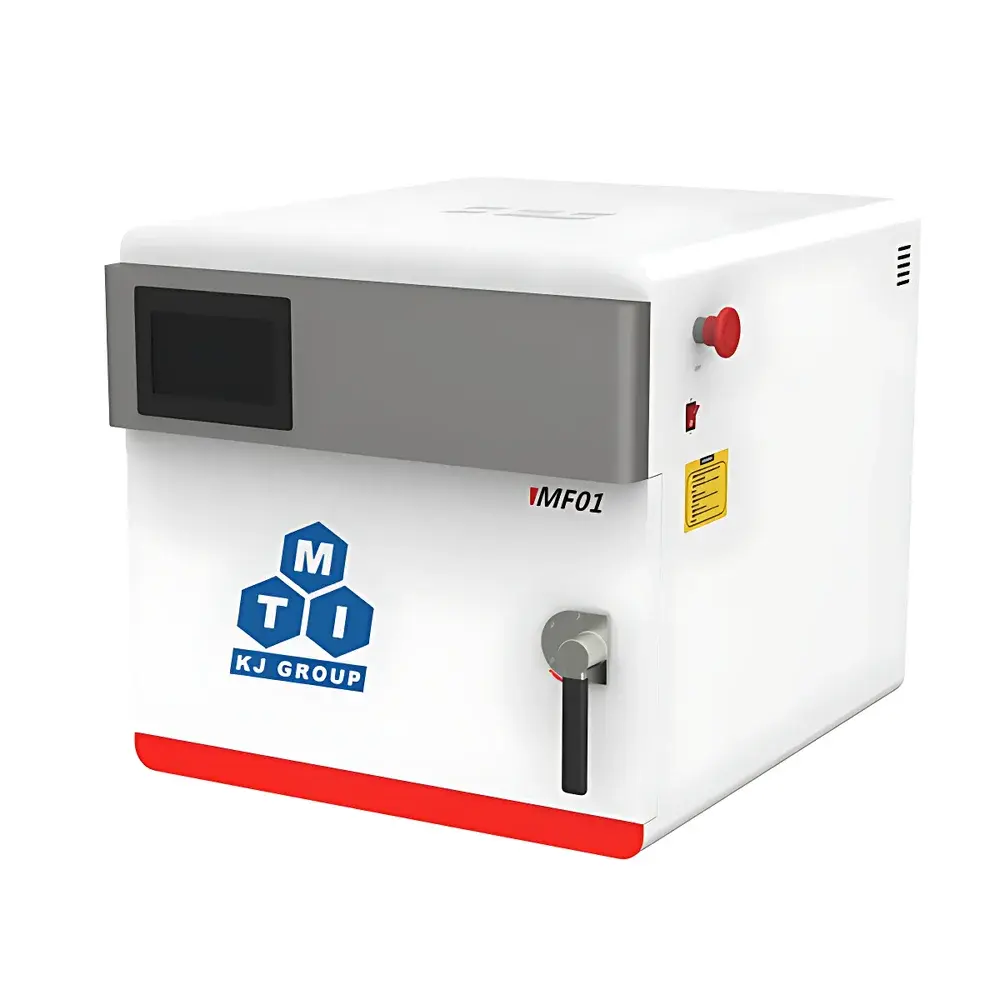
KJ GROUP MF Series Microwave High-Temperature Muffle Furnace
| Brand | KJ GROUP |
|---|---|
| Origin | Liaoning, China |
| Manufacturer Type | Authorized Distributor |
| Country of Origin | China |
| Model | MF |
| Pricing | Available Upon Request |
| Microwave Frequency | 2.45 GHz |
| Max Operating Temperature | 1600 °C |
| Microwave Output Power Range | 0.01–2.80 kW (adjustable) |
| Heating Chamber Dimensions (L×W×H) | up to 140 × 140 × 100 mm |
| Temperature Measurement | Type S thermocouple, 0–1600 °C, accuracy ±0.1% of reading |
| Control System | Mitsubishi PLC + Schneider HMI touchscreen |
| Programmable Ramp/Soak Profiles | 40-segment |
| Microwave Leakage | <0.05 mW/cm² |
| Safety Interlocks | Door-closed sensing, automatic power cutoff, overtemperature & overcurrent protection |
| Power Supply | 220 V ±10%, 50 Hz |
Overview
The KJ GROUP MF Series Microwave High-Temperature Muffle Furnace is a purpose-built laboratory instrument engineered for rapid, energy-efficient, and controllable high-temperature processing under ambient air atmosphere. Unlike conventional resistance-heated furnaces, the MF series employs 2.45 GHz industrial-grade microwave energy to directly couple with polarizable or conductive materials—enabling volumetric heating, reduced thermal gradients, and accelerated reaction kinetics. This principle supports fundamental research and process development in ceramic sintering, catalyst synthesis, ashing of organic matrices, thermal decomposition, and advanced material densification. Designed for reproducible operation at up to 1600 °C, the furnace integrates electromagnetic shielding, real-time thermal feedback, and programmable thermal profiles—making it suitable for GLP-compliant labs, university materials science departments, and R&D centers focused on functional ceramics, battery cathode precursors, and refractory composites.
Key Features
- Industrial magnetron-based microwave source with continuously adjustable output (0.01–2.80 kW), ensuring precise energy delivery across diverse material dielectric properties.
- Patented multi-layer insulation architecture combining low-conductivity ceramic fiber and reflective metallic shielding—minimizing standby heat loss and eliminating external surface hot spots.
- Uniform field distribution within the cavity, validated by temperature mapping per ASTM E220, resulting in improved microstructural homogeneity: finer grain size, higher density, and enhanced mechanical/electrical performance in sintered specimens.
- Integrated safety interlock system: automatic microwave cutoff upon door opening, delayed restart after closure, redundant overtemperature and overcurrent monitoring, and real-time leakage detection (<0.05 mW/cm², compliant with IEC 61000-3-2 and GB 4706.21).
- Robust control platform featuring Mitsubishi programmable logic controller (PLC) and Schneider Electric HMI touchscreen interface—supporting 40-segment ramp-hold programs, dynamic curve visualization, data logging (timestamped temperature/power/time), and USB export of CSV-formatted experimental records.
Sample Compatibility & Compliance
The MF furnace operates in ambient air and is compatible with crucibles made from alumina, silicon carbide, molybdenum disilicide (MoSi₂), and graphite—provided they exhibit appropriate microwave coupling characteristics and thermal stability at target temperatures. It is not recommended for use with fully metallic containers or sealed vessels without venting. The system conforms to electromagnetic compatibility (EMC) requirements per IEC 61326-1 for laboratory equipment and meets structural safety standards outlined in ISO 13857 (safe distances for machinery). While not certified for medical or pharmaceutical GMP production, its data integrity features—including user-accessible audit trails, password-protected parameter modification, and non-volatile profile storage—align with FDA 21 CFR Part 11 expectations for electronic records in research settings.
Software & Data Management
No proprietary cloud software is required. All operational data—including setpoint trajectories, actual temperature readings, microwave power output, and alarm events—are stored locally in non-volatile memory. Users may export full-session logs via USB flash drive in standard CSV format for post-processing in MATLAB, Python (Pandas), or Excel. The HMI interface supports dual-language display (English/Chinese) and permits manual override, auto-sequence execution, and constant-temperature hold modes—all with millisecond-level timestamp resolution. Firmware updates are performed offline using encrypted firmware packages distributed through KJ GROUP’s authorized support channel.
Applications
- Materials Synthesis: Microwave-assisted solid-state reactions for LiFePO₄, Ni-rich NMC, and perovskite oxides—reducing synthesis time from hours to minutes while suppressing lithium volatilization.
- Thermal Analysis Prep: Rapid ashing of biological tissues, polymers, or food samples prior to elemental analysis (ICP-OES, XRF), minimizing trace element loss versus conventional tube furnaces.
- Ceramic Processing: Pressureless sintering of ZrO₂, Al₂O₃, and Si₃N₄ with >98% theoretical density and submicron grain structure.
- Catalyst Activation: Controlled calcination of supported metal oxides (e.g., Co₃O₄/TiO₂) to optimize surface area and redox activity without sintering active phases.
- Failure Analysis: Accelerated thermal aging of electronic packaging materials, PCB substrates, and polymer composites under defined thermal stress protocols.
FAQ
What atmosphere options does the MF furnace support?
The standard configuration is designed for operation in ambient air only. Inert or reducing atmospheres require optional gas inlet/outlet ports and compatible sealing modifications—not included in base model MF1516 or MF3016.
Can the furnace be integrated into an automated lab workflow?
Yes—RS-485 Modbus RTU communication is available as an optional interface for integration with SCADA systems or centralized lab automation platforms.
Is calibration traceable to national standards?
Type S thermocouples are supplied with individual calibration certificates traceable to CNAS-accredited laboratories. Field recalibration is supported using reference thermocouples and portable calibrators meeting ISO/IEC 17025 requirements.
What maintenance is required for the magnetron and waveguide?
Under normal operating conditions (≤8 h/day, ≤1600 °C), the magnetron requires no scheduled replacement for ≥5,000 hours. Waveguide interior inspection is recommended annually; cleaning is performed only if visible carbon deposition or moisture ingress is observed.



