
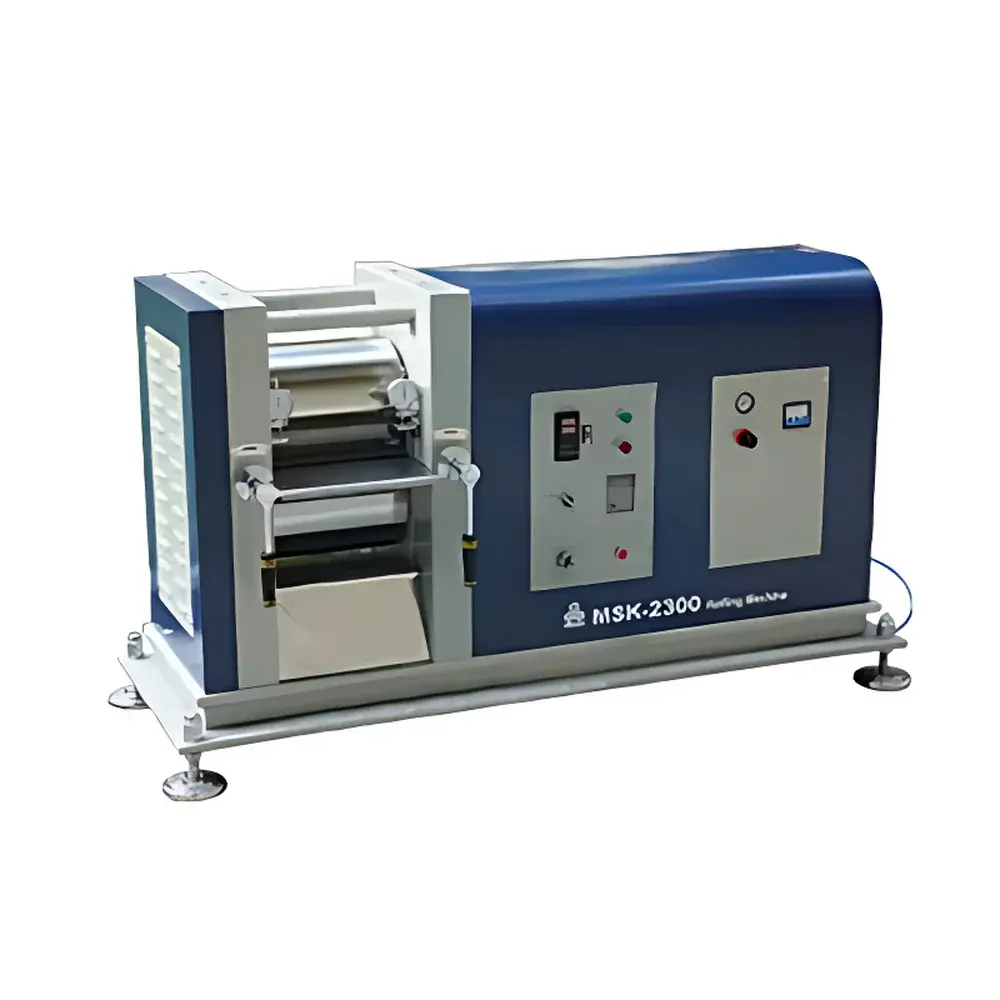
KJ GROUP MSK-2300 Hydraulic-Balanced Electric Calendering Roll Press
| Brand | KJ GROUP |
|---|---|
| Origin | Liaoning, China |
| Manufacturer Type | Authorized Distributor |
| Country of Origin | China |
| Model | MSK-2300 |
| Pricing | Available Upon Request |
| Power Supply | AC 220 V ±10% |
| Rated Power | 1.5 kW |
| Roll Diameter | 210 mm |
| Roll Width | 300 mm |
| Roll Material | 9Cr2Mo Tool Steel |
| Roll Hardness | HRC 66–68 |
| Maximum Feed Width | 300 mm |
| Rolling Speed Range | 0–3.6 m/min (0–60 rpm) |
| Air Supply Requirement | ≥4 MPa |
| Hydraulic Pressure Output Range | 0–50 MPa |
| Thickness Uniformity (Flatness) | <0.003 mm |
| Single-Side Dry-Film Thickness Tolerance | ±1.5 µm |
| Operating Ambient Temperature | 25 °C ±3 °C |
| Relative Humidity | 20–40% RH (or lower) |
| Dimensions (L×W×H) | 1500 × 500 × 1000 mm |
| Net Weight | ~1000 kg |
| Control Interface | Digital Pressure Gauge with RS-485 Output |
| Drive System | Variable-Frequency Motor with Stepless Speed Regulation |
| Roll Adjustment Method | Manual Inclined Wedge Mechanism |
| Hydraulic Balance System | Dual Hydraulic Cylinders with External Oil Pump (Pneumatically Actuated) |
Overview
The KJ GROUP MSK-2300 Hydraulic-Balanced Electric Calendering Roll Press is a precision-engineered laboratory and pilot-scale calendering system designed for controlled thickness reduction and surface densification of electrode coatings in lithium-ion battery manufacturing and R&D. It operates on the principle of cold roll compaction—applying uniform compressive force between two counter-rotating rolls to achieve consistent coating density, porosity control, and dimensional stability in composite electrode films. Unlike mechanically balanced or spring-loaded systems, the MSK-2300 integrates a dual-hydraulic-cylinder architecture actuated via external pneumatic oil pump control, enabling real-time pressure stabilization and traceable force application across the full roll width. This design ensures minimal lateral deflection and high axial load symmetry—critical for producing electrode sheets meeting stringent automotive-grade specifications (e.g., ISO 16750-3, IEC 62660-1). The system is intended for use in controlled environments (25 °C ±3 °C, RH ≤40%) to minimize moisture-induced variability during calendering of water- or NMP-based slurries.
Key Features
- Hydraulic force balancing system with dual synchronized cylinders delivering 0–50 MPa controllable pressure, ensuring axial load uniformity and eliminating edge thinning effects.
- Manually adjustable inclined wedge mechanism for precise, repeatable roll gap setting—enabling sub-micron resolution in initial gap calibration prior to hydraulic engagement.
- Stepless speed regulation (0–3.6 m/min) via frequency-controlled AC motor drive, supporting seamless integration into continuous electrode coating lines (e.g., slot-die coaters, infrared dryers).
- Digital pressure transducer with RS-485 serial output, compliant with Modbus RTU protocol, enabling direct logging of rolling force vs. time data into SCADA or LIMS platforms for GLP/GMP audit trails.
- Hardened 9Cr2Mo alloy steel rolls (HRC 66–68), 210 mm diameter × 300 mm face width, optimized for wear resistance and thermal stability under sustained loading conditions.
- Compact footprint (1500 × 500 × 1000 mm) with adjustable leveling feet to ensure mechanical stability on standard laboratory flooring; total mass (~1000 kg) contributes to vibration damping during high-force operation.
Sample Compatibility & Compliance
The MSK-2300 accommodates a wide range of electrode formulations—including aqueous cathode slurries (LiFePO₄, NMC), anode pastes (graphite/Si composites), solid-state electrolyte layers, and polymer-based separator coatings—within a maximum feed width of 300 mm. Its calibrated pressure control and sub-3-µm flatness tolerance (<0.003 mm) support qualification testing per ASTM D6988 (thickness uniformity of coated fabrics) and internal QC protocols aligned with USP for pharmaceutical film calendering analogs. While not certified to ISO/IEC 17025, its digital pressure interface supports traceable calibration against NIST-traceable deadweight testers. The system meets CE machinery directive requirements (2006/42/EC) for electrical safety and mechanical guarding when operated with interlocked access panels.
Software & Data Management
The MSK-2300 does not include embedded software but provides hardware-level data acquisition capability through its RS-485-enabled digital pressure gauge. Users may integrate this signal into third-party platforms such as LabVIEW, MATLAB Data Acquisition Toolbox, or industrial MES systems using standard Modbus RTU polling. Timestamped pressure logs can be correlated with line speed and ambient environmental data (temperature/humidity) to build multivariate process models for DOE-based optimization of calendering parameters. Audit-ready records comply with FDA 21 CFR Part 11 when paired with validated electronic signature workflows in enterprise LIMS deployments.
Applications
- Electrode densification studies for Li-ion, solid-state, and sodium-ion battery development.
- Process validation of slurry rheology–calendering response relationships (e.g., binder migration, particle rearrangement).
- Production of reference standards for thickness metrology (e.g., calibrated foil stacks for XRF or beta-backscatter calibration).
- Pre-compression of freestanding electrodes prior to cold-press lamination or hot-rolling stages.
- R&D of flexible energy storage devices requiring ultra-thin, high-uniformity active layers (e.g., microbatteries, wearable electronics).
FAQ
What is the maximum recommended operating pressure for long-term reliability?
Continuous operation at pressures exceeding 40 MPa is not advised without scheduled maintenance intervals; optimal service life is achieved at ≤35 MPa with biannual hydraulic fluid analysis.
Can the MSK-2300 be integrated with automated feed systems?
Yes—its RS-485 interface and programmable speed control allow synchronization with servo-driven web handlers via PLC-level coordination using discrete I/O triggers.
Is roll surface polishing or regrinding supported by KJ GROUP?
Roll refurbishment services—including precision grinding, hardness verification, and surface finish certification—are available directly from KJ GROUP’s Liaoning service center under contract maintenance agreements.
Does the system meet explosion-proof requirements for solvent-based slurry processing?
No—the MSK-2300 is rated for general-purpose laboratory use only; solvent-handling applications require additional ATEX-certified enclosures and purge systems not supplied with the base unit.



