
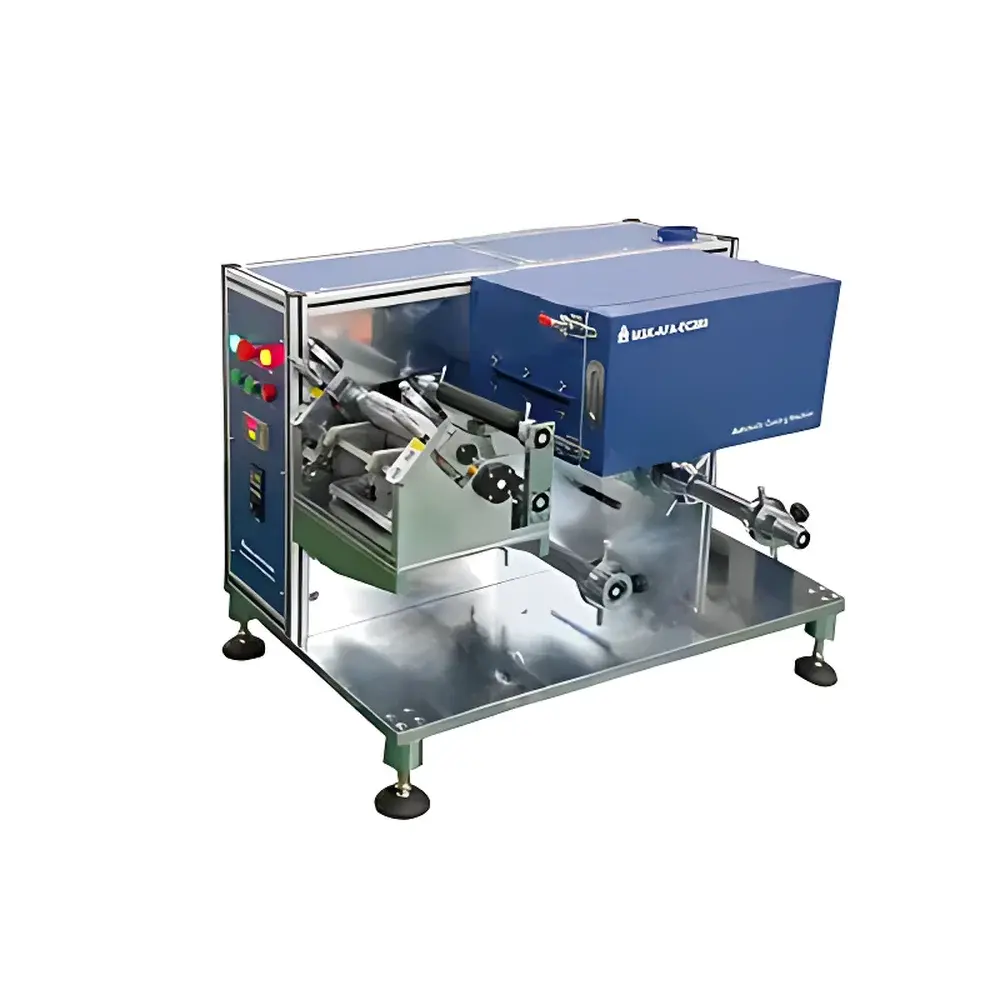
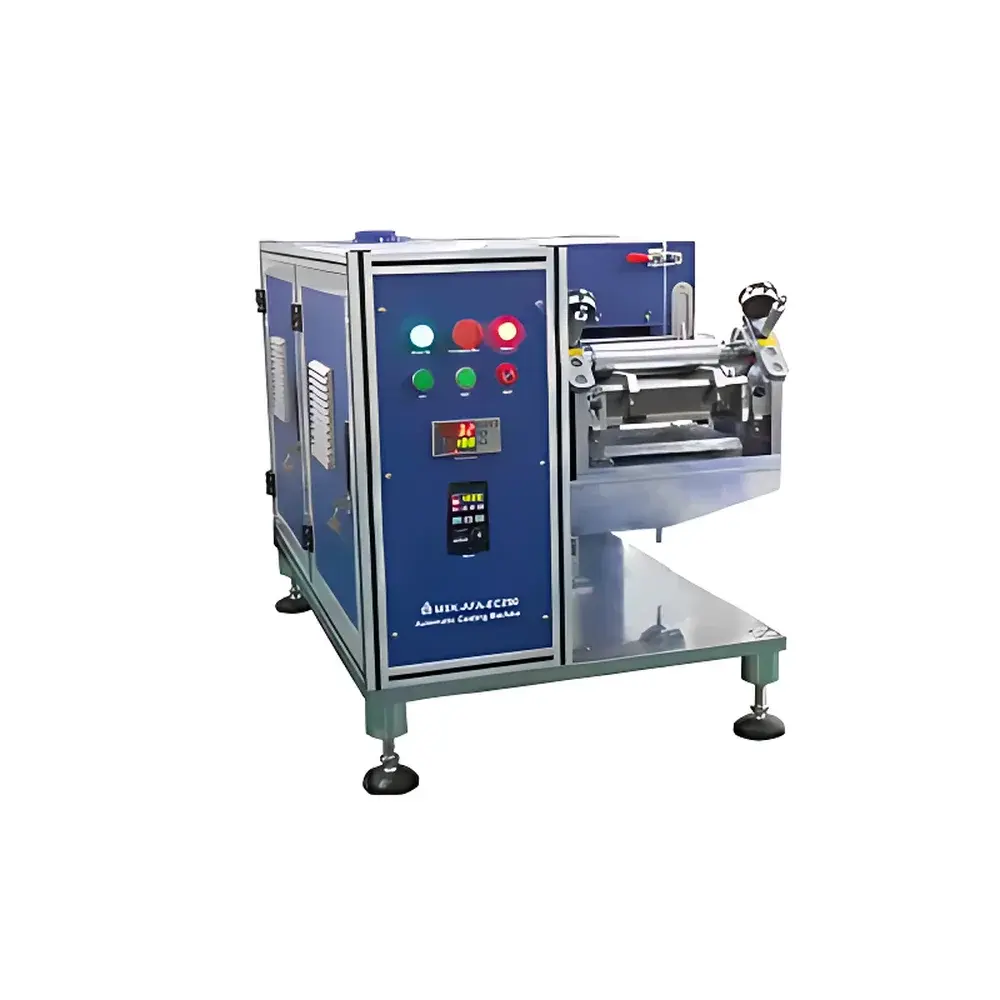
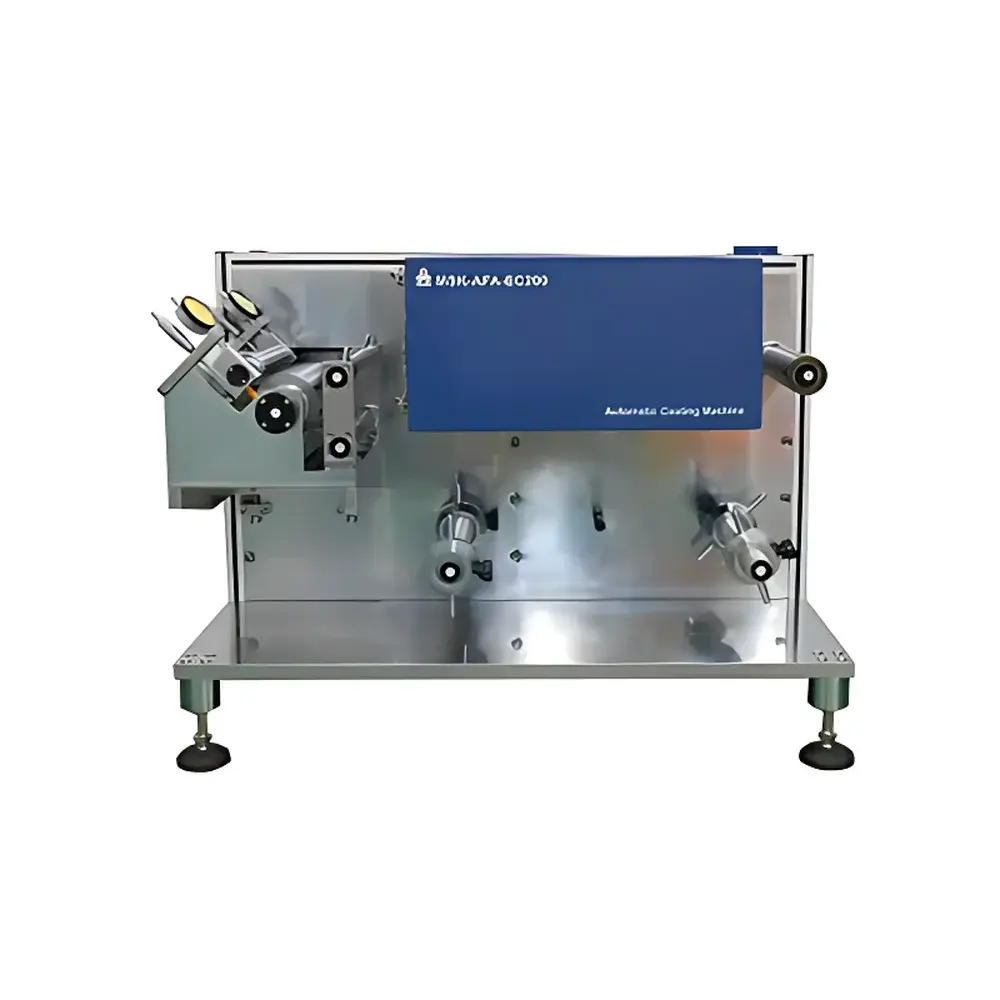
KJ GROUP MSK-AFA-EC200 Automatic Doctor Blade Coating System
| Brand | KJ GROUP |
|---|---|
| Origin | Liaoning, China |
| Manufacturer Type | Authorized Distributor |
| Country of Origin | China |
| Model | MSK-AFA-EC200 |
| Price | Upon Request |
| Input Voltage | AC 220 V, 50 Hz |
| Max. Power Consumption | ~3 kW |
| Substrate Width | ≤200 mm |
| Coating Width | ≤180 mm |
| Coating Speed | 200 mm/min (adjustable) |
| Coating Thickness Range | 20–200 µm (dry film basis) |
| Coating Accuracy | ±6 µm (±8 µm at edges) |
| Tension Control | Automatic unwind/rewind tension regulation |
| Rewind/Unwind Core Diameter | Max. Φ200 mm |
| Core Type | 3-inch mandrel with T-slot or air-expanding shaft |
| Edge Guiding Accuracy | ±0.5 mm |
| Drying Temperature Range | Up to 150 °C ±5 °C |
| Oven Length | 500 mm |
| Drying Method | Resistive heating with dual-zone forced-air convection (top & bottom) |
| Overall Dimensions | 1000 × 650 × 650 mm (L×W×H) |
| Operating Environment | Altitude <1000 m |
| Required Utilities | Grounded AC 220 V supply |
| Footprint Clearance | 800 × 600 × 700 mm workbench (≥200 kg load capacity) |
Overview
The KJ GROUP MSK-AFA-EC200 Automatic Doctor Blade Coating System is a precision-engineered laboratory-scale coating platform designed for reproducible, uniform thin-film deposition on flexible substrates. It operates on the principle of doctor blade (knife-over-roll) coating—a contact-based metering method where a precisely gapped blade shears excess slurry from a moving web, enabling controlled wet-film thickness generation prior to thermal drying. This system is optimized for R&D workflows in electrochemical energy storage, particularly battery electrode fabrication (anode/cathode slurry coating on Cu/Al foil), but also supports applications in functional polymer films, photographic emulsion casting, paper coating, and composite laminate pre-preg processing. Its integrated design combines automated web handling, real-time tension management, and calibrated thermal drying—ensuring process consistency across iterative formulation trials and small-batch prototyping.
Key Features
- Automated slurry agitation system with variable-speed stirring rod ensures homogeneous suspension stability during continuous coating, minimizing sedimentation-induced thickness variation.
- Motor-driven unwinding and rewinding modules with programmable speed synchronization maintain constant web velocity and eliminate slip-induced edge defects.
- Integrated edge-guidance mechanism with optical sensor feedback achieves ±0.5 mm positional repeatability, critical for narrow-width substrates and multi-layer alignment.
- Adjustable blade-to-substrate gap and independent tension control (via pneumatic brake and torque motor) allow empirical optimization of shear rate and wet-film rheology response.
- Resistively heated convection oven (500 mm length) features dual-zone airflow distribution (top + bottom) and PID-regulated temperature control (max. 150 °C ±5 °C), ensuring uniform solvent evaporation without blistering or skinning.
- Modular core interface accommodates both T-slot and air-expanding 3-inch mandrels (max. Φ200 mm roll diameter), supporting rapid changeover between material formats.
Sample Compatibility & Compliance
The MSK-AFA-EC200 accepts standard metallic foils (e.g., Al, Cu, Ni), polymer films (PET, PI, PP), and paper-based substrates up to 200 mm wide. Coating thickness range (20–200 µm dry) is validated for aqueous and NMP-based slurries typical in Li-ion battery cathode (NMC, LFP) and anode (graphite, SiOx) formulations. The system meets fundamental mechanical safety requirements per IEC 61000-6-2 (immunity) and IEC 61000-6-4 (emission). While not certified to ISO 9001 or FDA 21 CFR Part 11 out-of-the-box, its operational logs, temperature profiles, and speed/tension setpoints are exportable via USB for internal GLP/GMP-aligned documentation. All electrical components comply with CE marking directives for low-voltage equipment (LVD 2014/35/EU) and electromagnetic compatibility (EMC 2014/30/EU).
Software & Data Management
This is a microprocessor-controlled standalone instrument with embedded firmware (no PC dependency). Parameter settings—including coating speed, oven setpoint, agitation RPM, and tension target—are configured via a backlit LCD touchscreen interface with password-protected administrator mode. Real-time status indicators display actual oven temperature, web speed deviation, and tension feedback. All operational parameters and timestamped run records (start/stop time, duration, setpoints) are stored internally (non-volatile memory) and exportable as CSV files via USB port. For traceability-critical environments, users may integrate external data loggers or SCADA systems using analog 0–10 V outputs for speed, temperature, and tension signals.
Applications
- Lithium-ion and solid-state battery R&D: Electrode slurry coating on current collectors for half-cell/full-cell prototyping.
- Functional thin-film development: Conductive polymer, perovskite precursor, or catalyst ink deposition for sensors and optoelectronics.
- Coated substrate qualification: Evaluation of adhesion, cracking behavior, and surface morphology under varying drying kinetics.
- Process transfer studies: Scaling down production-line coating parameters (e.g., gap height, dwell time, Peclet number) to lab-scale validation.
- Quality control benchmarking: Inter-laboratory comparison of coating uniformity (via SEM cross-section or profilometry) using standardized reference slurries.
FAQ
What substrate materials are compatible with the MSK-AFA-EC200?
Standard metallic foils (Al, Cu, Ni), polyester (PET), polyimide (PI), polypropylene (PP), and cellulose-based papers—provided they exhibit sufficient tensile strength and thermal stability up to 150 °C.
Is compressed air required for operation?
Yes. A clean, oil-free compressed air source (0.4–0.6 MPa) is necessary for the air-expanding mandrel option and optional pneumatic braking on the unwind/rewind stations.
Can coating thickness be adjusted in real time during a run?
No. Wet-film thickness is determined by blade gap, slurry rheology, and line speed—set manually prior to initiation. However, speed and oven temperature are adjustable on-the-fly via the HMI.
Does the system support multi-layer sequential coating?
Not natively. It is a single-pass system. Multi-layer deposition requires manual re-threading or integration with a second coater in tandem configuration.
What maintenance is recommended for long-term accuracy?
Monthly inspection of blade edge integrity, quarterly calibration of oven thermocouples against a traceable reference, and biannual lubrication of guide rollers and mandrel bearings per the technical manual.
Related Products



