
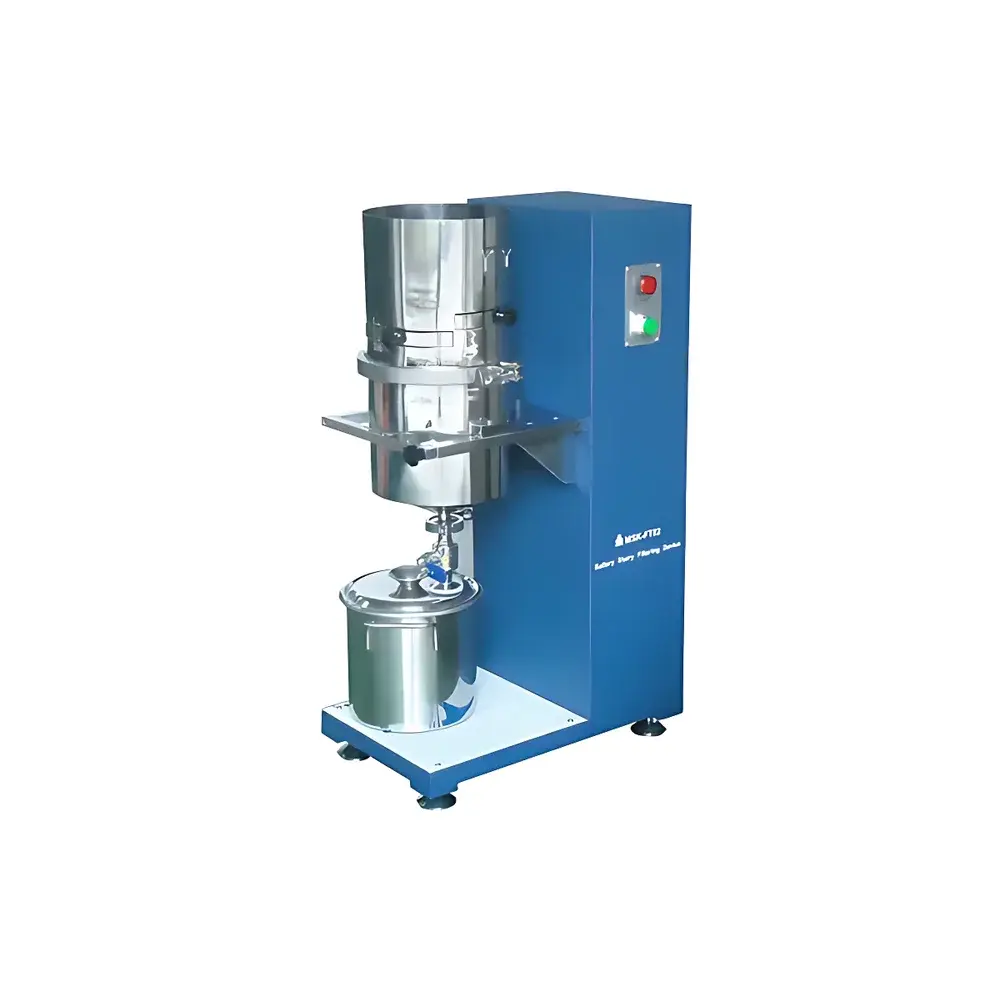
KJ GROUP MSK-FT02 Laboratory Slurry Conditioning System
| Brand | KJ GROUP |
|---|---|
| Origin | Liaoning, China |
| Manufacturer Type | Authorized Distributor |
| Country of Origin | China |
| Model | MSK-FT02 |
| Pricing | Upon Request |
| Power Supply | DC 24 V, 50 W |
| Primary Functions | Magnetic Filtration & Sieve-Based Filtration |
| Processing Capacity | 5 L per Cycle |
| Filter Mesh Range | 80–120 Mesh (Interchangeable Dual-Layer Cartridge) |
| Magnetic Field Strength | 8,000–10,000 Gauss (Adjustable Magnet Assembly) |
| Maximum Slurry Viscosity | ≤15,000 cP |
| Operating Temperature | ≤40 °C |
| Relative Humidity Range | 30–90% RH |
| Vibration Sensitivity | Requires Stable, Non-Vibrating Environment |
| Maximum Solid Content | ≤80 wt% |
| Dimensions (L×W×H) | 500 × 300 × 850 mm |
Overview
The KJ GROUP MSK-FT02 Laboratory Slurry Conditioning System is an engineered solution for post-dispersion, pre-coating slurry refinement in lithium-ion battery electrode manufacturing R&D environments. Designed specifically for lab-scale process validation and formulation optimization, the system integrates dual-stage conditioning—magnetic iron removal and precision mechanical filtration—into a compact, CE-compliant platform. It operates on the principle of laminar slurry flow through a controlled magnetic field gradient followed by size-selective sieving via interchangeable dual-layer mesh cartridges. This sequential treatment mitigates particle agglomeration, removes ferromagnetic contaminants (e.g., wear debris from mixing blades or milling media), and eliminates oversized gel clusters or undispersed aggregates—factors directly linked to coating defects such as pinholes, streaks, and thickness non-uniformity. Unlike high-shear inline homogenizers or ultrasonic systems, the MSK-FT02 applies no additional shear or thermal input, preserving binder integrity and slurry rheology while enhancing batch-to-batch reproducibility.
Key Features
- Dual-layer modular filter cartridge with quick-release clamping mechanism—enables tool-free mesh replacement across 80–120 mesh range for targeted particle cutoff control.
- Adjustable permanent magnet array generating 8,000–10,000 Gauss surface field strength; optimized geometry ensures uniform magnetic flux distribution across full cross-sectional flow path.
- Multi-point disassembly design—including removable feed inlet, filter housing, magnet chamber, and outlet manifold—facilitates complete wetted-part access for cleaning and residue inspection per GLP-aligned lab protocols.
- Low-voltage DC24V operation (50 W max) minimizes electrical hazard risk and supports integration into fume hood or glovebox environments without grounding complications.
- Structural frame fabricated from corrosion-resistant stainless steel (AISI 304); all wetted surfaces electropolished to Ra < 0.4 µm to prevent slurry adhesion and simplify cleaning validation.
- Compact footprint (500 × 300 × 850 mm) enables benchtop deployment in space-constrained battery labs without requiring floor mounting or dedicated utility connections.
Sample Compatibility & Compliance
The MSK-FT02 accommodates aqueous and NMP-based electrode slurries with viscosities up to 15,000 cP and solid loadings up to 80 wt%, including cathode formulations (NMC, LFP, NCA) and anode slurries (graphite/Si composites with CMC/SBR or PVDF binders). Its non-contact magnetic separation stage avoids catalytic degradation of redox-active species, while the absence of moving parts in the filtration zone eliminates shear-induced binder chain scission. The system complies with EU Machinery Directive 2006/42/EC and carries full CE marking documentation, including risk assessment per EN ISO 12100 and EMC conformity per EN 61326-1. It meets baseline requirements for use in ISO/IEC 17025-accredited testing laboratories and supports audit readiness for GMP-relevant process development workflows under ICH Q5E and Q7 guidance.
Software & Data Management
The MSK-FT02 is a standalone electromechanical unit with no embedded microcontroller or digital interface. All operational parameters—including cycle count, elapsed processing time per batch, and ambient temperature/humidity logs—are recorded manually in laboratory notebooks or integrated into existing LIMS/QMS platforms via standardized SOP templates. Its passive architecture eliminates cybersecurity concerns associated with networked instrumentation and ensures full traceability under FDA 21 CFR Part 11 when paired with electronic lab notebook (ELN) systems featuring audit trail functionality. Calibration of magnetic field strength is performed using a certified Hall-effect gaussmeter (not included); filter mesh integrity verification follows ASTM E11-22 procedures for test sieves.
Applications
- Pre-coating slurry qualification for slot-die, comma-bar, or knife-over-roll coating trials.
- Root-cause analysis of coating defects by isolating magnetic contamination vs. particle size distribution effects.
- Binder compatibility screening—evaluating slurry stability after repeated filtration cycles without rheological drift.
- Slurry aging studies under controlled humidity/temperature conditions to assess sedimentation resistance post-conditioning.
- Technology transfer support: generating consistent slurry batches between pilot line and full-scale production via validated conditioning parameters.
FAQ
Does the MSK-FT02 require compressed air or external pumping?
No—it is gravity-fed and designed for manual or peristaltic pump-assisted operation; no pneumatic or hydraulic utilities are needed.
Can the system handle slurries containing conductive carbon additives (e.g., Super P, Ketjenblack)?
Yes—carbon black and CNTs are non-ferromagnetic and pass unaffected through the magnetic stage; filtration performance depends solely on aggregate size relative to selected mesh.
Is validation documentation (IQ/OQ) available?
KJ GROUP provides a Factory Acceptance Test (FAT) report and CE technical file summary; site-specific IQ/OQ protocols must be developed by the end user per ISO/IEC 17025 or internal quality standards.
What maintenance intervals are recommended?
Magnet cleaning and mesh inspection after every 10 cycles; full disassembly and electropolish verification annually or after 200 operating hours—whichever occurs first.



