
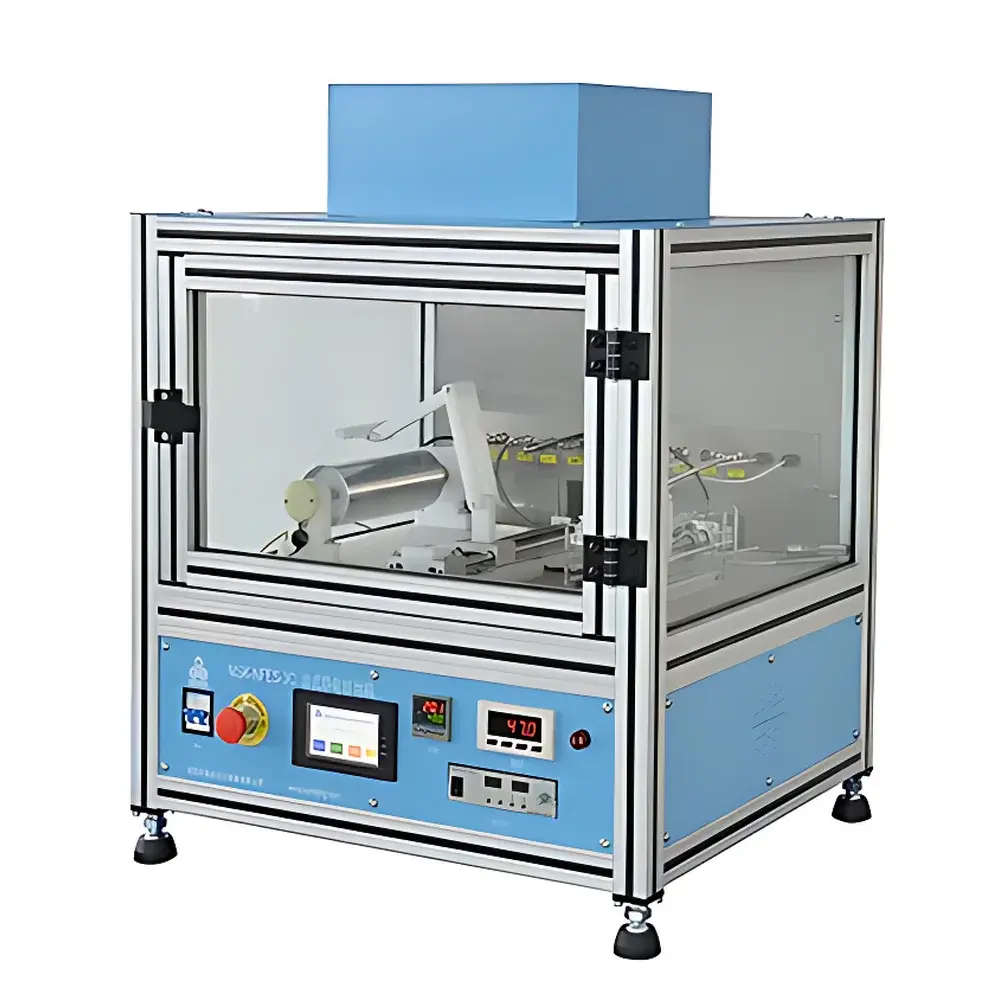
KJ GROUP MSK-NFES-3C Desktop Electrospinning System
| Brand | KJ GROUP |
|---|---|
| Origin | Liaoning, China |
| Model | MSK-NFES-3C |
| Power Supply | 220 V, 50 Hz, 1100 W |
| High-Voltage Output | 0–30 kV |
| Temperature Control Range | RT to 50 °C |
| Syringe Pump Flow Rate | 0.0001–1 mm/s |
| Max Syringe Diameter | Ø30 mm |
| Standard Syringe Volume | 20 mL |
| Plunger Stroke Range | 0.01–90 mm |
| Collector Drum Speed | 400–3800 rpm (100 rpm increments) |
| Oscillation Speed | 5–100 mm/s (5 mm/s increments) |
| Oscillation Range | 100–200 mm |
| Drum Dimensions | Ø80 × 200 mm |
| Optional Collector Platform | Manual X/Y (1–10 mm/s), Auto X/Y (1–20 mm/s / 1–10 mm/s), Max Sample Size: 180 × 180 mm, Layer Spacing: 0.1–100 mm |
| Overall Dimensions | 700 × 600 × 900 mm (L×W×H) |
| Total Mass | 75 kg |
Overview
The KJ GROUP MSK-NFES-3C Desktop Electrospinning System is an engineered platform for controlled fabrication of polymeric nanofibers via electrohydrodynamic processing. It operates on the principle of electrostatic fiber drawing—where a high-voltage electric field (up to 30 kV) induces charge accumulation at the surface of a polymer solution or melt extruded through a fine nozzle, overcoming surface tension and elongating the fluid jet into ultrafine fibers. These fibers solidify mid-air due to solvent evaporation or cooling, depositing as nonwoven mats with diameters ranging from ~50 nm to several micrometers. The system supports both needle-based and needleless configurations (via optional accessories), enabling reproducible synthesis of fibrous architectures with tunable morphology—including beaded, ribbon-like, porous, or core-shell structures—depending on solution rheology, voltage, collector geometry, and ambient conditions.
Key Features
- Integrated high-stability DC high-voltage generator (0–30 kV, adjustable in 0.1 kV steps) with overvoltage and current-limiting protection circuits.
- Precision syringe pump with linear actuation: flow resolution down to 0.0001 mm/s; compatible with glass or plastic syringes up to Ø30 mm; standard 20 mL syringes included.
- Temperature-controlled feed reservoir (RT to 50 °C) to modulate solution viscosity and volatility during spinning—critical for thermally sensitive polymers or low-boiling-point solvents.
- Motorized rotating drum collector (Ø80 × 200 mm) with speed range 400–3800 rpm (100 rpm increments) and programmable oscillation (5–100 mm/s, 5 mm/s step, 100–200 mm amplitude) for uniform fiber alignment and layer stacking.
- Modular design supporting optional collector platforms: manual or automated XY translation stages (1–20 mm/s in X, 1–10 mm/s in Y) with programmable layer spacing (0.1–100 mm) for gradient or multilayer deposition.
- Compact desktop footprint (700 × 600 × 900 mm) with EMI-shielded enclosure, interlocked safety door, and grounded discharge wand for operator protection per IEC 61010-1 requirements.
Sample Compatibility & Compliance
The MSK-NFES-3C accommodates a broad spectrum of processable materials—including aqueous and organic solutions of synthetic polymers (e.g., PVA, PVP, PLGA, PAN), biopolymers (e.g., collagen, chitosan, gelatin), prepolymers, and nanoparticle-polymer composites. Solvent compatibility includes DMF, chloroform, THF, ethanol, acetic acid, and water-based systems—subject to viscosity (< 10,000 mPa·s recommended) and conductivity (< 5 mS/m typical) constraints. All electrical components comply with CE marking directives (EMC Directive 2014/30/EU, Low Voltage Directive 2014/35/EU). The system supports documentation practices aligned with GLP and GMP environments, including user-accessible calibration logs and parameter traceability for critical process variables (voltage, flow rate, temperature, rotation speed).
Software & Data Management
While the base configuration features manual analog/digital controls with LED displays for real-time monitoring of voltage, flow rate, temperature, and rotational speed, the system is compatible with optional PC-based control software (KJ-ESP Control Suite v3.x). This software enables synchronized parameter logging at 10 Hz sampling rate, script-based protocol execution (e.g., ramped voltage + stepped flow + timed oscillation), and export of timestamped CSV files for post-processing. Audit trail functionality records user login, parameter changes, and emergency stops—supporting compliance with FDA 21 CFR Part 11 when deployed with validated electronic signatures and role-based access control.
Applications
- Development of nanofibrous scaffolds for tissue engineering (e.g., neural, vascular, dermal regeneration) requiring precise control over fiber diameter distribution and pore interconnectivity.
- Production of filtration membranes for air/water purification, where hierarchical porosity and surface functionalization enhance particulate capture efficiency and antimicrobial activity.
- Synthesis of battery separator layers and solid-state electrolyte supports with high ionic conductivity and mechanical stability under thermal cycling.
- Fabrication of sensing substrates for electrochemical or optical biosensors—leveraging high surface-area-to-volume ratios and facile surface modification via post-electrospinning grafting.
- Rapid prototyping of functional coatings for wound dressings, drug-eluting patches, and catalytic supports with spatially resolved composition gradients.
FAQ
What types of polymers are compatible with the MSK-NFES-3C?
Commonly used polymers include polyacrylonitrile (PAN), polylactic acid (PLA), polyvinyl alcohol (PVA), polyethylene oxide (PEO), polycaprolactone (PCL), and natural biopolymers such as gelatin and chitosan—provided their solution viscosity falls within the operational range and exhibits sufficient chain entanglement for stable jet formation.
Is solvent recovery supported?
The system does not include integrated solvent recovery; however, it is designed for use inside certified fume hoods with external condensation traps or activated carbon filters to meet OSHA and local VOC emission regulations.
Can the system produce aligned fibers?
Yes—fiber alignment is achieved via high-speed drum rotation (>2000 rpm), combined with oscillating collector motion and optimized nozzle-to-collector distance (typically 10–20 cm), yielding orientation degrees quantifiable by wide-angle X-ray scattering (WAXS) or SEM image analysis.
What maintenance is required?
Routine maintenance includes cleaning of the nozzle assembly after each run, periodic verification of high-voltage cable insulation resistance (>100 MΩ), and recalibration of syringe pump displacement accuracy every 6 months or after 500 hours of cumulative operation.
Is technical support available internationally?
KJ GROUP provides remote troubleshooting, application consultation, and firmware updates via secure web portal; on-site service is available through authorized regional partners in North America, EU, and APAC regions under extended warranty agreements.



