
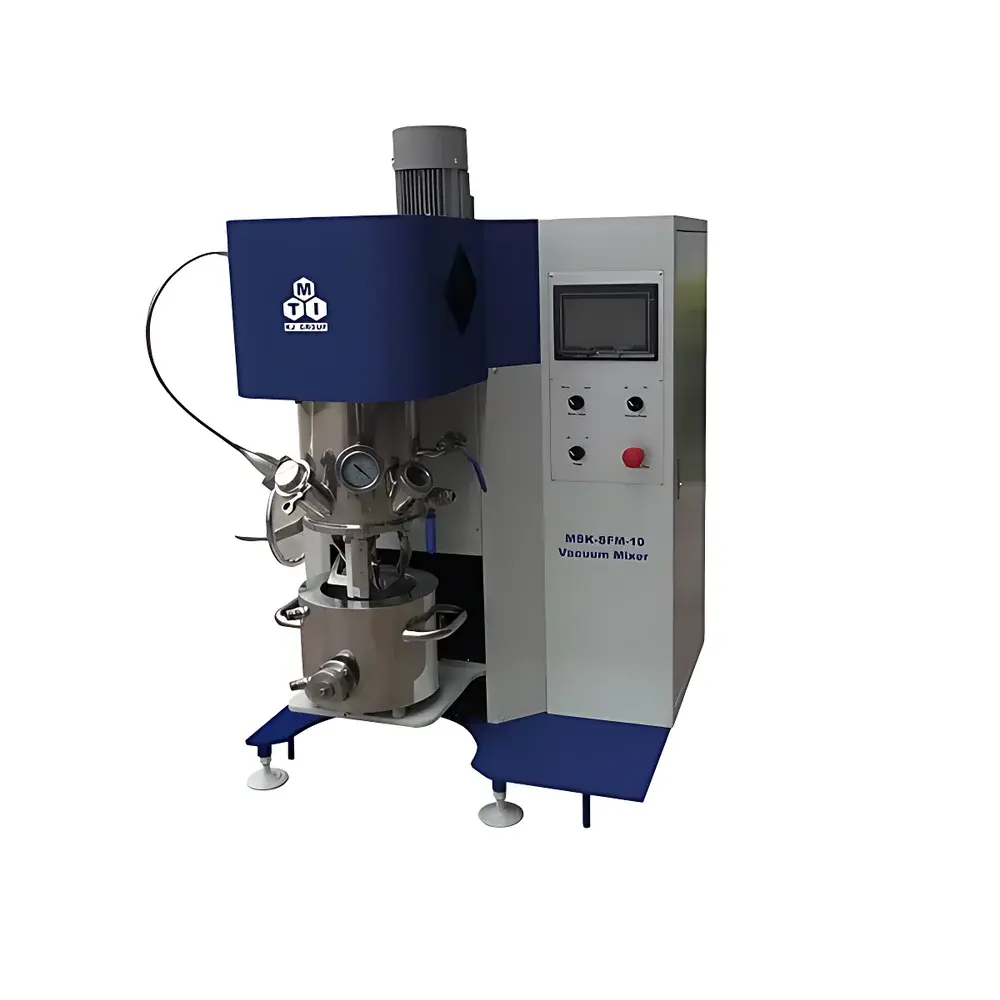
KJ GROUP MSK-SFM-10 Dual Planetary Vacuum Mixer
| Brand | KJ GROUP |
|---|---|
| Origin | Liaoning, China |
| Manufacturer Type | Authorized Distributor |
| Country of Origin | China |
| Model | MSK-SFM-10 |
| Voltage | AC 208–240 V, 50/60 Hz |
| Total Power | 1.8 kW |
| Mixing Canister | Ø180 mm × 150 mm (Design Volume: 3 L |
| Effective Volume | 2 L) with Circulating Water Jacket |
| Dispersion Disc | Ø45 mm |
| Orbital Speed | 0–70 rpm |
| Stirring Speed | 0–112 rpm |
| Dispersion Speed | 0–3800 rpm |
| Dispersion Tip Linear Velocity | 0–9.42 m/s |
| Lift Motor Power | 370 W |
| Dimensions (W×D×H) | 960 × 890 × 1250 mm |
| Weight | 350 kg |
| Certifications | CE |
Overview
The KJ GROUP MSK-SFM-10 Dual Planetary Vacuum Mixer is an engineered solution for high-shear, high-uniformity dispersion and homogenization of viscous pastes, slurries, and composite formulations under controlled vacuum conditions. Designed around the dual planetary motion principle—where mixing tools simultaneously rotate on their own axes while orbiting the canister center—the system eliminates stagnant zones and ensures comprehensive material turnover across the entire volume. The integrated vacuum capability (down to ≤10 mbar, when paired with optional mechanical vacuum pump) removes entrapped air and volatile components prior to and during mixing, preventing bubble formation that compromises coating uniformity, electrode density, and interfacial integrity in downstream processing. Its 304 stainless steel mixing canister—equipped with a double-walled circulating water jacket—provides chemical resistance against acidic, alkaline, and organic solvent-based systems commonly encountered in battery cathode slurry preparation (e.g., NMP-based LiCoO₂ or LiFePO₄ dispersions), phosphor synthesis, and advanced ceramic formulations.
Key Features
- Dual planetary agitation architecture combining orbital rotation (0–70 rpm), stirring shaft rotation (0–112 rpm), and high-speed dispersion disc rotation (0–3800 rpm) for multi-scale shear input and particle deagglomeration.
- 304 stainless steel mixing canister with precision-machined internal geometry and seamless welds, certified for corrosion resistance per ASTM A240 and compliant with ISO 8502-3 surface cleanliness requirements for cleanroom-adjacent operation.
- Vacuum-integrated design featuring dedicated 1/2″ air exhaust port, M14×1.5 vacuum interface, and DN-viewports for real-time process monitoring under sub-atmospheric conditions.
- Programmable multi-segment speed control for both orbital and dispersion functions—each segment independently configurable for speed setpoint and dwell time—to accommodate complex rheological transitions (e.g., viscosity rise during binder swelling).
- Water-jacketed canister enables active thermal management; compatible with external recirculating chillers (optional) to maintain slurry temperature within 35–50°C, mitigating thermal degradation of PVDF binders or solvent volatility shifts.
- CE-marked per Machinery Directive 2006/42/EC and Low Voltage Directive 2014/35/EU; electrical safety and EMC compliance verified by TÜV Rheinland.
Sample Compatibility & Compliance
The MSK-SFM-10 accommodates non-hazardous, non-explosive slurries with viscosities ranging from 1,000 to 500,000 mPa·s (measured at 25°C, 10 s⁻¹ shear rate). It is routinely deployed in R&D and pilot-scale production of lithium-ion battery electrode slurries (aqueous and NMP-based), solid-state electrolyte suspensions, luminescent phosphor dispersions, and tape-casting ceramic slurries. All wetted surfaces meet USP Class VI biocompatibility criteria for extractables testing, and the system supports GLP-compliant documentation workflows when integrated with validated data acquisition software. Process parameters—including vacuum level, rotational speeds, temperature, and elapsed time—are recordable for audit trails aligned with FDA 21 CFR Part 11 requirements (when used with compliant software).
Software & Data Management
While the base unit features analog speed dials and mechanical timers, it supports digital retrofit via optional PLC-based controller (KJ-PLC-MIX-10) offering RS485 Modbus RTU communication, password-protected parameter locking, and CSV export of time-stamped operational logs. When interfaced with KJ LabSuite™ v3.2 (sold separately), users gain full traceability: electronic signatures, version-controlled SOP execution, automatic calibration logging, and export-ready reports conforming to ISO/IEC 17025 documentation standards.
Applications
- Lithium-ion battery electrode slurry formulation: Achieving <5 µm primary particle dispersion in LiNiMnCoO₂ (NMC) cathodes and silicon-carbon anodes without gelation or premature crosslinking.
- Solid-state battery electrolyte blending: Homogenizing sulfide-based (e.g., Li₆PS₅Cl) or oxide-based (LLZO) powders into polymer matrices under inert gas/vacuum to suppress moisture-induced decomposition.
- Phosphor and quantum dot ink preparation: Ensuring narrow particle size distribution (PSD) and absence of agglomerates critical for LED encapsulation and display printing.
- Advanced ceramic green tape casting: Producing defect-free, low-void-content slurries for multilayer capacitor and LTCC substrates.
- Functional nanocomposite pastes: Dispersing CNTs, graphene flakes, or metal oxides into conductive or dielectric matrices with minimal aspect-ratio damage.
FAQ
What vacuum level can the MSK-SFM-10 achieve?
With the optional dual-stage rotary vane vacuum pump (KJ-VAC-202), the system reaches ≤10 mbar absolute pressure after 15 minutes of evacuation from ambient, verified using integrated Pirani gauge output (0–1000 mbar range).
Is the mixing canister removable for cleaning or replacement?
Yes—the canister is secured via ISO-KF 50 flange with Viton O-ring seal, enabling tool-free removal and autoclavable cleaning per ISO 15883-1 protocols.
Can the unit operate under inert gas atmosphere instead of vacuum?
Yes—by capping the vacuum port and introducing regulated N₂ or Ar through the 3/4″ ball valve inlet (with optional mass flow controller), users may perform oxygen-sensitive mixing without modification.
Does the system support IQ/OQ/PQ validation documentation?
KJ GROUP provides factory-issued IQ/OQ templates and on-site PQ support (at additional cost) aligned with ASTM E2500 and EU Annex 15 guidelines.
What maintenance intervals are recommended for long-term reliability?
Lubrication of planetary gearboxes every 500 operating hours; inspection of dispersion disc concentricity and shaft runout annually; verification of vacuum seal integrity before each high-value batch.



