
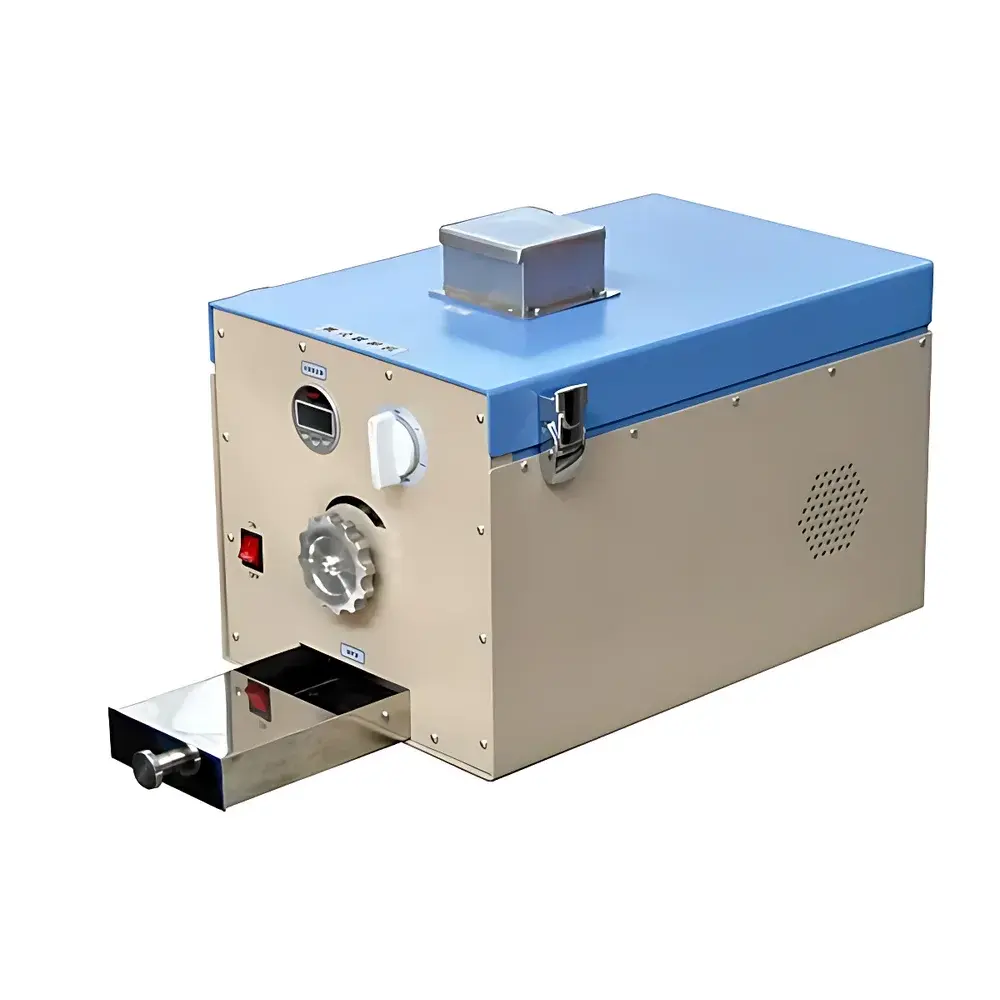
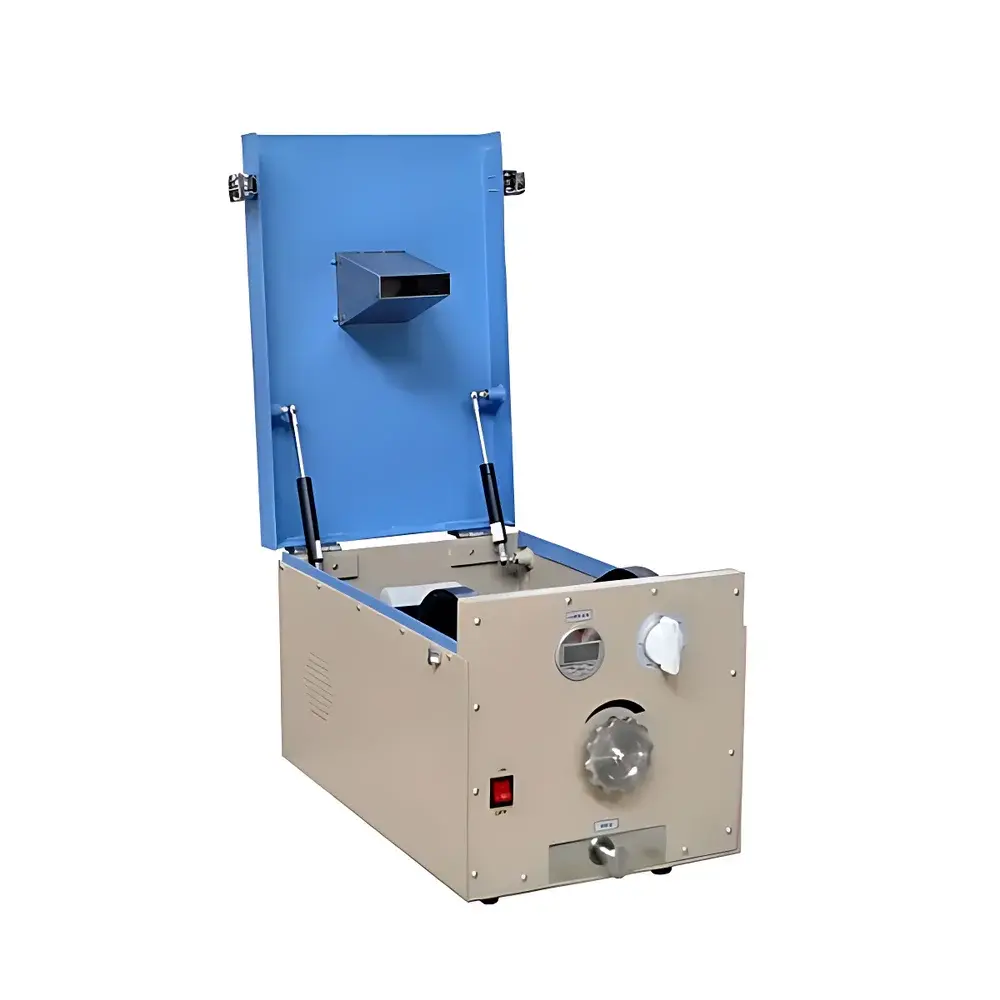
KJ GROUP MSK-SFM-ALO Jaw Crusher
| Brand | KJ GROUP |
|---|---|
| Origin | Liaoning, China |
| Manufacturer Type | Authorized Distributor |
| Country of Origin | China |
| Model | MSK-SFM-ALO |
| Price | Upon Request |
| Power Supply | 220 V, 50 Hz |
| Motor Power | 550 W |
| Crushing Speed | 500 rpm |
| Max Feed Size | 5–20 mm |
| Adjustable Jaw Gap Range | 0.01–5.00 mm (digital micrometer display, 0.01 mm resolution) |
| Feed Opening | 92 × 38 mm |
| Max Single Feed Capacity | 200 g |
| Output Particle Size | 0.5–2 mm (material-dependent) |
| Drawer Load Capacity | 200 g |
| Dimensions (Operational) | 400 × 640 × 870 mm (L×W×H) |
| Dimensions (Closed) | 400 × 600 × 500 mm (L×W×H) |
| Net Weight | ~59 kg |
| Jaw Liner Material | High-purity alumina ceramic (99.5% Al₂O₃) |
| Max Material Hardness Tolerance | <8 HRC |
Overview
The KJ GROUP MSK-SFM-ALO Jaw Crusher is a compact, laboratory-scale comminution instrument engineered for controlled primary size reduction of brittle, low-to-moderate hardness materials prior to downstream processing—such as ball milling, homogenization, or analytical sample preparation. It operates on the principle of compressive crushing via reciprocating motion between a fixed and a movable jaw, both lined with high-density alumina ceramic (99.5% Al₂O₃), ensuring minimal contamination and exceptional wear resistance. Unlike conventional steel-jaw crushers, the MSK-SFM-ALO eliminates metallic leaching and cross-contamination risks—critical for applications in battery electrode precursor synthesis, ceramic powder processing, geological sample preparation, and pharmaceutical excipient refinement. Its design conforms to fundamental mechanical principles of jaw crusher kinematics (single-toggle mechanism), optimized for reproducible throughput and consistent particle size distribution under defined feed conditions.
Key Features
- Alumina ceramic jaw liners (fixed and movable jaws) and side chamber linings—providing chemical inertness, non-metallic contamination control, and extended service life for abrasive-sensitive samples.
- Precision-adjustable jaw gap via calibrated digital micrometer (0.01 mm resolution), displayed on an integrated LED readout—enabling repeatable control over output particle size distribution.
- Compact footprint (400 × 600 × 500 mm closed) and modular drawer-style collection system—facilitating rapid cleaning, residue removal, and compatibility with glovebox or inert-atmosphere environments.
- Robust 550 W induction motor delivering stable 500 rpm eccentric shaft rotation—optimized for continuous-duty operation with thermal overload protection.
- Feed hopper geometry (92 × 38 mm opening) and ≤200 g batch capacity—designed to prevent bridging and ensure uniform material flow into the crushing zone.
- Structural housing fabricated from reinforced steel with vibration-dampening mounts—minimizing operational noise and transmission of mechanical resonance to adjacent instrumentation.
Sample Compatibility & Compliance
The MSK-SFM-ALO is validated for use with non-fibrous, non-ductile, and non-sticky materials exhibiting hardness below 8 HRC—including lithium iron phosphate (LiFePO₄), silicon carbide (SiC), graphite flakes, feldspar, limestone, and polymer granules. It is unsuitable for metals, elastomers, or hygroscopic compounds requiring ambient moisture exclusion. While not certified to ISO/IEC 17025 or ASTM D2976 (Standard Test Method for Determining Crushability of Aggregates), its alumina-lined architecture aligns with GLP-compliant sample prep workflows where trace metal integrity is essential. The absence of lubricants in the crushing chamber and tool-free liner access support audit-ready maintenance logs per FDA 21 CFR Part 11–aligned documentation practices.
Software & Data Management
The MSK-SFM-ALO is a manually operated, standalone mechanical device with no embedded firmware, touchscreen interface, or data export capability. All operational parameters—including jaw gap setting, feed mass, and run duration—are recorded externally by the user in lab notebooks or LIMS-integrated electronic records. The digital micrometer’s 0.01 mm resolution supports traceable gap calibration verification; users are advised to log initial and post-run gap values alongside batch identifiers for full procedural transparency. For automated integration, third-party programmable logic controllers (PLCs) may interface with the unit’s dry-contact start/stop terminals (optional accessory).
Applications
- Pre-grinding of cathode/anode active materials prior to planetary ball milling in battery R&D labs.
- Size reduction of geological core fragments for XRF or ICP-MS sample submission—preserving elemental fidelity without Fe/Cr/Ni interference.
- Particle size standardization of ceramic green bodies before sintering trials.
- Routine fragmentation of pharmaceutical tablet blanks for dissolution kinetics studies.
- Preparation of homogeneous feedstock for laser diffraction particle size analysis (e.g., Malvern Mastersizer).
- Teaching laboratories demonstrating mechanical comminution theory, energy-size relationships (Rittinger’s law), and wear mechanisms in brittle fracture.
FAQ
What materials are incompatible with the MSK-SFM-ALO?
Metals, alloys, rubber, thermoplastics above their glass transition temperature, fibrous biomass, and highly hydrated salts are not recommended due to risk of jamming, excessive wear, or uncontrolled deformation.
Can the jaw gap be locked during operation?
No—the digital micrometer is a manual adjustment mechanism; gap remains fixed during crushing but requires re-calibration after extended use or liner replacement.
Is the alumina liner replaceable in the field?
Yes—both fixed and movable jaw liners are secured with stainless steel fasteners and can be exchanged using standard hex tools without specialized fixtures.
Does the unit meet CE or UL safety standards?
It carries CE marking per Machinery Directive 2006/42/EC and complies with EN 60204-1 for electrical safety; UL certification is not held, though component-level UL-listed motors and switches are employed.
How often should the jaw liners be inspected?
Visual inspection is recommended after every 20 operating hours or 50 batches—particularly when processing silica-rich or high-abrasion feedstocks—to assess ceramic surface microfracture or edge chipping.
Related Products



