
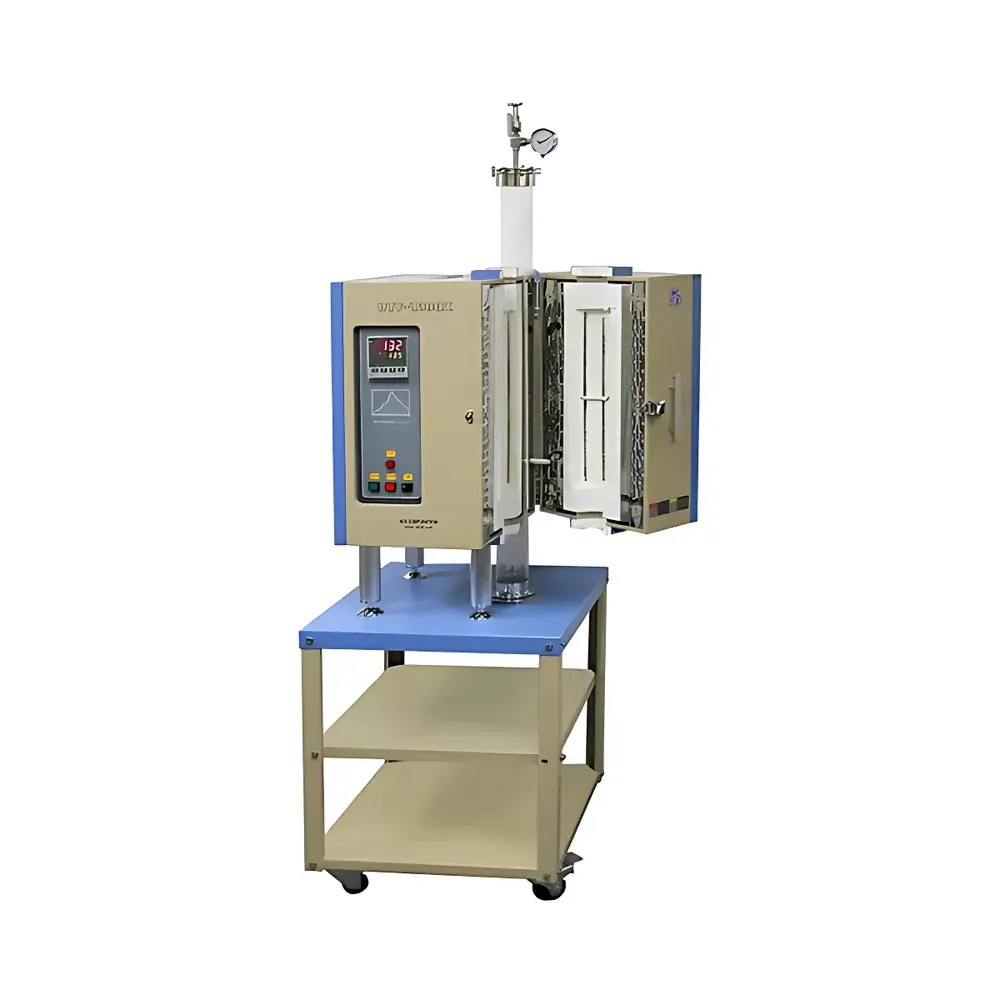
KJ GROUP OTF-1200X-80-VT Vertical Opening Tube Furnace
| Brand | KJ GROUP |
|---|---|
| Origin | Liaoning, China |
| Manufacturer Type | Authorized Distributor |
| Country of Origin | China |
| Model | OTF-1200X-80-VT |
| Power Supply | AC 220 V, 50 Hz, 6 kW |
| Maximum Operating Temperature | 1200 °C (≤1 h), Continuous at 1100 °C |
| Heating Zone Length | 440 mm |
| Uniform Temperature Zone | 200 mm |
| Quartz Tube Dimensions | Ø80 mm OD × Ø72 mm ID × 1000 mm L |
| Heating Element | Mo-doped Fe-Cr-Al Alloy Wire with Zirconia Coating |
| Cooling System | Dual-layer Shell with Forced Air Circulation |
| Surface Temperature | <55 °C |
| Temperature Control | 30-Stage PID Programmable Controller |
| Temperature Stability | ±1 °C |
| Vacuum Performance | 10⁻² torr (with Mechanical Pump), 10⁻⁵ torr (with Turbomolecular Pump) |
| Leak Rate | <5 mtorr/min |
| Dimensions (W×D×H) | 550 mm × 380 mm × 520 mm |
| Net Weight | 80 kg |
| Certification | CE Compliant |
Overview
The KJ GROUP OTF-1200X-80-VT is a vertically opening, programmable tube furnace engineered for high-temperature thermal processing under controlled atmosphere or vacuum conditions. Designed around a vertical lift mechanism, this furnace enables rapid, safe access to the quartz reaction tube without horizontal displacement—minimizing thermal stress on fragile samples and simplifying loading/unloading in vertical CVD, annealing, sintering, or precursor decomposition workflows. Its core architecture employs a dual-layer stainless steel shell with integrated forced-air cooling, ensuring operator safety and stable ambient surface temperatures below 55 °C during extended operation at 1100 °C. The furnace utilizes Mo-doped Fe-Cr-Al resistance heating elements coated with stabilized zirconia for enhanced oxidation resistance and thermal longevity, supporting repeatable operation up to 1200 °C for short-duration cycles (≤1 h) and continuous use at 1100 °C. Temperature uniformity is maintained across a 200 mm isothermal zone within the 440 mm active heating length, critical for reproducible material synthesis and phase transformation studies.
Key Features
- Vertical lift design with counterbalanced hinge mechanism for ergonomic, tool-free access to the quartz tube—eliminating horizontal sliding and reducing risk of tube breakage or seal misalignment.
- Dual-shell construction with axial fan-driven air circulation ensures consistent external surface temperature (<55 °C) even during prolonged operation at 1100 °C.
- High-purity fused quartz tube (Ø80 mm OD × Ø72 mm ID × 1000 mm L) compatible with inert, reducing, oxidizing, and low-pressure atmospheres; interior coating of US-sourced alumina enhances infrared reflectivity and minimizes particulate shedding.
- 30-segment programmable PID controller with ramp-soak profiles, real-time data logging capability (via optional RS485/Modbus interface), and over-temperature cut-off protection.
- CE-certified electrical architecture compliant with EN 61000-6-3 (EMC) and EN 61000-6-2 (immunity); grounding continuity verified per IEC 61000-4-5 surge immunity standards.
Sample Compatibility & Compliance
The OTF-1200X-80-VT accommodates standard 80 mm OD quartz tubes and supports sample geometries up to 70 mm in diameter and 900 mm in length. It is routinely deployed in ASTM C1171 (ceramic fiber heat treatment), ISO 8501-4 (metal oxide calcination), and USP (pharmaceutical excipient thermal stability) protocols. When configured with optional VCR or KF25 vacuum flanges and turbomolecular pumping, the system meets residual gas analysis requirements for semiconductor-grade annealing (per SEMI F20-0212). All vacuum components comply with ISO-KF and VCR clean-braze standards; leak integrity is validated to <5 mtorr/min under nitrogen purge—ensuring compatibility with GLP/GMP environments requiring documented process traceability.
Software & Data Management
While the furnace operates natively via its embedded PID interface, optional integration with KJ GROUP’s LabFurnaceControl™ software (Windows-based, USB/RS485) enables remote parameter setting, real-time temperature curve visualization, automated report generation (CSV/PDF), and audit-trail-enabled data export compliant with FDA 21 CFR Part 11 requirements—including electronic signatures, user-level access control, and immutable event logs. Data timestamps are synchronized to NTP servers; all thermal profiles are timestamped, versioned, and exportable for regulatory submission or inter-laboratory comparison.
Applications
- Chemical vapor deposition (CVD) of transition metal dichalcogenides (e.g., MoS₂, WS₂) using vertical precursor delivery and precise thermal gradient control.
- Controlled-atmosphere annealing of perovskite thin films for photovoltaic device optimization (N₂/H₂/Ar mixtures, 300–800 °C).
- Thermal decomposition kinetics studies of battery cathode precursors (e.g., Ni-rich NMC oxalates) under dynamic gas flow and ramped heating.
- Graphitization of carbon nanofibers and templated mesoporous carbons at 1000–1100 °C under Ar flow.
- Calibration and aging of thermocouples (Type S, R, B) and RTDs in accredited metrology labs following ISO/IEC 17025 procedures.
FAQ
What vacuum level can be achieved with the standard configuration?
With the included mechanical pump and standard O-ring seals, the system reaches ≤10⁻² torr. For ultra-high vacuum applications (e.g., graphene growth), a turbomolecular pump and metal-sealed KF/VCR flanges are recommended to achieve ≤10⁻⁵ torr.
Is the quartz tube included with the furnace?
Yes—the furnace ships with one standard fused quartz tube (Ø80 mm OD × Ø72 mm ID × 1000 mm L) meeting ASTM F799 specifications for hydroxyl content (<10 ppm) and UV transmission.
Can the furnace be integrated into an automated glovebox environment?
Yes—its compact footprint (550 × 380 × 520 mm), rear-mounted gas/vacuum ports, and 220 V single-phase input allow seamless integration into Class 1000+ inert-atmosphere gloveboxes with pass-through feedthroughs.
Does the PID controller support Modbus RTU communication?
Yes—the optional RS485 expansion module provides full Modbus RTU register mapping for integration with PLC-based process control systems or SCADA platforms.
What maintenance intervals are recommended for long-term reliability?
Inspect quartz tube end caps and O-rings every 50 operating hours; replace heating element insulation annually under continuous 1100 °C use; recalibrate thermocouple input annually per ISO/IEC 17025 calibration hierarchy.
Related Products



