
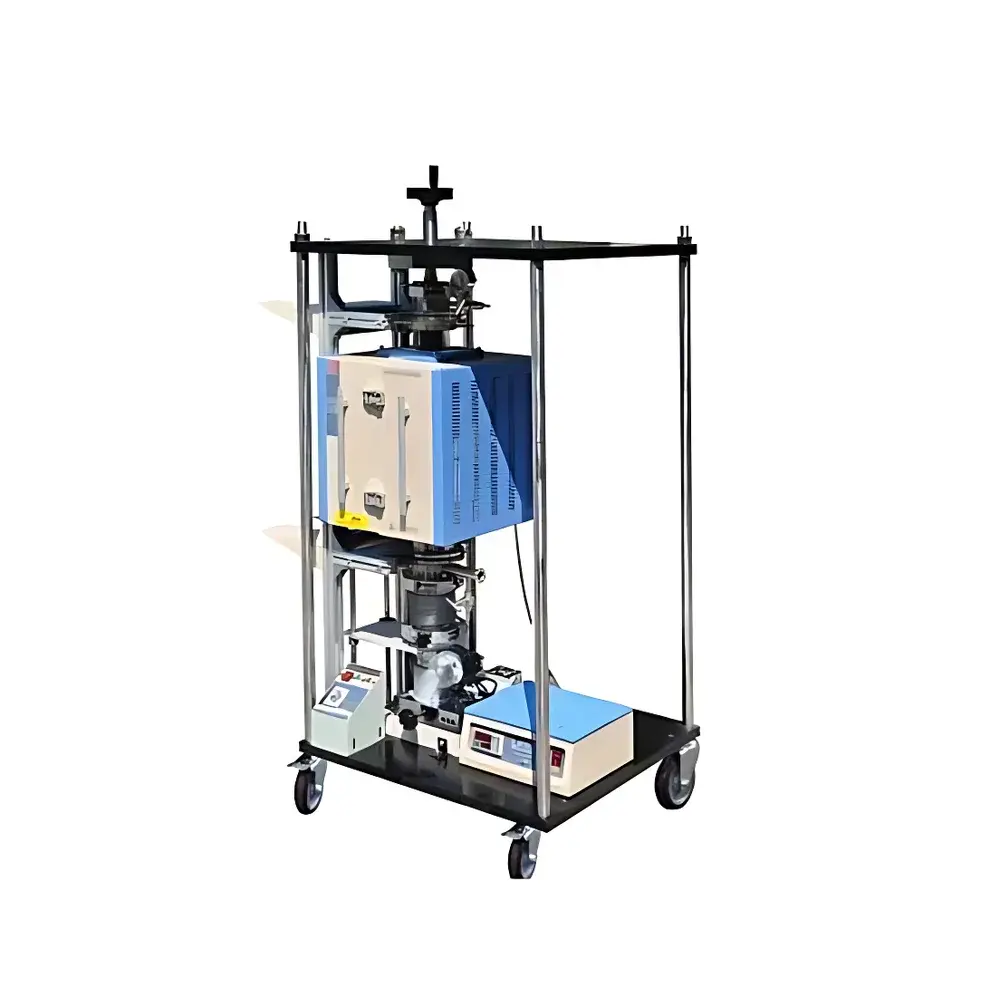
KJ GROUP OTF-1200X-VHP4 Vacuum Hot Press Furnace
| Brand | KJ GROUP |
|---|---|
| Origin | Liaoning, China |
| Manufacturer Type | Authorized Distributor |
| Country of Origin | China |
| Model | OTF-1200X-VHP4 |
| Input Voltage | AC 220 V, 50/60 Hz |
| Max. Heating Power | 2.2 kW |
| Max. Operating Temperature | 1100 °C |
| Temperature Uniformity | ±1 °C |
| Heating Zone Length | 300 mm |
| Quartz Tube Dimensions | OD 100 mm × ID 95 mm × L 1200 mm |
| Hydraulic System | Adjustable piston cylinder (Ø25 mm), 15 mm stroke, max. load 20 T, max. applied pressure 6 T (10 MPa on gauge) |
| Vacuum Performance | 10⁻² torr (mechanical pump), 10⁻⁵ torr (turbo-molecular pump) |
| Overall Dimensions | 1050 mm × 750 mm × 1750 mm |
| Net Weight | 365 kg |
| Optional Accessories | Rotary vane vacuum pump, recirculating chiller, high-temperature pressure-resistant dies |
Overview
The KJ GROUP OTF-1200X-VHP4 Vacuum Hot Press Furnace is a precision-engineered thermal processing system designed for simultaneous application of controlled high temperature and uniaxial mechanical pressure under vacuum or inert gas atmosphere. It operates on the principle of solid-state sintering and diffusion bonding—enabling densification of advanced ceramics, metal matrix composites, thermoelectric materials, and multilayer thin-film substrates without introducing interfacial contamination or oxidation. With a maximum operating temperature of 1100 °C and programmable 30-segment PID temperature control, the furnace ensures thermal stability and repeatability critical for reproducible microstructural development. The integrated hydraulic actuation system delivers up to 6 metric tons of compressive force directly to the sample via a water-cooled, adjustable piston assembly housed inside a fused quartz reaction tube—ensuring uniform stress distribution and minimizing thermal gradient-induced distortion.
Key Features
- High-purity fused quartz tube (OD 100 mm, ID 95 mm, L 1200 mm) with dual water-cooled flanges for rapid thermal isolation and safe vacuum sealing.
- Internally alumina-coated furnace chamber (US-sourced coating) enhancing infrared reflectivity, reducing thermal loss, and improving long-term resistance to thermal cycling degradation.
- Electro-hydraulic pressure actuation system featuring a Ø25 mm stainless steel cylinder with 15 mm linear stroke and calibrated load feedback—capable of delivering up to 6 T (10 MPa) compressive force with fine positional control.
- Three-zone independent heating configuration (center zone active, end zones auxiliary) optimized for axial temperature homogeneity across the 300 mm hot zone.
- Dual-stage vacuum architecture compatible with both rotary vane and turbo-molecular pumping systems, achieving base pressures down to 10⁻⁵ torr for ultra-low residual gas partial pressure during sintering.
- Industrial-grade 30-segment programmable temperature controller with RS485 communication interface and real-time data logging capability.
Sample Compatibility & Compliance
The OTF-1200X-VHP4 supports a wide range of powder-based and layered material systems—including SiC, AlN, ZnO, Bi₂Te₃, NiTi shape-memory alloys, and oxide-based multilayer capacitors. Its modular design accommodates custom graphite, molybdenum, or boron nitride tooling sets rated for continuous operation at ≤1100 °C. All electrical and vacuum components conform to IEC 61000-6-2 (EMC immunity) and IEC 61000-6-4 (EMC emission) standards. The system meets general safety requirements per EN 61000-1-2 and is suitable for installation in ISO Class 7 cleanroom environments when equipped with appropriate filtration and exhaust management. While not pre-certified for FDA 21 CFR Part 11, its data logging architecture supports audit-trail implementation for GLP/GMP-aligned laboratories upon integration with validated third-party software platforms.
Software & Data Management
Temperature and pressure profiles are managed via an embedded industrial PID controller with front-panel touchscreen interface and USB export functionality. Real-time process variables—including setpoint, actual temperature, ramp rate, dwell time, and hydraulic pressure—are recorded at user-defined intervals (1–60 s resolution). Exported CSV files are compatible with MATLAB, Python (Pandas), and LabVIEW for post-process statistical analysis and DOE correlation studies. Optional Ethernet-enabled controllers support Modbus TCP integration into centralized MES or SCADA infrastructures for automated batch reporting and remote monitoring. Firmware updates are delivered via secure HTTPS portal with version-controlled release notes and validation documentation.
Applications
- Densification of nanocrystalline ceramic powders without grain growth.
- Low-temperature co-firing of LTCC (low-temperature cofired ceramic) multilayer structures.
- Thermocompression bonding of dissimilar substrates (e.g., silicon-on-insulator to glass carriers).
- Preparation of textured piezoelectric ceramics via hot pressing under controlled uniaxial stress.
- Consolidation of spark plasma sintering (SPS)-preconditioned compacts where slower heating rates improve interfacial diffusion kinetics.
- Process development for solid-state battery electrode laminates requiring void-free interparticle contact at sub-eutectic temperatures.
FAQ
What vacuum level is required for oxide ceramic sintering?
For most oxide systems (e.g., Al₂O₃, YSZ), a base pressure of ≤10⁻² torr is sufficient to suppress surface decomposition; however, for reactive systems like Ti₃SiC₂ or MAX-phase precursors, ≤10⁻⁵ torr is recommended to minimize oxygen/nitrogen pickup.
Can the furnace accommodate cylindrical dies larger than 60 mm in diameter?
Yes—the internal quartz tube ID (95 mm) permits dies up to Ø90 mm; however, thermal uniformity beyond Ø60 mm requires customized multi-zone power modulation and die-specific calibration curves.
Is the hydraulic system compatible with inert gas backfilling during cooling?
Yes—gas-tight flange seals and pressure-rated O-rings allow controlled Ar or N₂ backfill to 0.1–0.5 MPa during cool-down to prevent thermal shock and oxidation of sensitive phases.
Does KJ GROUP provide calibration certificates traceable to NIST standards?
Traceable temperature calibration (Type S thermocouple) and pressure transducer verification are available as optional services with documented uncertainty budgets per ISO/IEC 17025 guidelines.
What maintenance intervals are recommended for the hydraulic pump and vacuum lines?
Rotary vane pump oil should be replaced every 500 operational hours; molecular pump bearings require inspection every 5,000 hours; quartz tube integrity must be verified visually before each run, especially after thermal cycling above 900 °C.



