
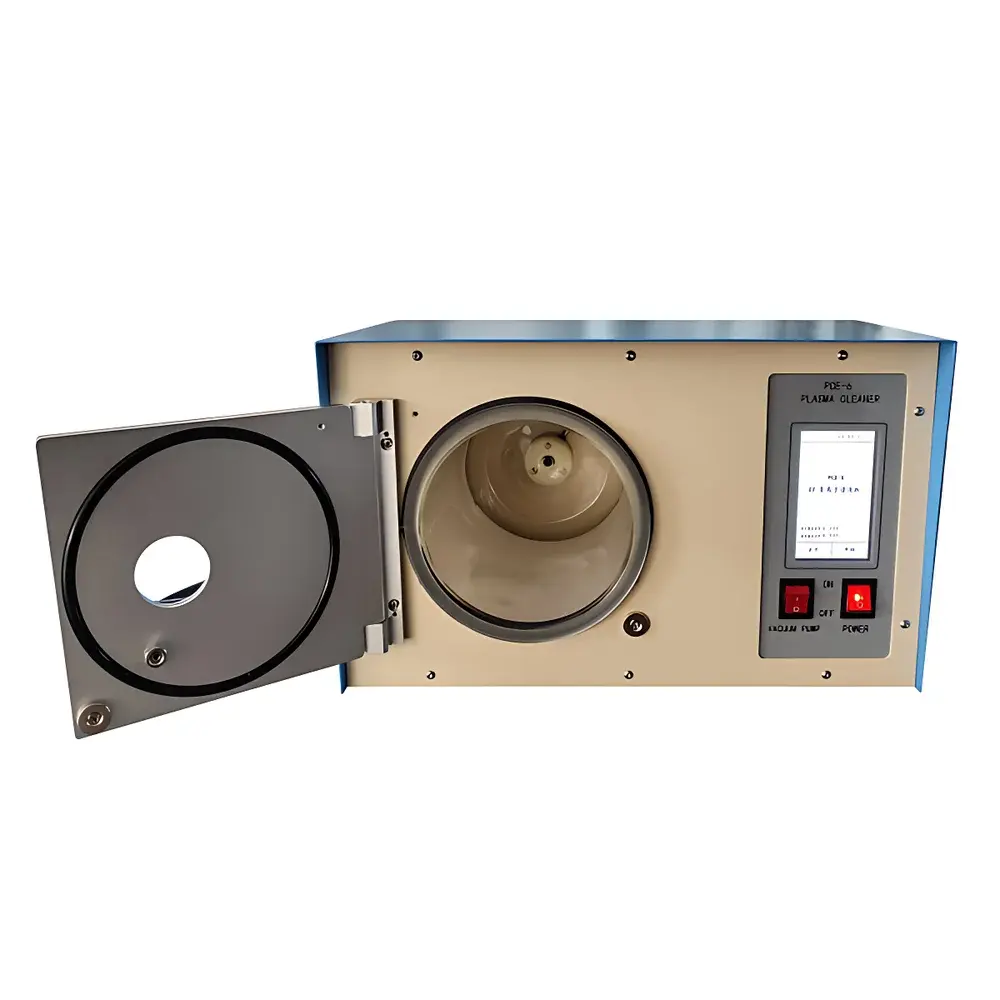
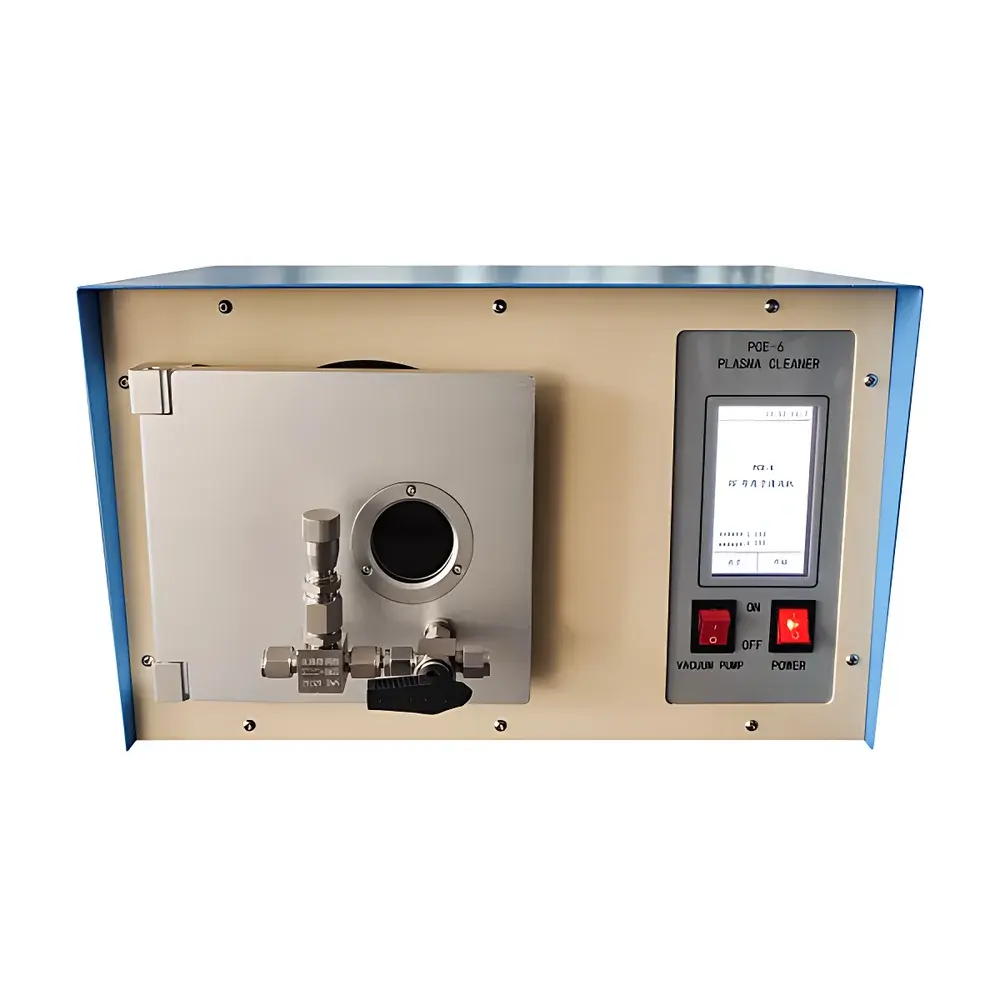
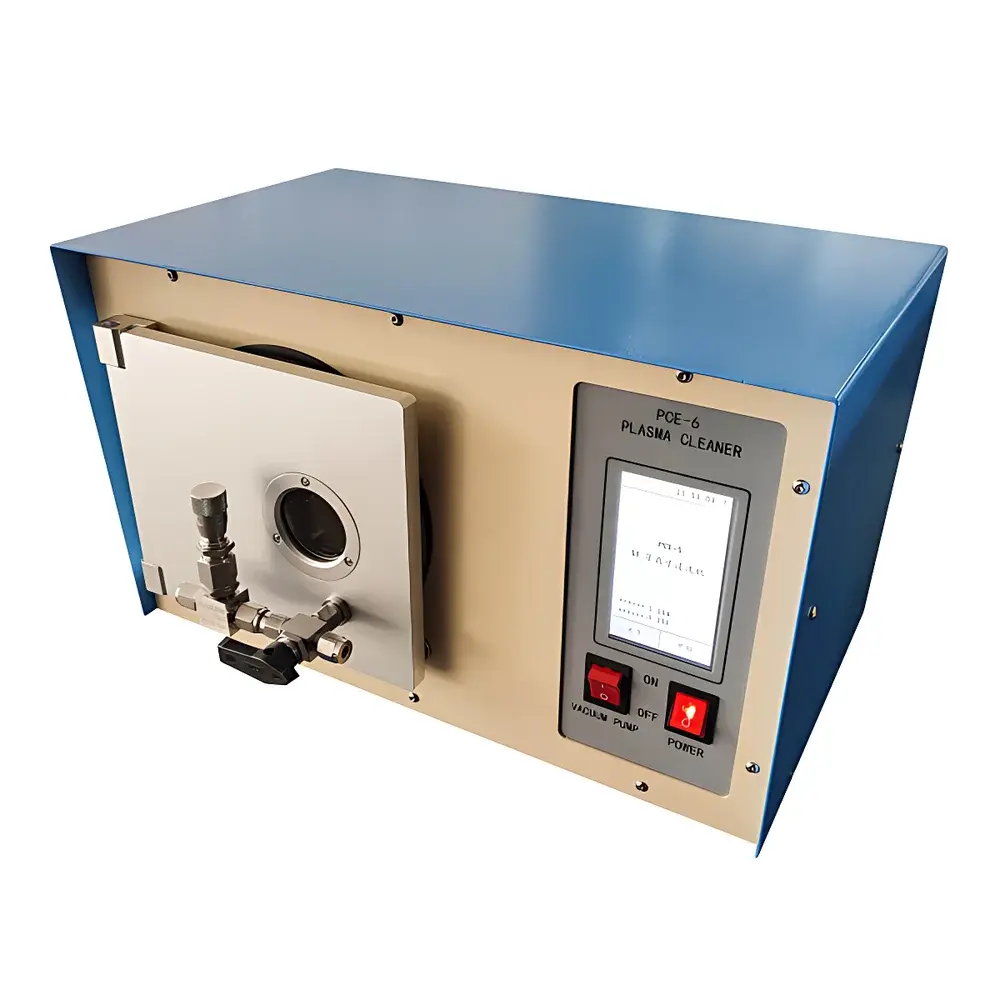
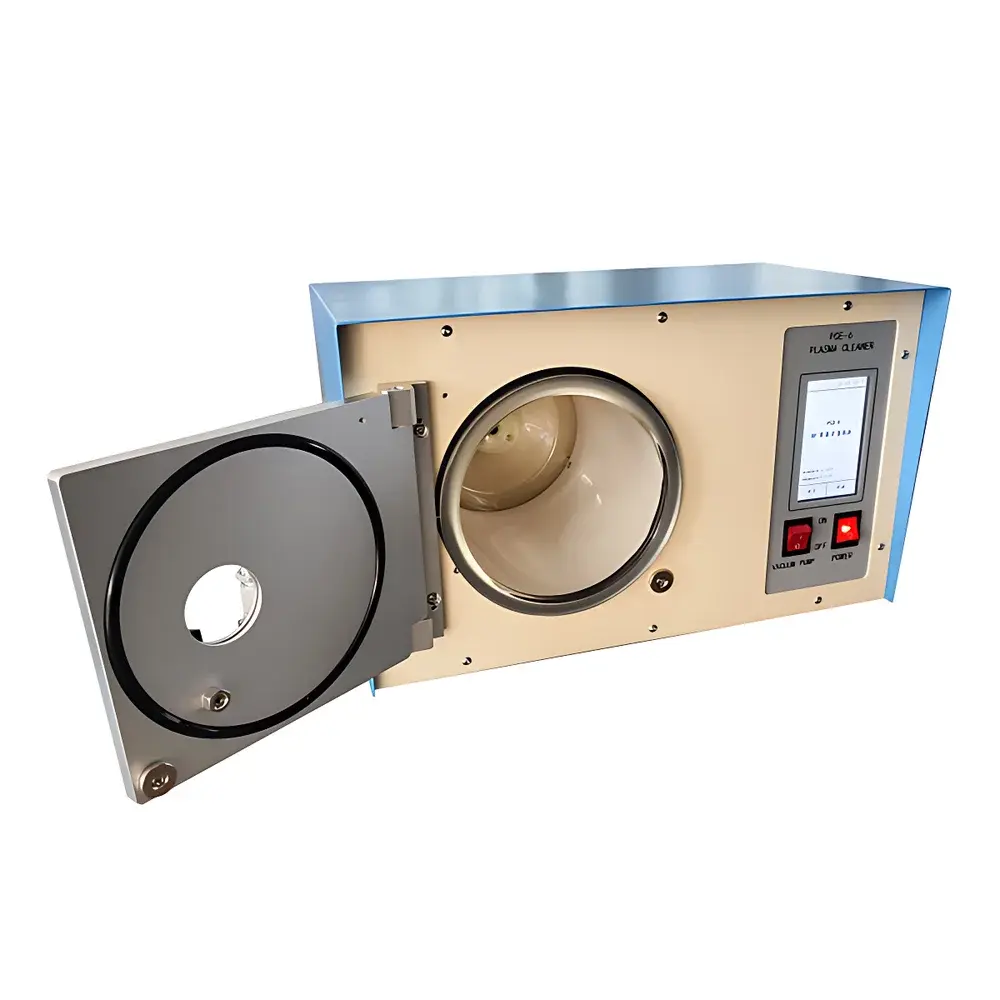
KJ GROUP PCE-6 Compact RF Plasma Cleaner
| Brand | KJ GROUP |
|---|---|
| Origin | Liaoning, China |
| Manufacturer Type | Authorized Distributor |
| Country of Origin | China |
| Model | PCE-6 |
| RF Frequency | 3.0 MHz (±1%) |
| Output Power | 7.2 W / 10.2 W / 29.6 W (3-step manual adjustment) |
| Chamber Dimensions | Ø160 mm × 190 mm |
| Chamber Volume | ≈3.8 L |
| Chamber Material | High-purity fused quartz |
| Vacuum Pump | Direct-coupled dual-stage rotary vane pump, 120 L/min |
| Ultimate Vacuum | ≤50 mtorr |
| Gas Inlets | 3 independent mass-flow-controlled ports (6 mm Swagelok® compression fittings) |
| Gas Compatibility | O₂, N₂, Ar, H₂, air, and custom gas mixtures |
| Control Interface | Manual tactile panel with real-time digital display of power, time, and vacuum level |
| Overall Dimensions | 400 mm × 300 mm × 300 mm |
| Net Weight | 10.2 kg |
| Input Power | AC 220 V, 50/60 Hz |
| Total System Power Consumption | <600 W |
| Vacuum Pump Power | <500 W |
| Sealing | Aluminum folding flange with Ø45 mm quartz viewport |
Overview
The KJ GROUP PCE-6 Compact RF Plasma Cleaner is a benchtop low-pressure plasma system engineered for precision surface activation, organic contaminant removal, and controlled surface functionalization in research and quality control laboratories. It operates on the principle of capacitively coupled radio-frequency (RF) plasma generation at 3.0 MHz — a frequency selected to balance efficient electron energy transfer with minimal substrate heating and dielectric stress. Within the high-purity fused quartz chamber (Ø160 mm × 190 mm), process gases—including oxygen, argon, nitrogen, hydrogen, synthetic air, or pre-mixed blends—are ionized under reduced pressure (≤50 mtorr) to generate reactive species (e.g., atomic oxygen, metastable atoms, UV photons, and low-energy ions). These species chemically etch hydrocarbon residues, reduce native oxides, and introduce polar functional groups (e.g., –OH, –COOH) to render surfaces hydrophilic—or conversely, fluorinated gases can induce hydrophobicity. Unlike atmospheric plasma systems, the PCE-6’s vacuum-based architecture ensures reproducible, uniform treatment across substrates up to 150 mm in diameter, with no arcing risk on delicate samples such as ITO-coated glass, silicon wafers, polymer films, or MEMS devices.
Key Features
- Compact footprint (400 × 300 × 300 mm) optimized for space-constrained labs and glovebox integration
- Fused quartz plasma chamber with optical-grade Ø45 mm viewport for real-time process observation and endpoint monitoring
- Three-step manually adjustable RF power output (7.2 W, 10.2 W, 29.6 W) enabling fine-tuned energy delivery for sensitive substrates or aggressive ashing
- Dual-stage rotary vane vacuum pump (120 L/min) achieving ≤50 mtorr base pressure within <90 seconds—critical for stable plasma ignition and gas-phase reaction control
- Triple independent gas inlet system with Swagelok® 6 mm compression fittings and integrated three-way valve for precise gas selection, flow switching, and chamber purging
- Tactile control panel with digital LED display showing real-time RF power, elapsed treatment time, and chamber vacuum level (in mtorr)
- Aluminum folding flange design ensures rapid chamber access, repeatable sealing integrity, and compatibility with standard vacuum accessories
Sample Compatibility & Compliance
The PCE-6 accommodates rigid and flexible substrates up to 150 mm in diameter and 20 mm in height—including silicon wafers, quartz slides, PDMS stamps, PET/PC films, metal foils, ceramic substrates, and bioactive scaffolds. Its low-power RF regime minimizes thermal load and ion bombardment damage, making it suitable for temperature-sensitive polymers (e.g., PMMA, SU-8, parylene) and biological coatings. The system supports method development aligned with ASTM F2525 (Standard Guide for Plasma Cleaning of Medical Device Components) and ISO 13485 process validation requirements. While not certified to FDA 21 CFR Part 11 out-of-the-box, its manual operation mode and deterministic parameter set (fixed power steps, discrete time settings, visible vacuum readout) facilitate full traceability during GLP/GMP-compliant cleaning protocols when paired with lab notebook documentation.
Software & Data Management
The PCE-6 operates via a dedicated hardware control interface without embedded microprocessor-based automation or PC connectivity. All operational parameters are set and monitored locally: RF power level (3 fixed steps), treatment duration (0–30 min, 1-sec resolution), and chamber vacuum (digital mtorr readout). This analog-digital hybrid architecture eliminates firmware dependencies, reduces electromagnetic interference risks near sensitive instrumentation (e.g., SEMs or AFMs), and ensures long-term operational stability without software updates or driver compatibility concerns. For regulated environments, users may log treatment records manually or integrate external timers/data loggers via dry-contact triggers (optional accessory port available upon request). No proprietary software installation, cloud services, or data export functions are included—consistent with ISO/IEC 17025 Clause 7.5.2 requirements for equipment with defined, non-programmable functionality.
Applications
- Pre-bonding surface activation of glass, silicon, and polymers to improve adhesion in microfluidic device assembly
- Removal of photoresist residuals and organic contaminants prior to thin-film deposition (e.g., sputtering, ALD, CVD)
- Hydrophilization of PDMS for improved aqueous reagent wetting in lab-on-a-chip platforms
- Surface oxidation of carbon-based materials (graphene, CNTs) to modulate work function and interfacial charge transfer
- Controlled ashing of soft lithography masters and replica molds without dimensional distortion
- Plasma-assisted cleaning of TEM grids, XRD sample holders, and SEM stubs to eliminate hydrocarbon buildup
- Functional group grafting on biomaterial surfaces (e.g., chitosan films, collagen scaffolds) to enhance cell attachment
FAQ
What gases are compatible with the PCE-6, and how are they introduced?
The system supports O₂, N₂, Ar, H₂, compressed air, and custom binary/mixed gases via three independently controllable inlet lines fitted with 6 mm Swagelok® compression fittings. A front-panel three-way valve enables sequential or simultaneous gas introduction with manual flow regulation.
Is the quartz chamber resistant to halogen-based chemistries (e.g., CF₄, SF₆)?
No. The fused quartz chamber is rated for oxygen, inert, and reducing plasmas only. Halogen-containing gases cause rapid etching of quartz and are strictly incompatible.
Can the PCE-6 be used for plasma etching of silicon or metals?
Limited etching is possible using O₂ or Ar/O₂ mixtures at 29.6 W, but the system lacks directional ion acceleration (no bias electrode) and is not designed for anisotropic etch profiles. It is optimized for isotropic surface modification—not microfabrication-grade etching.
Does the unit include vacuum oil, and what maintenance is required?
Yes, the dual-stage rotary vane pump ships with ISO VG 100 vacuum oil. Recommended maintenance includes oil changes every 200 operating hours and periodic inspection of the O-ring seal on the aluminum flange.
Is remote operation or automation possible?
Not natively. The PCE-6 is a manually operated instrument. Automation requires external relay control of the power switch and timer; no RS-232, USB, or Ethernet interface is provided.



