
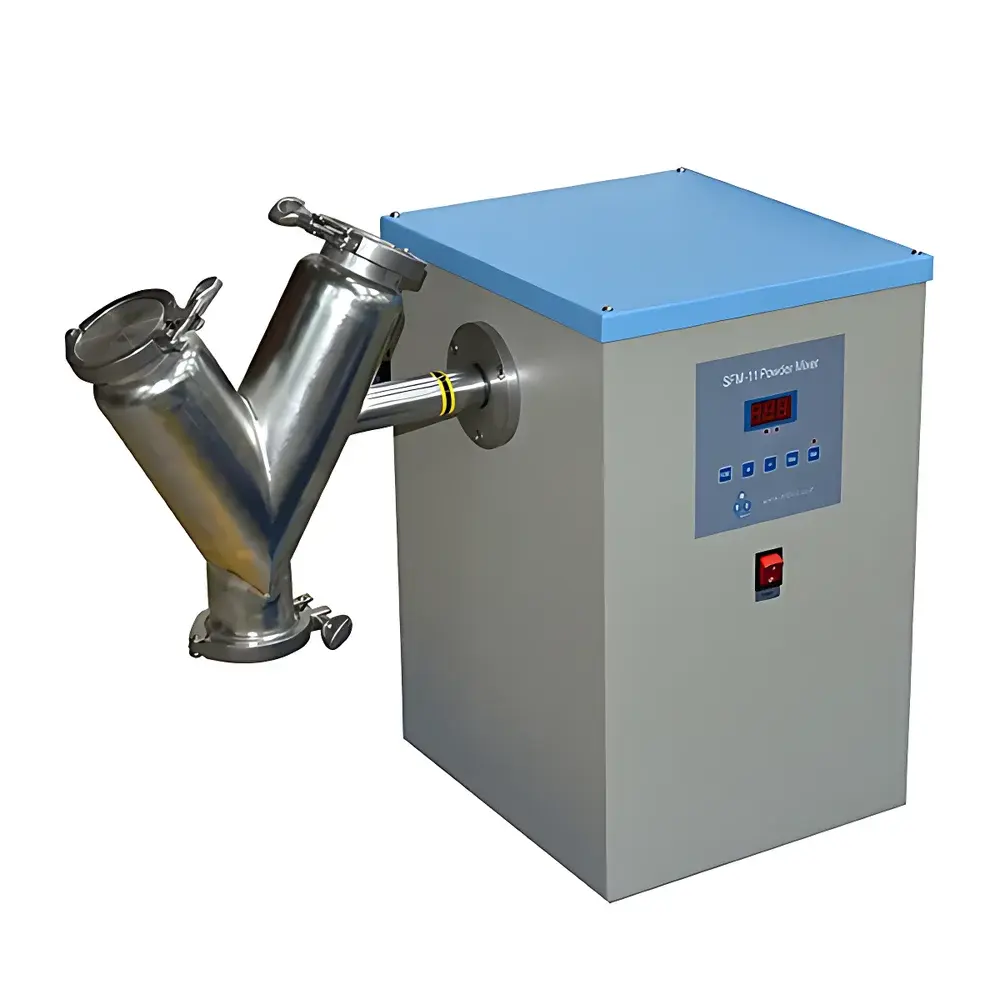
KJ GROUP SFM-11 Laboratory-Scale V-Shaped Powder Mixer
| Brand | KJ GROUP |
|---|---|
| Origin | Liaoning, China |
| Manufacturer Type | Authorized Distributor |
| Country of Origin | China |
| Model | SFM-11 |
| Price | Upon Request |
| Mixing Chamber Capacity | 2500 mL |
| Recommended Fill Ratio | 0.3–0.4 |
| Rotational Speed Range | 20–90 rpm |
| Timer Range | 1–900 min |
| Dimensions (L×W×H) | 550 × 270 × 550 mm |
| Net Weight | 45 kg |
| Chamber Material | Stainless Steel (AISI 304) |
| Optional Accessories | 50 mL & 250 mL V-shaped chambers |
Overview
The KJ GROUP SFM-11 Laboratory-Scale V-Shaped Powder Mixer is a precision-engineered, benchtop dry powder blending system designed for reproducible, low-volume homogenization of solid particulates in research and quality control environments. It operates on the principle of gravitational convective mixing—leveraging the symmetrical asymmetry of dual unequal-height V-shaped cylinders mounted on a central rotating arm. As the assembly rotates at controlled angular velocity, material undergoes continuous axial translation, radial inversion, and cascading motion within the chamber, enabling efficient interparticle dispersion without shear-induced degradation. This mechanism is particularly suited for fragile crystalline APIs, battery cathode precursors, ceramic green bodies, and composite polymer fillers where mechanical attrition must be minimized. The SFM-11’s compact footprint (550 × 270 × 550 mm), low acoustic emission (<65 dB(A) at 1 m), and sealed stainless-steel construction align with ISO 14644-1 Class 8 cleanroom compatibility requirements for pharmaceutical development labs.
Key Features
- Stainless steel (AISI 304) mixing chamber with electropolished interior surface—ensuring corrosion resistance, non-contamination, and full cleanability per FDA-recommended cleaning validation protocols.
- Adjustable rotational speed (20–90 rpm) via precision AC motor and frequency inverter, enabling optimization for density-mismatched blends (e.g., LiCoO₂ + carbon black) or cohesive fine powders (e.g., lactose monohydrate).
- Digital timer with 1-second resolution and programmable range from 1 minute to 15 hours—supporting GLP-compliant batch documentation and repeatable process parameter locking.
- Zero dead-volume geometry: seamless V-chamber welds and smooth internal radii eliminate material retention zones, reducing cross-contamination risk between sequential batches.
- Modular chamber interface: accepts optional 50 mL and 250 mL V-shaped auxiliary chambers for micro-scale formulation screening or high-value material conservation.
- Integrated safety interlock: automatic power cutoff upon chamber door opening, compliant with IEC 61000-6-2 electromagnetic immunity standards.
Sample Compatibility & Compliance
The SFM-11 accommodates free-flowing and marginally cohesive dry powders, granules, and micronized particles ranging from 1 µm to 2 mm in median particle size. It is routinely deployed in applications requiring adherence to USP uniformity of dosage units, ASTM D5727–22 for powder blend homogeneity assessment, and ISO 4776 for laboratory-scale mixing equipment classification. When used with certified grinding media—including agate (for trace-metal-sensitive electrochemical materials), yttria-stabilized zirconia (for high-energy impact-resistant milling), or 316L stainless steel (for general-purpose attrition)—the unit supports dual-mode operation: gentle blending (no media) or low-intensity mechanochemical activation (with media). All chamber and accessory materials comply with EU Regulation (EC) No. 1935/2004 for food-contact suitability and USP Class VI biocompatibility testing.
Software & Data Management
While the SFM-11 operates as a standalone electromechanical system, its digital timer module logs start time, duration, and final rotation count—data exportable via RS-232 serial interface to LIMS or ELN platforms (e.g., LabWare, Benchling). Optional firmware upgrade enables audit-trail functionality meeting FDA 21 CFR Part 11 requirements: electronic signatures, user-level access control, and immutable timestamped event records. Process parameters are stored in non-volatile memory with battery-backed retention (>10 years), ensuring continuity during power interruption—a critical feature for GMP-regulated stability studies.
Applications
- Pharmaceutical R&D: Blending of active pharmaceutical ingredients (APIs) with excipients prior to direct compression tablet development.
- Battery Materials: Homogenization of NMC/NCA cathode precursors with conductive carbon additives under inert atmosphere glovebox integration.
- Advanced Ceramics: Uniform dispersion of Al₂O₃ or SiC nanoparticles in polymeric binders for tape-casting slurries.
- Food Science: Pilot-scale mixing of functional ingredient blends (e.g., probiotics + prebiotic fibers) without thermal degradation.
- Electronics: Preparation of homogeneous ZnO or SnO₂ nanopowder dispersions for printed gas sensor fabrication.
- Metallurgy: Pre-alloying of refractory metal powders (e.g., W–Ni–Fe) prior to spark plasma sintering.
FAQ
What is the maximum recommended fill volume for the standard 2500 mL chamber?
The optimal loading range is 30–40% of total chamber volume—i.e., 750–1000 mL of bulk powder—to ensure sufficient headspace for effective tumbling motion and particle cascade.
Can the SFM-11 be operated under inert gas or vacuum conditions?
Yes—optional sealed chamber variants with Swagelok®-compatible gas inlet/outlet ports and Viton® O-rings are available for oxygen-sensitive formulations (e.g., lithium metal anode composites).
Is calibration of the rotational speed and timer traceable to national standards?
Speed accuracy is ±0.5 rpm (verified via laser tachometer against NIST-traceable reference); timer accuracy is ±0.1 s/hour (certified per ISO/IEC 17025-accredited calibration report).
How frequently should maintenance be performed on the drive train?
Lubrication of the planetary gear reducer is required every 2000 operational hours; belt tension inspection is recommended quarterly—full service manual and spare parts list provided with shipment.
Does KJ GROUP offer IQ/OQ documentation packages for regulated laboratories?
Yes—comprehensive Installation Qualification (IQ) and Operational Qualification (OQ) protocols, including test scripts, acceptance criteria, and raw data templates, are available upon request for GMP, GLP, and ISO 17025 compliance.



