
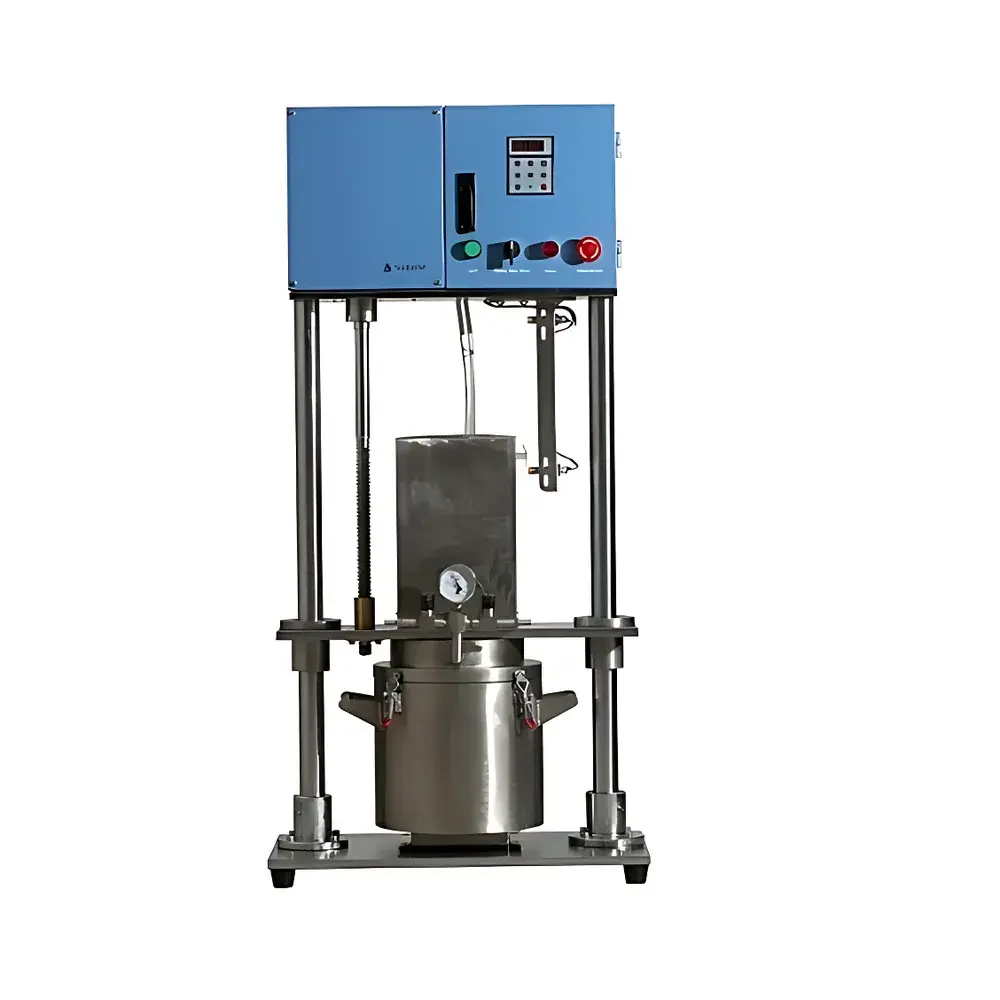
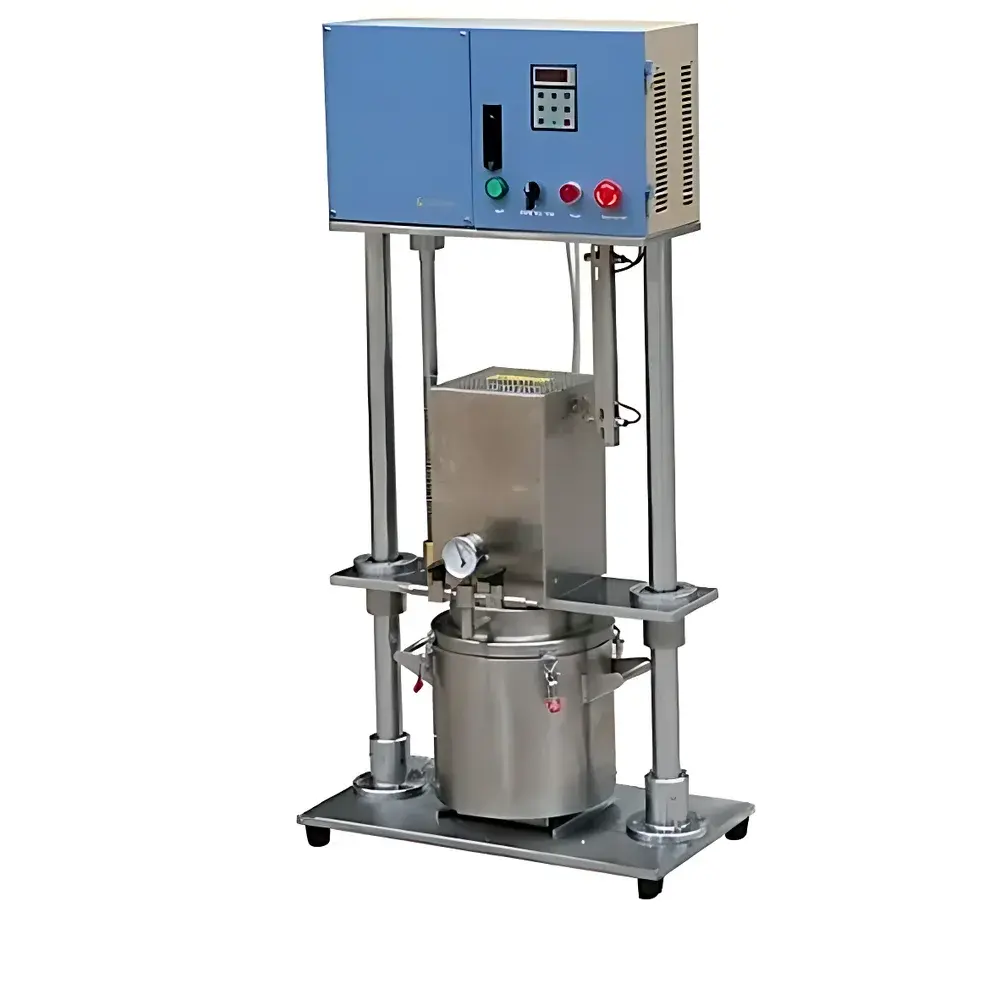
KJ GROUP SFM-6 Vacuum Planetary Mixer
| Brand | KJ GROUP |
|---|---|
| Origin | Liaoning, China |
| Manufacturer Type | Authorized Distributor |
| Country of Origin | China |
| Model | SFM-6 |
| Voltage | 220 V AC |
| Power Rating | 6 kW |
| Speed Range | 0–2800 rpm |
| Programmable Parameters | Time, Speed, Rotation Direction (CW/CCW) |
| Vacuum Capability | ≤12 hPa (maintained under sealed operation) |
| Chamber Construction | Dual-layer stainless steel (304 inner, 304 outer) |
| Lid Actuation | Pneumatic lift system |
| Dimensions (W×D×H) | 580 × 320 × 1340 mm |
| Net Weight | 120 kg |
| Certification | CE compliant per Machinery Directive 2006/42/EC and EMC Directive 2014/30/EU |
Overview
The KJ GROUP SFM-6 Vacuum Planetary Mixer is an engineered solution for high-integrity powder processing in R&D and pilot-scale laboratories. It operates on the principle of planetary motion—where mixing bowls rotate on their own axes while simultaneously revolving around a central axis—generating complex shear and centrifugal forces that ensure homogeneous dispersion of multi-component dry or semi-dry formulations. Integrated vacuum capability (≤12 hPa) suppresses oxidation, inhibits moisture absorption, and eliminates entrapped air during blending—critical for cathode active materials (e.g., LiCoO₂, LiFePO₄), advanced ceramics, battery electrode slurries, and functional composites where gas inclusion compromises density, conductivity, or sintering behavior. Designed for reproducible batch-to-batch consistency, the SFM-6 delivers controlled mechanical energy input without thermal runaway, supporting GLP-aligned process documentation when paired with validated software protocols.
Key Features
- Planetary dual-motion architecture: Independent rotation and revolution of mixing vessels ensures uniform shear distribution across viscous or granular matrices.
- Dual-layer 304 stainless steel vacuum chamber: Inner and outer walls provide structural integrity, thermal insulation, and long-term corrosion resistance under repeated vacuum cycling.
- Pneumatically actuated lid mechanism: Enables hands-free, repeatable sealing with calibrated pressure feedback—reducing operator variability and enhancing safety during vacuum hold phases.
- Wide-speed digital drive: 0–2800 rpm range accommodates low-shear deagglomeration (10–110 rpm) and high-energy homogenization (up to 2800 rpm), programmable in 1-rpm increments.
- Integrated programmable logic controller (PLC): Stores up to 20 user-defined recipes with time-stamped parameters—including speed ramp profiles, direction reversal sequences, vacuum dwell duration, and total cycle time.
- CE-certified design: Compliant with EN ISO 12100:2010 (risk assessment), EN 60204-1:2018 (electrical safety), and EN 61000-6-2/6-4 (EMC immunity/emission standards).
Sample Compatibility & Compliance
The SFM-6 accommodates standard laboratory mixing containers (e.g., 50–500 mL polypropylene, alumina, or stainless steel jars) with optional custom clamping fixtures. It supports powders with particle sizes ranging from submicron ceramics (100 µm), as well as solvent-based pastes with viscosities up to 10⁴ mPa·s. Vacuum compatibility enables processing of oxygen-sensitive compounds (e.g., lithiated transition metal oxides) without inert gas purging. All operational logs—including vacuum level, torque load, temperature rise (via optional PT100 sensor), and cycle completion status—are timestamped and exportable, facilitating alignment with ISO/IEC 17025 documentation requirements and internal audit trails for QC/QA departments.
Software & Data Management
The SFM-6’s embedded PLC interface provides real-time display of vacuum pressure (hPa), rotational speed (rpm), elapsed time, and direction status. Recipe data is stored locally with non-volatile memory retention (>100,000 write cycles). Optional RS-485 Modbus RTU or USB-C data export enables integration into LIMS or MES platforms. When used with KJ GROUP’s optional LabLink Pro software (v3.2+), users gain CSV-log generation, trend graphing of torque vs. time, deviation alerts for out-of-spec vacuum decay, and electronic signature support compliant with FDA 21 CFR Part 11 Annex 11 principles for regulated environments.
Applications
- Battery material R&D: Homogeneous blending of LiNiₓMnᵧCo₂O₂ (NMC), LiFePO₄, conductive carbon, and PVDF binders under inert or vacuum conditions.
- Advanced ceramics: Dispersing nano-ZrO₂, SiC, or AlN powders in organic carriers prior to tape casting or injection molding.
- Pharmaceutical solid dispersions: Preparing amorphous drug-polymer blends with minimized thermal history and oxidative degradation.
- Electronic pastes: Mixing Ag, Cu, or Ni metallizations for thick-film printing with controlled rheology and void minimization.
- Research-scale composites: Incorporating nanofillers (CNTs, graphene oxide) into polymer matrices without agglomeration.
FAQ
What vacuum level can the SFM-6 achieve and maintain during operation?
The chamber achieves and holds ≤12 hPa (≈9 mmHg) under static seal conditions; actual operating vacuum depends on sample outgassing and seal integrity.
Is the mixing speed adjustable in real time during a running cycle?
Yes—the PLC allows dynamic speed adjustment via front-panel encoder or external HMI without interrupting vacuum or motion sequence.
Does the SFM-6 support bidirectional mixing (clockwise and counterclockwise rotation)?
Yes; direction reversal is programmable per segment within a recipe, enabling optimized deagglomeration and shear reversal protocols.
Can torque monitoring be added as an upgrade?
Torque sensing is available as a factory-installed option (SFM-6-TQ), providing analog 4–20 mA output and digital logging synchronized with speed/vacuum data.
What maintenance intervals are recommended for pneumatic and vacuum components?
Pneumatic seals require inspection every 500 operating hours; vacuum pump oil (if external) should be changed per OEM schedule—typically every 3 months under continuous use.



