
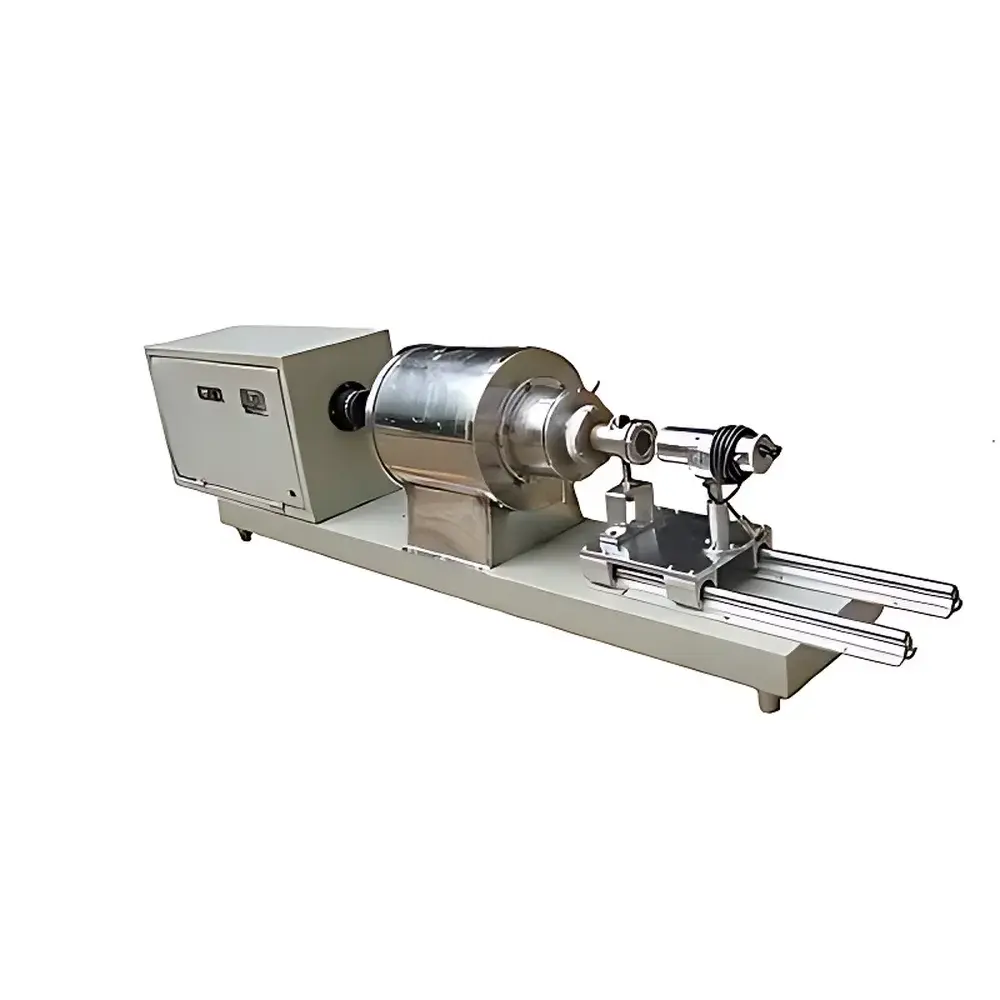
KJ GROUP SJY-II-14/17 Image-Based Sintering Point Analyzer
| Brand | KJ GROUP |
|---|---|
| Origin | Liaoning, China |
| Model | SJY-II-14/17 |
| Max Operating Temperature | 1400 °C or 1700 °C (selectable) |
| Furnace Bore Diameter | 30 mm |
| Heating Rate | 0–10 °C/min (programmable) |
| Temperature Control Accuracy | ±1 °C |
| Programmable Ramp Segments | ≥32 |
| Optical Magnification | 8×–9× |
| Image Capture Resolution | ≥12 MP CCD |
| Minimum Temperature Interval for Image Storage | 1 °C (user-adjustable) |
| Sample Geometry | Cylindrical, max Ø6 mm × 8 mm |
| Vacuum Capability | −0.1 MPa (standard) |
| Power Supply | 220 V ±10%, 2.5 kW |
| Interface | Standard computer interface (USB/RS-232) |
| Software Functions | Image storage/printing, contact angle quantification, linear dimensional change analysis (shrinkage/expansion), historical data retrieval, multi-frame temporal overlay |
Overview
The KJ GROUP SJY-II-14/17 Image-Based Sintering Point Analyzer is a high-temperature optical observation system engineered for quantitative thermal behavior characterization of refractory materials, foundry sands, ceramic raw materials, and metallurgical compacts. It operates on the principle of real-time transmitted-light imaging under controlled thermal ramping, enabling direct visual assessment of sintering onset, densification kinetics, surface melting, globularization, and interfacial wetting dynamics. Unlike conventional dilatometers or pyrometric softening point testers, this instrument integrates precision programmable heating with high-resolution digital imaging—allowing users to correlate morphological transitions (e.g., pore closure, particle coalescence, meniscus formation) with absolute temperature values at sub-degree resolution. Its design supports both industrial process validation and fundamental research into solid-state reaction mechanisms, phase evolution, and interfacial thermodynamics in oxidizing, inert, or vacuum-controlled atmospheres.
Key Features
- Two high-temperature furnace variants: 1400 °C and 1700 °C maximum operating temperatures, each featuring a 30 mm internal bore for uniform radial heat distribution and minimal thermal gradient across the field of view.
- Programmable multi-segment thermal profiling with up to 32 independent ramp/soak steps, adjustable heating rates from 0 to 10 °C/min, and PID-based temperature regulation achieving ±1 °C stability over extended dwell periods.
- Optical path optimized for transmitted illumination, delivering 8×–9× magnification with calibrated spatial referencing—enabling semi-quantitative measurement of axial and radial dimensional changes directly from captured frames.
- High-sensitivity 12-megapixel CCD camera synchronized with furnace temperature feedback; image capture interval configurable down to 1 °C increments, ensuring full temporal fidelity during critical transition events (e.g., initial shrinkage, neck formation, melt front propagation).
- Integrated vacuum system capable of reaching −0.1 MPa (100 mbar absolute); optional ultra-high vacuum configuration (1.0×10⁻² Pa) available for experiments requiring oxygen-sensitive or volatile-component suppression.
- Robust mechanical design with water-cooled optical viewport and thermally isolated imaging chamber to maintain long-term optical alignment and sensor integrity during repeated thermal cycling.
Sample Compatibility & Compliance
The SJY-II-14/17 accommodates standard cylindrical specimens measuring Ø6 mm × 8 mm, compatible with ASTM C24–22 (Standard Test Method for Pyrometric Cone Equivalent), ISO 565–2015 (Ceramic powders — Determination of sintering behavior), and GB/T 7322–2017 (Refractory materials — Determination of refractoriness). Custom sample holders—including low-mass alumina crucibles, graphite susceptors, and inert substrate mounts—are supported for specialized applications such as metal-ceramic wetting studies or slag-oxide interaction analysis. All operational parameters are logged with timestamped metadata, supporting GLP-compliant recordkeeping. The system meets IEC 61000-6-3 (EMC emission limits) and IEC 61000-6-2 (immunity requirements) for laboratory instrumentation.
Software & Data Management
Control and analysis are performed via dedicated Windows-based software communicating with the instrument through USB or RS-232. The software provides real-time temperature-image synchronization, allowing side-by-side comparison of thermal profiles and corresponding morphological sequences. Built-in tools include pixel-to-length calibration, dynamic contact angle measurement using tangent-fitting algorithms, time-temperature-shrinkage curve generation, and frame-differencing for localized expansion/contraction mapping. All images and derived metrics are stored in vendor-neutral TIFF and CSV formats. Audit trails record user actions, parameter modifications, and calibration events—fully compliant with FDA 21 CFR Part 11 requirements when configured with electronic signature and role-based access control.
Applications
- Determination of sintering onset temperature (SOT) and densification rate in advanced ceramics (e.g., SiC, Al₂O₃, ZrO₂) and powder metallurgy preforms.
- Quantification of refractoriness and softening behavior of fireclay, silica, and basic refractories used in blast furnace linings and ladle coatings.
- Interfacial contact angle measurement between molten metals (e.g., Al, Cu, Fe alloys) and oxide substrates—critical for predicting infiltration behavior in metal matrix composites.
- Evaluation of binder burnout kinetics and green body collapse thresholds in investment casting shell materials and ceramic core formulations.
- Teaching laboratories: Visual demonstration of solid-state diffusion, liquid-phase sintering, and eutectic melting phenomena in undergraduate and graduate materials science curricula.
FAQ
What temperature accuracy is achievable during dynamic heating cycles?
Temperature accuracy remains within ±1 °C across the full range, verified by integrated Pt/Rh thermocouple feedback and validated against NIST-traceable reference standards prior to shipment.
Can the system operate under reactive gas atmospheres (e.g., H₂, CO, NH₃)?
Yes—the furnace chamber is sealed and compatible with gas inlet/outlet ports; custom gas-handling modules (mass flow controllers, scrubbers, exhaust condensers) can be integrated upon request.
Is remote operation supported for unattended overnight testing?
Fully supported via Ethernet-enabled PC control; scheduled shutdown, email alerts on completion/failure, and automatic backup to network drives are configurable.
How is image focus maintained across large temperature ranges?
The optical stage incorporates a motorized focus mechanism with thermal drift compensation algorithm, automatically adjusting focus position based on real-time furnace temperature feedback.
Does the software support batch processing of multiple test runs for statistical comparison?
Yes—data export templates allow automated extraction of key metrics (e.g., Tshrink-start, Tglobular, θcontact) across datasets, enabling ANOVA-ready tabulation in external statistical packages.



