
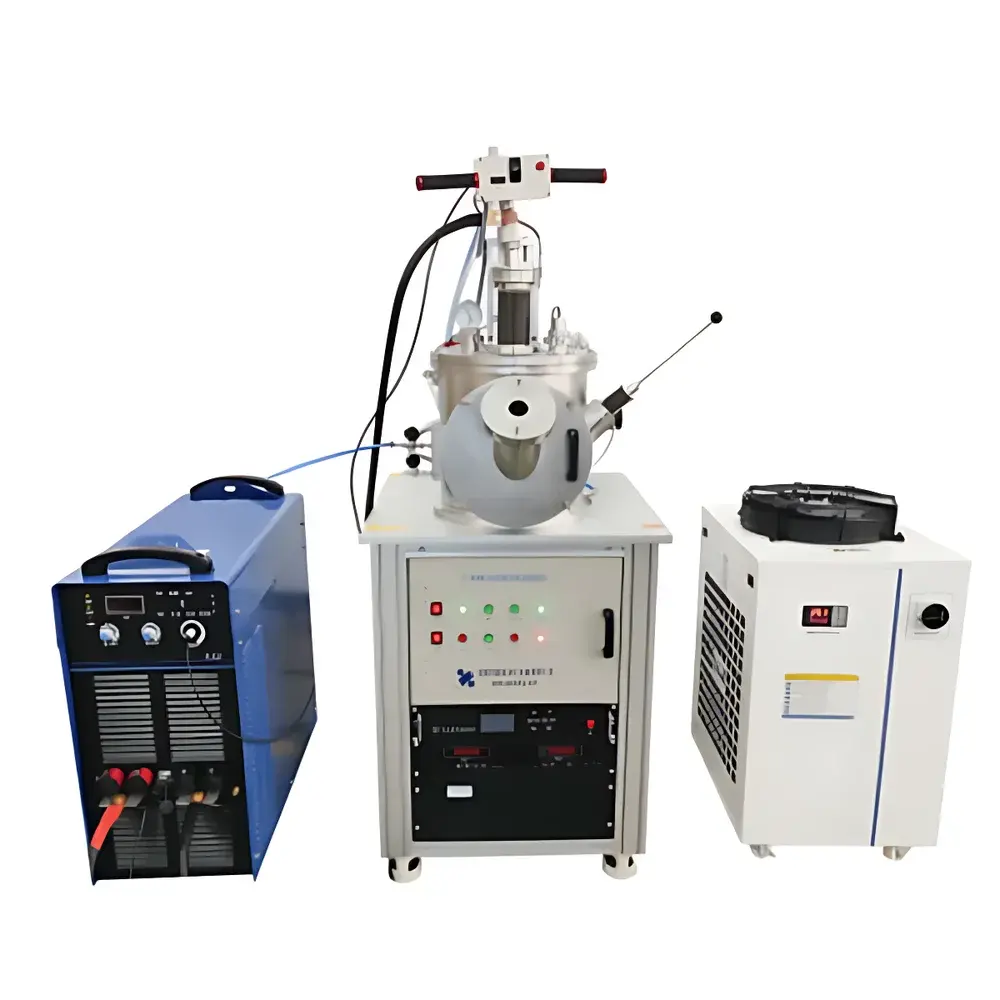
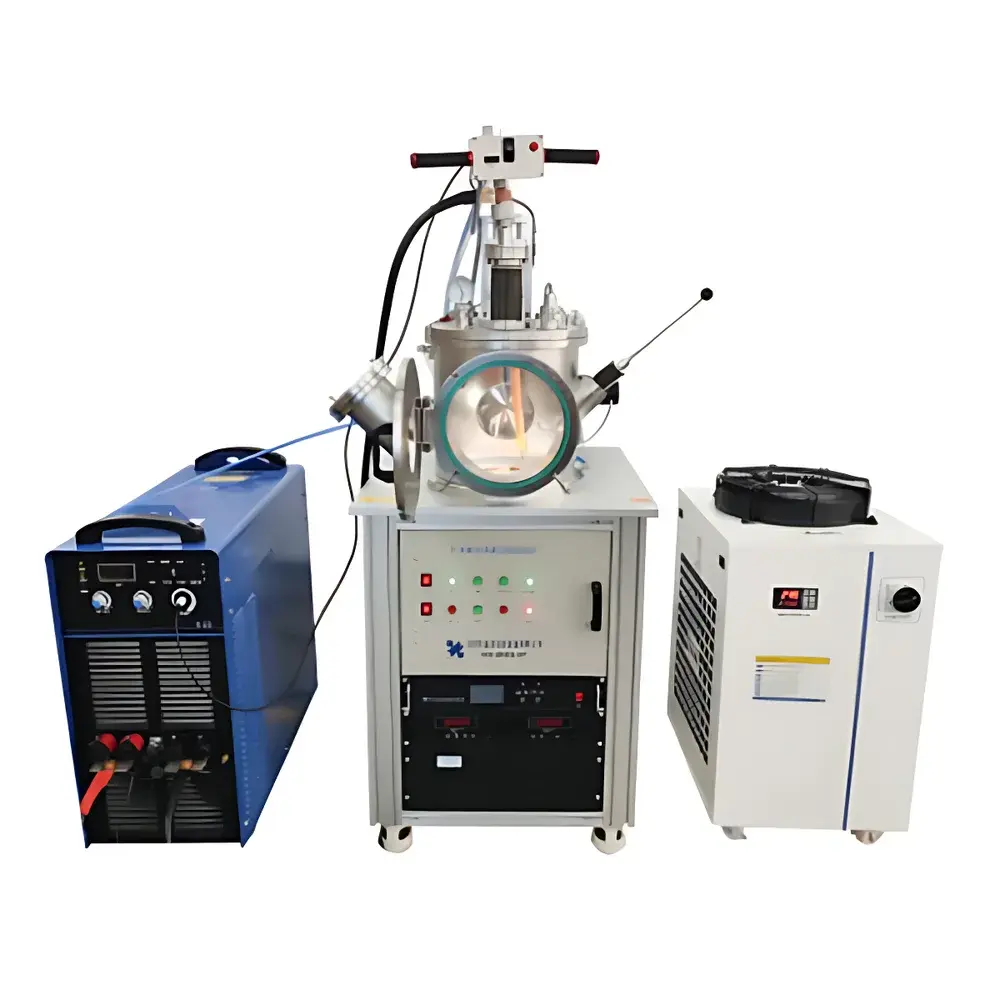
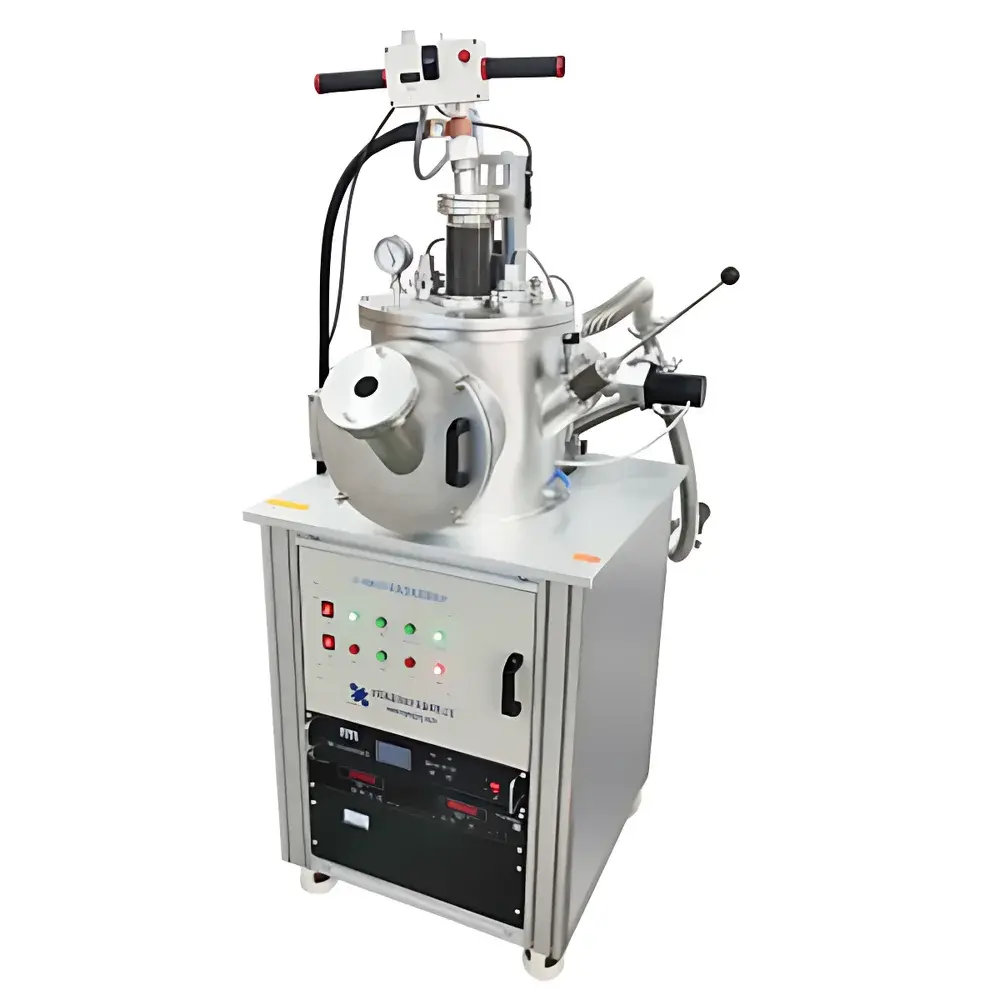
KJ GROUP SP-MSM1000 High-Vacuum Arc Melting Furnace
| Brand | KJ GROUP |
|---|---|
| Origin | Liaoning, China |
| Manufacturer Type | Direct Manufacturer |
| Origin Category | Domestic (China) |
| Model | SP-MSM1000 |
| Max Operating Temperature | 3500 °C |
| Base Vacuum | ≤1×10⁻⁶ torr (with turbomolecular pump, cold state) |
| Chamber Dimensions | Φ400 mm × 350 mm |
| Cooling | Dual-loop deionized water system (flow rate: 2 m³/h |
| pressure | 0.2–0.4 MPa |
| temp | 15–25 °C) |
| Arc Power Supply | 22.6 kW, max arc current: 630 A |
| Total System Power | ≤27 kW (380 V, 3-phase, 50/60 Hz) |
| Crucible Capacity | up to 500 g per station |
| Optional Modules | Suction casting (Φ8×75 mm), gravity casting (Φ20×80 mm) |
| Compliance | Designed for ASTM F2629, ISO 15148, and GLP-compliant metallurgical sample preparation workflows |
Overview
The KJ GROUP SP-MSM1000 High-Vacuum Arc Melting Furnace is a research-grade metallurgical synthesis platform engineered for precise, contamination-controlled melting and refining of refractory metals and advanced alloys under ultra-high vacuum or high-purity inert gas atmospheres. It operates on the principle of direct-current (DC) consumable-electrode arc melting—where a high-current arc (up to 630 A) is struck between a water-cooled copper electrode and a conductive charge placed in a water-cooled copper crucible. This localized, high-energy heat source enables rapid, uniform heating to temperatures exceeding 3500 °C—sufficient to melt tungsten, molybdenum, niobium, tantalum, and intermetallic compounds with minimal volatilization loss. The dual-layer SS304 stainless steel chamber, integrated with a quartz viewport and active water cooling, ensures structural integrity during thermal cycling and maintains vacuum integrity down to ≤1×10⁻⁶ torr (measured at cold state with turbomolecular pumping). Designed for reproducible alloy homogenization and compositional control, the SP-MSM1000 supports iterative remelting—via motorized electrode positioning and vacuum-compatible mechanical manipulation—without breaking atmosphere, thereby preserving stoichiometry and minimizing oxidation or nitrogen pickup.
Key Features
- Dual-layer water-cooled stainless steel (SS304) vacuum chamber with integrated quartz observation window for real-time process monitoring
- High-efficiency DC arc power supply (22.6 kW, 630 A max) with stable arc ignition and adjustable current/voltage profiles
- Water-cooled copper crucible with built-in electromagnetic stirring—enhancing melt homogeneity and reducing segregation in multi-component alloys
- Motor-driven vertical electrode actuation system enabling precise arc gap control and repeatable electrode positioning
- Vacuum-compatible mechanical manipulator arm for in-situ ingot flipping and reorientation under inert gas or vacuum conditions
- Modular configuration support: single- or multi-station crucible arrangements (standard capacity: 500 g per station)
- Integrated turbomolecular pump system achieving base pressure ≤1×10⁻⁶ torr; compatible with high-purity argon (≥5.0 N) backfilling
- Dedicated closed-loop deionized water cooling circuit (KJ-6200 chiller, 2 m³/h flow) for simultaneous cooling of chamber walls, crucible, and electrode
Sample Compatibility & Compliance
The SP-MSM1000 accommodates a broad spectrum of conductive metallic feedstocks—including elemental powders, pre-alloyed pellets, master alloys, and scrap—enabling synthesis of Ti-, Ni-, Co-, Fe-, Zr-, and refractory-based systems (e.g., NbSi₂, MoSi₂, NiAl, HEAs). Its design conforms to key metallurgical process standards: ASTM F2629 (Standard Practice for Arc Melting of Titanium and Titanium Alloys), ISO 15148 (Metallic materials — Determination of melting temperature by differential thermal analysis), and supports GLP/GMP-aligned documentation requirements when paired with validated data logging. Vacuum integrity and gas purity controls meet prerequisites for oxygen-sensitive processing per ASTM E1447 and USP , ensuring low interstitial content (O, N, C) in final ingots. All wetted surfaces are electropolished SS304 or oxygen-free high-conductivity (OFHC) copper—minimizing metallic contamination and facilitating cleaning between runs.
Software & Data Management
While the SP-MSM1000 operates via industrial PLC-based local control (HMI touchscreen interface), it supports optional RS485/Modbus TCP integration for external SCADA or LIMS connectivity. Real-time parameters—including arc voltage/current, chamber pressure (capacitance manometer + Pirani gauge), coolant temperature/flow, and electrode position—are logged at user-defined intervals (1–30 s resolution) and exportable in CSV format. Audit trails comply with FDA 21 CFR Part 11 requirements when deployed with validated third-party electronic lab notebook (ELN) software. Vacuum pump status, overtemperature alarms, and arc instability detection are mapped to discrete digital I/O outputs for facility-wide safety interlocking.
Applications
- Primary synthesis and purification of high-melting-point metals (W, Mo, Ta, Nb) and their alloys
- Preparation of homogeneous master alloys for subsequent casting, additive manufacturing, or powder metallurgy feedstock
- Compositional refinement via multiple remelting cycles under controlled Ar partial pressure
- Ingot homogenization studies for phase diagram validation and solidification behavior analysis
- Small-batch production of research-scale samples for XRD, SEM-EDS, TEM, and mechanical testing
- Development of thermoelectric, high-entropy (HEA), and amorphous-forming metallic systems
- Suction casting of rod-shaped specimens (Φ8×75 mm) for tensile or creep testing
- Gravity casting into cylindrical molds (Φ20×80 mm) for microstructure evaluation and DSC calibration standards
FAQ
What vacuum level is achievable, and how is it measured?
Base pressure ≤1×10⁻⁶ torr is verified using a calibrated capacitance manometer in the cold chamber, with the turbomolecular pump operating at full speed and all valves sealed.
Can the furnace operate under controlled gas partial pressures?
Yes—high-purity argon (≥5.0 N) is introduced via mass flow controller; pressure regulation from 10⁻⁶ torr (vacuum) to 1 atm is supported with real-time feedback.
Is electromagnetic stirring compatible with all crucible sizes?
Stirring functionality is standard across all water-cooled copper crucibles offered; field strength and frequency are fixed but optimized for 100–500 g melt masses.
What electrical infrastructure is required for installation?
A dedicated 380 V, 3-phase, 50/60 Hz supply with ≥63 A circuit breaker and grounding resistance <4 Ω is mandatory; harmonic filtering is recommended due to SCR-based power supply topology.
How is maintenance access designed for critical components?
The top flange is hinged for rapid chamber opening; the electrode assembly, crucible mount, and molecular pump interface are modular and tool-free replaceable per OEM service manual procedures.



