
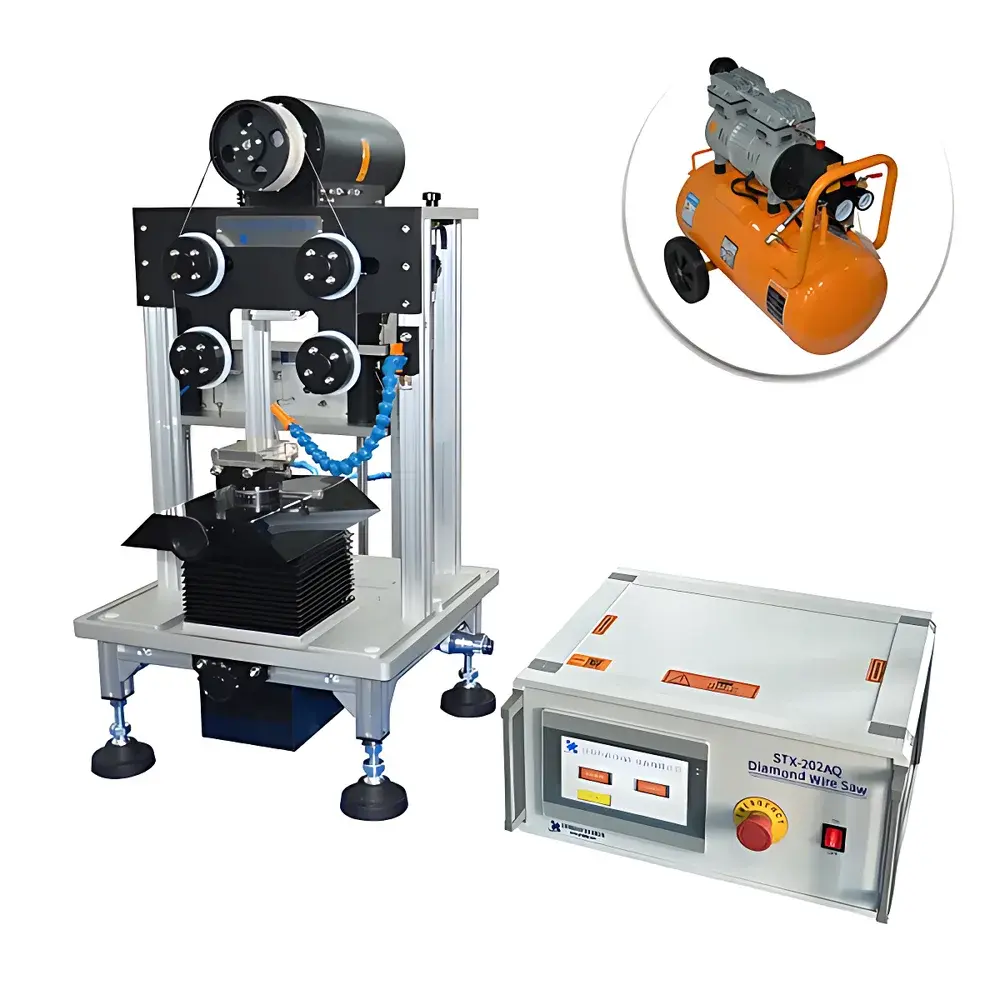
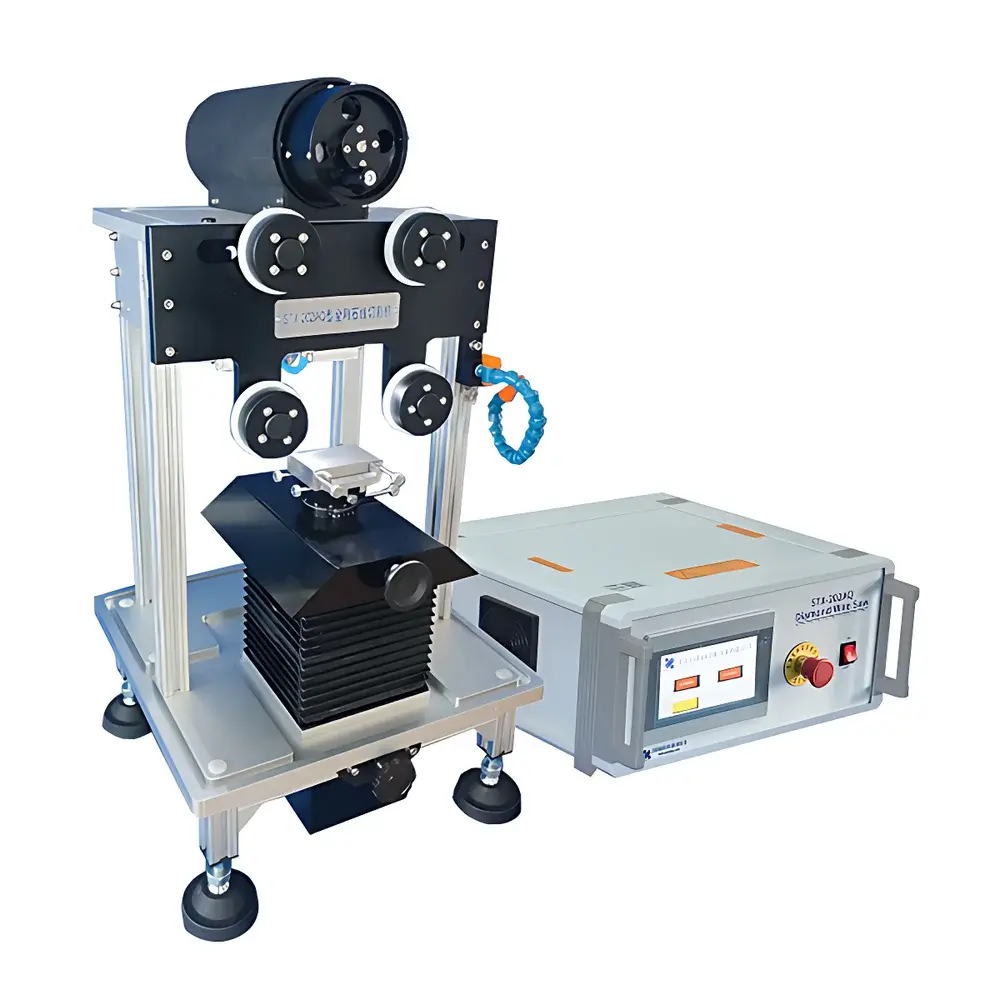
KJ GROUP STX-202AQ Precision Diamond Wire Saw
| Brand | KJ GROUP |
|---|---|
| Origin | Liaoning, China |
| Model | STX-202AQ |
| Instrument Type | Precision Diamond Wire Cutting System |
| Frame Material | Aluminum Alloy Structure |
| Power Supply | AC 220 V ±10%, 50 Hz, 10 A |
| Total Power Consumption | 100 W |
| Wire Diameter Range | Ø0.08–0.45 mm |
| Maximum Wire Length | ≤20 m |
| Wire Tensioning Method | Adjustable Pneumatic Tensioning (≥0.6 MPa Air Source Required) |
| Spindle Drive Mode | Reciprocating Rotation |
| Spindle Speed | 2–260 rpm (Adjustable) |
| Feed Rate | 0.05–40 mm/min |
| Retract Speed | 1–40 mm/min |
| Z-Axis Travel | ≤60 mm |
| Y-Axis Travel | ≤50 mm |
| Sample Holder Dimensions | 80 × 51 × 12 mm |
| Max Sample Diameter | Φ50 mm |
| Two-Axis Manual Rotary Stage | Horizontal 0–360°, Tilt ±15° |
| Guide Wheel Inner Span | ≤95 mm |
| Operating Ambient | 0–45 °C, 10–85% RH (non-condensing) |
| Cooling | Required (cutting oil recommended) |
| Control System | PLC + 7-inch Touchscreen HMI |
| Net Weight | ~40 kg |
| Footprint | 414 × 500 × 810 mm |
Overview
The KJ GROUP STX-202AQ Precision Diamond Wire Saw is an entry-level, benchtop diamond wire cutting system engineered for high-accuracy sectioning of brittle, anisotropic, and heterogeneous materials in academic research laboratories, materials science departments, and quality control facilities. It operates on the principle of abrasive wire sawing: a continuously reciprocating diamond-impregnated wire—tensioned pneumatically and driven by a precision-controlled spindle—removes material via micro-abrasion under controlled feed and coolant application. Unlike rotary blade or laser-based systems, this method minimizes thermal damage, mechanical stress, and chipping—critical for preserving crystallographic integrity in cleavable single crystals (e.g., Si, sapphire, Bi₂Te₃), minimizing delamination in layered composites, and maintaining interfacial fidelity in biomineralized tissues. The STX-202AQ supports both orthogonal slicing and angled sectioning (up to ±15° tilt), enabling preparation of oriented thin sections for XRD texture analysis, TEM lamella pre-thinning, geological thin-section mounting, and histological specimen fabrication.
Key Features
- Pneumatically regulated wire tensioning system ensures uniform, repeatable force application across wire diameters from Ø0.08 mm to Ø0.45 mm—preventing breakage during fine-wire operation while maintaining cut straightness and kerf consistency.
- Reciprocating spindle drive with 2–260 rpm variable speed control allows optimization of surface finish and material removal rate across hardness gradients—from soft polymers and biological tissues to hard ceramics (HV >15 GPa) and carbides.
- Linear motor-driven Z-axis feed with programmable velocity (0.05–40 mm/min) enables sub-micron positional repeatability and facilitates ultra-thin sectioning down to 80 µm thickness within a 25 mm × 25 mm area—validated per ASTM E3 for metallographic sample preparation.
- Modular aluminum alloy frame provides structural rigidity with low thermal drift and vibration damping—essential for long-duration unattended cuts (e.g., overnight geological slabbing) without dimensional drift.
- Dedicated PLC-based control unit with 7-inch resistive touchscreen interface supports parameter storage, stepwise program sequencing, real-time feed monitoring, and emergency stop integration—designed for compliance with IEC 61000-6-2/6-4 electromagnetic compatibility standards.
Sample Compatibility & Compliance
The STX-202AQ accommodates a broad spectrum of non-ferrous and non-magnetic specimens up to Φ50 mm diameter and 60 mm height—including oxide and nitride ceramics (Al₂O₃, ZrO₂, Si₃N₄), III–V and IV-group semiconductors (Si, Ge, GaAs), infrared optical crystals (ZnS, ZnSe, Ge), geological aggregates (granite, basalt, meteorites), thermoelectric ingots (Bi₂Te₃, PbTe), and hydrated biological composites (decalcified bone–implant interfaces, resin-embedded vascular grafts). All cutting protocols are compatible with ISO 14644-1 Class 8 cleanroom environments when used with external oil mist extraction. While the instrument itself does not carry CE or UL certification, its electrical architecture conforms to GB/T 18268.1–2010 (equivalent to IEC 61326-1) for laboratory measurement equipment. For GLP/GMP-regulated workflows, audit trails may be implemented via external logging of touchscreen event timestamps and manual logbook entries.
Software & Data Management
The STX-202AQ utilizes embedded firmware—not PC-hosted software—thereby eliminating OS dependency, driver conflicts, or cybersecurity vulnerabilities associated with Windows-based controllers. All operational parameters (speed, feed, dwell time, tension setpoint) are stored locally in non-volatile memory with password-protected access levels (operator vs. administrator). The touchscreen interface logs timestamped start/stop events and fault codes (e.g., “Tension Low”, “Coolant Flow Absent”) but does not support automated data export. Users requiring electronic records for FDA 21 CFR Part 11 compliance must integrate external USB data loggers or industrial PLC SCADA systems via RS-485 Modbus RTU port (available as optional interface module). No cloud connectivity or remote diagnostics are provided—ensuring full data sovereignty and alignment with institutional IT security policies.
Applications
- Materials Science: Cross-sectional slicing of sintered ceramic targets for SEM-EDS phase mapping; angle-cutting of thermoelectric bars for anisotropic resistivity testing per ASTM D790.
- Geosciences: Production of 30-µm-thick petrographic thin sections from silicate-rich rock cores using resin-embedded stabilization and slow-feed protocols.
- Electronics R&D: Kerf-free dicing of GaN-on-sapphire wafers prior to epitaxial lift-off; trenching of MEMS packaging substrates without sidewall chipping.
- Biomedical Engineering: Sectioning of titanium-coated dental implants bonded to human mandibular bone blocks—preserving osseointegration interfaces for histomorphometric quantification (BS/BV, Tb.Th).
- Optics Manufacturing: Fabrication of AR-coated ZnS windows with <±2 µm parallelism tolerance across 20 mm apertures—verified using Fizeau interferometry post-polishing.
FAQ
What cooling media are compatible with the STX-202AQ?
Mineral-based cutting oils (ISO VG 32–68) or water-soluble synthetic coolants meeting ASTM D4627 specifications are recommended. Pure water is not advised due to accelerated wire wear and corrosion risk on aluminum components.
Can the STX-202AQ perform fully automated multi-step cuts?
Yes—via programmable PLC sequences defining spindle speed, feed rate, retract velocity, and dwell time at endpoint. However, tool-change or repositioning between steps requires manual intervention.
Is vacuum chucking or magnetic fixturing supported?
No. The standard fixture uses mechanical clamping with brass-faced cross-vise jaws. Vacuum or electromagnetic alternatives are not offered nor mechanically adaptable to the existing stage interface.
What is the minimum achievable kerf width?
With Ø0.08 mm diamond wire and optimized feed/tension settings, kerf widths of 110–130 µm are routinely achieved on silicon—measured via optical profilometry per ISO 25178-601.
Does KJ GROUP provide IQ/OQ documentation packages?
Factory-issued Installation Qualification (IQ) checklists are included. Operational Qualification (OQ) test protocols must be developed in-house per user-defined acceptance criteria, as no standardized OQ templates are supplied.



