
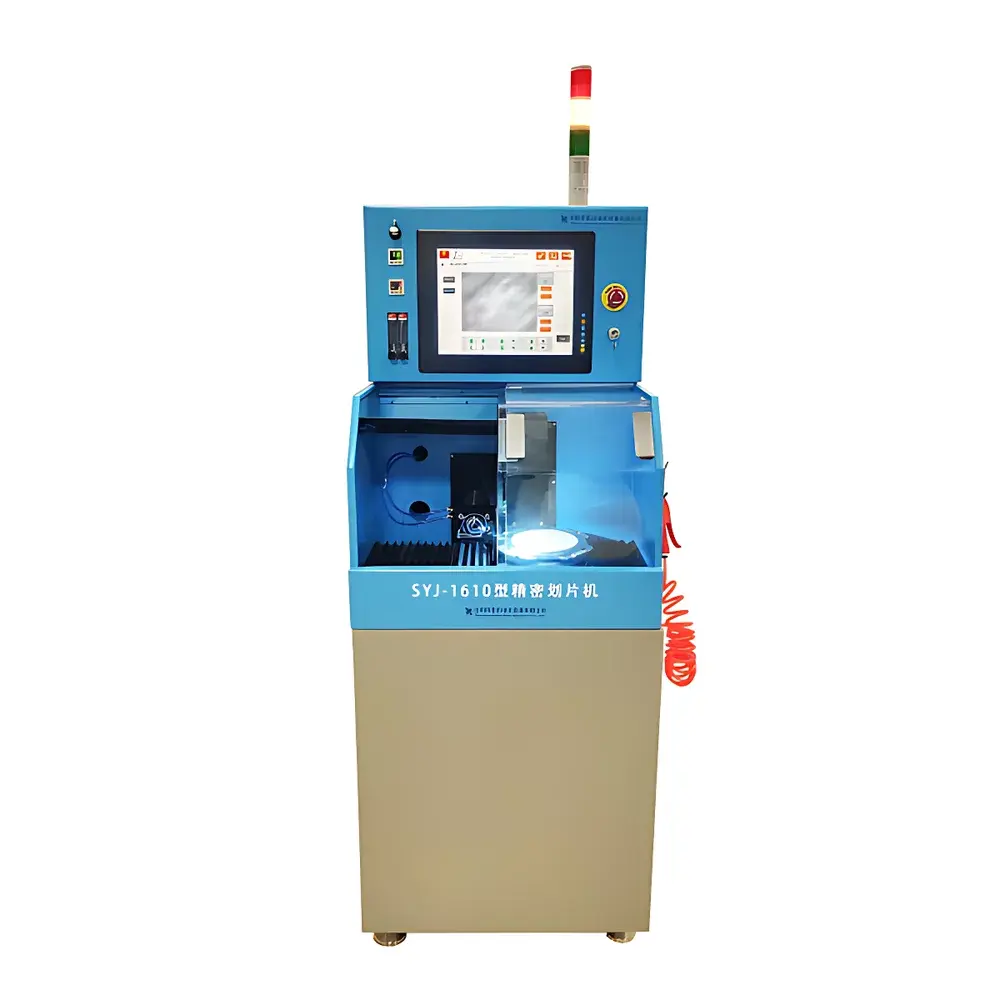
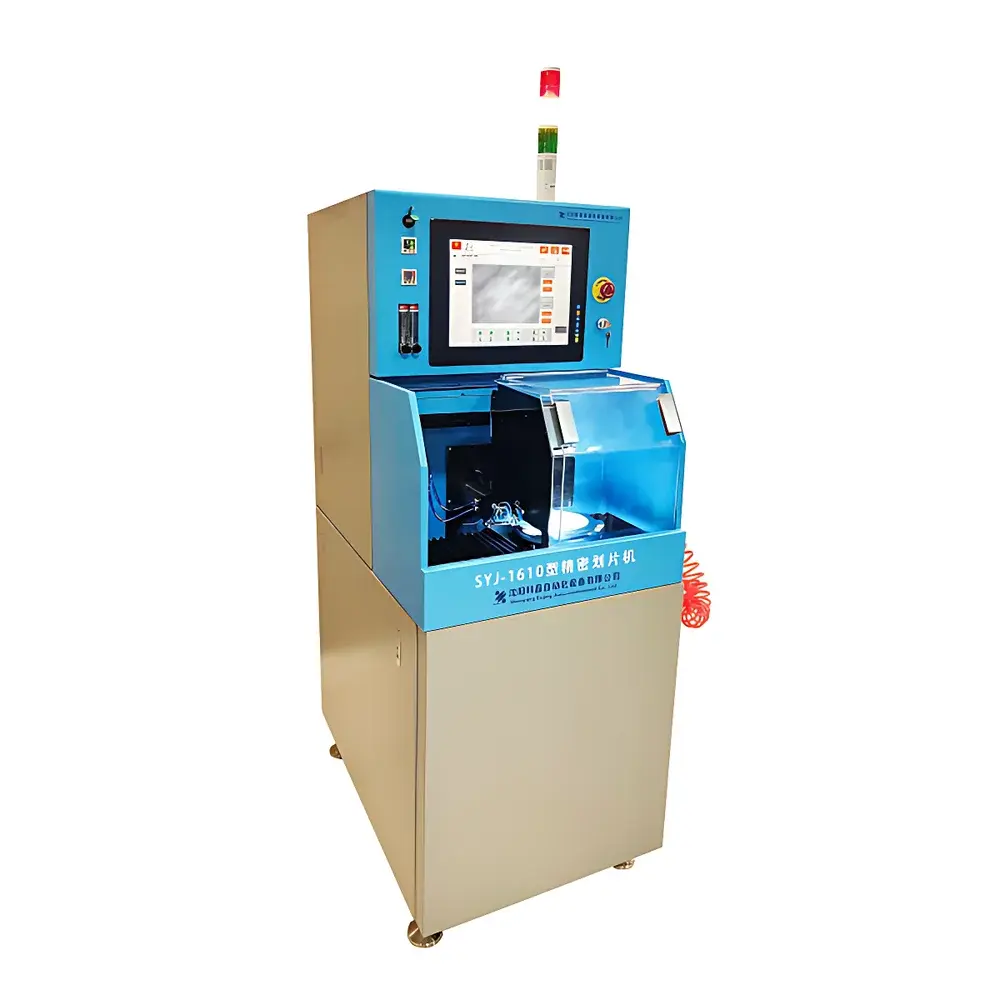
KJ GROUP SYJ-1610 Precision Dicing Saw
| Brand | KJ GROUP |
|---|---|
| Origin | Liaoning, China |
| Manufacturer Type | Authorized Distributor |
| Country of Origin | China |
| Model | SYJ-1610 |
| Instrument Type | Precision Dicing Saw |
| Power Supply | 220 VAC ±10%, Single-phase |
| Rated Power | 3.0 kW |
| Spindle Speed Range | 3,000–50,000 rpm |
| Spindle Output Power | 1.5 kW |
| X-axis Travel | 240 mm |
| X-axis Speed | 0–400 mm/s |
| Y-axis Travel | 165 mm |
| Y-axis Step Accuracy | 0.003 mm per 5 mm |
| Y-axis Full-range Positioning Error | ≤0.005 mm over 160 mm |
| Z-axis Stroke | 30 mm |
| Z-axis Repeatability | ±0.001 mm |
| Compatible Blade Diameter | φ50–φ60 mm |
| θ-axis Drive | Direct-Drive (DD) Motor |
| θ-axis Rotation Range | 320° |
| θ-axis Angular Resolution | 1 arcsecond |
| Illumination | LED Ring Light + Coaxial Illumination |
| Imaging System | Industrial CCD Camera |
| Display | 15″ Industrial-grade Color LCD Touchscreen |
| Control Architecture | PC-based with Embedded Windows XP |
| Workpiece Capacity | Ø150 mm (6″) Circular Chuck or 160 × 160 mm Square Stage |
| Dimensions (W×D×H) | 675 × 885 × 1665 mm |
| Net Weight | 500 kg |
Overview
The KJ GROUP SYJ-1610 Precision Dicing Saw is an industrial-grade, high-accuracy wafer and substrate dicing system engineered for controlled mechanical separation of brittle and composite materials in R&D laboratories and pilot production environments. It operates on the principle of precision abrasive blade cutting under computer numerical control (CNC), integrating air-bearing spindle technology, closed-loop motion control, and real-time process monitoring to achieve micron-level repeatability in kerf width, cut depth, and alignment accuracy. Designed for applications requiring minimal chipping, low subsurface damage, and strict dimensional fidelity—such as semiconductor packaging prototyping, MEMS device singulation, optical crystal segmentation, and ceramic or sapphire substrate dicing—the SYJ-1610 delivers deterministic material removal without thermal degradation or microcrack propagation.
Key Features
- Air-bearing spindle with 3,000–50,000 rpm variable-speed operation, delivering 1.5 kW continuous output power, low vibration (20,000 operating hours).
- XYZθ four-axis CNC architecture: X- and Y-axes employ imported linear guides and preloaded ball screws; Y-axis features full-closed-loop grating feedback with mathematical error compensation modeling for sub-micron positional fidelity.
- Z-axis with ±0.001 mm repeatability and non-contact height sensing capability enables automated blade-to-surface approach, eliminating manual trial cuts and minimizing tool wear.
- Direct-drive (DD) θ-axis with 320° rotation range and 1 arcsecond resolution supports precise angular indexing for multi-directional scribe lines and stepped-dicing patterns.
- Integrated 15″ industrial touchscreen HMI running a dedicated Windows XP-based control platform—fully localized in English firmware—enables all operations—including recipe loading, axis jogging, focus calibration, and emergency stop—via intuitive touch interface.
- Optical alignment subsystem includes a high-resolution industrial CCD camera, motorized auto-focus, and dual illumination modes (LED ring light and coaxial illumination) for enhanced contrast on reflective, transparent, or textured surfaces.
- Hermetically sealed water-resistant enclosure with stainless-steel wetted components, integrated coolant containment, and mist suppression ensures ISO Class 7 cleanroom compatibility and operator safety compliance.
Sample Compatibility & Compliance
The SYJ-1610 accommodates wafers and substrates up to Ø150 mm (6″) on vacuum chucks or square stages (160 × 160 mm), supporting silicon, GaAs, SiC, quartz, glass, alumina, LTCC, and polymer-based laminates. Its mechanical dicing methodology avoids plasma-induced damage or laser heat-affected zones, making it suitable for materials sensitive to thermal stress or electrical charging. The system conforms to general laboratory safety standards (IEC 61000-6-2/6-4 EMC immunity/emission), incorporates redundant interlocks (door lock, air pressure, coolant flow, and power sequencing), and supports audit-ready operation logs when integrated into GLP/GMP workflows via external data export protocols.
Software & Data Management
Control software provides programmable recipe management with up to 99 stored dicing profiles, each defining spindle speed, feed rate, cut depth, dwell time, and axis path interpolation. All parameters are timestamped and logged locally with checksum-verified storage. While native OS is Windows XP, the system exports ASCII-formatted log files (.csv/.txt) compatible with LIMS integration and statistical process control (SPC) platforms. Optional RS-232 or Ethernet communication modules enable remote status polling and alarm forwarding—though FDA 21 CFR Part 11 electronic signature compliance requires third-party validation and supplementary audit-trail middleware.
Applications
- Semiconductor R&D: Dicing of compound semiconductor wafers (e.g., InP, GaN) prior to packaging qualification.
- Micro-optics fabrication: Precise segmentation of fused silica or BK7 lens arrays without edge chipping.
- MEMS/NEMS prototyping: Singulation of piezoelectric or electrostatic actuators with <5 µm kerf tolerance.
- Advanced ceramics processing: Controlled sectioning of zirconia, silicon nitride, or aluminum oxide substrates for sensor element isolation.
- Academic thin-film research: Cross-sectional sample preparation for TEM/SEM analysis where ion milling artifacts must be avoided.
FAQ
What types of blades are compatible with the SYJ-1610?
Standard mounting accepts diamond-impregnated or resin-bonded blades with outer diameters between 50 mm and 60 mm, hub thickness ≤3.2 mm, and arbor size Ø12.7 mm.
Is vacuum chucking available for non-standard substrates?
Yes—customizable vacuum port configurations and replaceable chuck plates support irregular geometries, including rectangular dies and low-profile carriers.
Can the system perform partial-depth cuts or trenching?
Yes—Z-axis programmability allows stepwise depth control, enabling blind grooves, via formation, and layered-material selective ablation.
Does the SYJ-1610 support automated batch processing?
It supports sequential execution of multiple recipes but lacks robotic loader integration; manual loading/unloading is required between runs.
What maintenance intervals are recommended for the air-bearing spindle?
Compressed air filtration (0.01 µm, dew point <−20 °C) must be maintained continuously; scheduled bearing inspection is advised every 5,000 operational hours or annually, whichever occurs first.



