
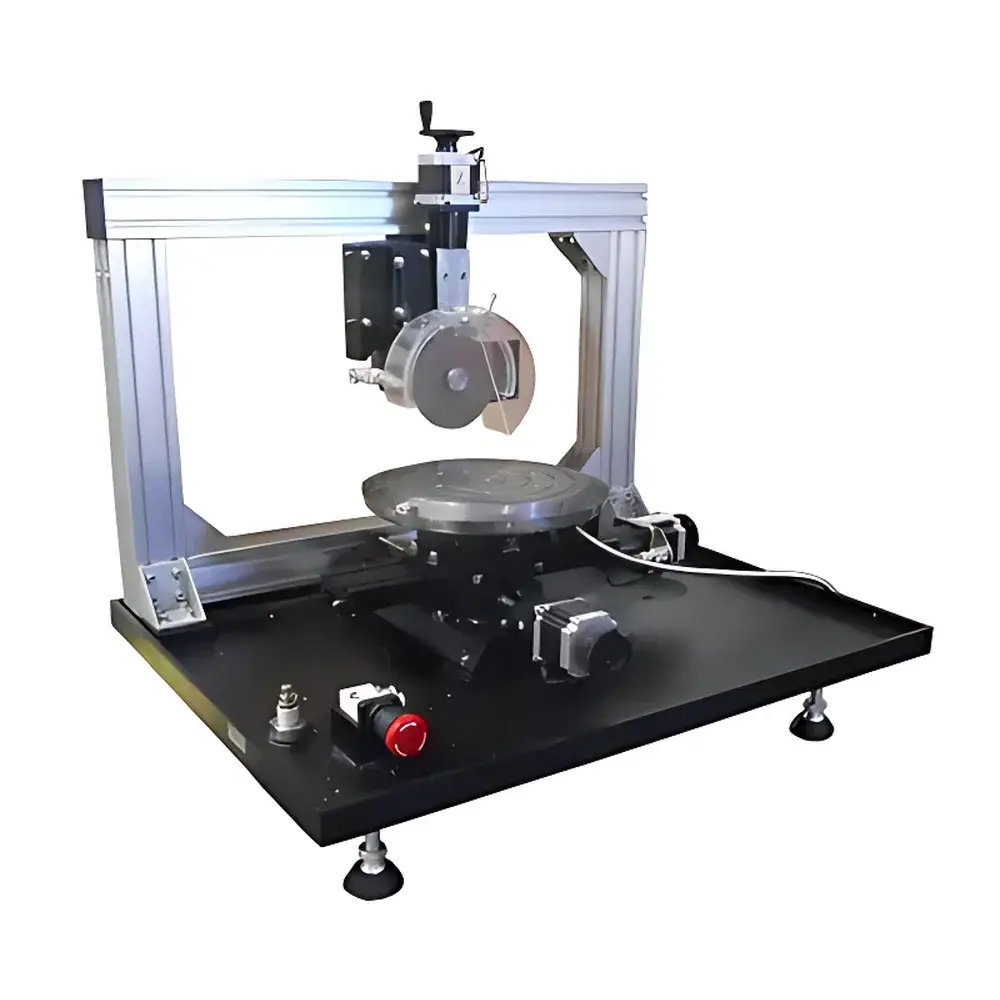
KJ GROUP SYJ-800 CNC Precision Dicing Saw
| Brand | KJ GROUP |
|---|---|
| Origin | Liaoning, China |
| Model | SYJ-800 |
| Instrument Type | Precision CNC Dicing Saw |
| Power Supply | AC 220 V, 50 Hz, 10 A |
| Spindle Speed | 0–3000 rpm (infinitely variable) |
| Spindle Motor Power | 180 W |
| X/Y Axis Travel | 200 mm × 200 mm |
| Z Axis Travel | 55 mm |
| Maximum Dicing Depth | 10 mm |
| Minimum Groove Depth | 1.3 mm |
| Positioning Accuracy (X/Y/Z) | 0.01 mm |
| Rotary Stage Accuracy | ±0.02° over 360° |
| Vacuum Chuck Diameter | Ø203.2 mm (8") |
| Carrier Plate Diameter | Ø220 mm (glass) |
| Compatible Blade Sizes | Ø100 mm / Ø150 mm (ID: Ø12.7 mm) |
| Blade Thickness Options | 0.15–0.5 mm |
| Operating Ambient | 0–45 °C, 10–85% RH (non-condensing) |
| Dimensions (W×D×H) | 700 × 530 × 710 mm |
| Weight | ≈55 kg |
| Control Interface | USB-connected Windows PC running MTICUT software |
Overview
The KJ GROUP SYJ-800 CNC Precision Dicing Saw is a computer numerical control (CNC)–driven dicing and grooving system engineered for high-accuracy sectioning of brittle and hard materials in research laboratories and pilot-scale production environments. It operates on the principle of controlled mechanical abrasion using diamond-impregnated or electroplated blades, with motion precisely governed by three-axis (X/Y/Z) stepper motor actuation and a programmable rotary stage. Unlike manual or semi-automatic cutters, the SYJ-800 integrates deterministic path planning via its proprietary MTICUT software—enabling repeatable, traceable, and parameterized dicing sequences across diverse substrates including single-crystal wafers, optical ceramics, fused silica, sapphire, silicon carbide, geological specimens, and metallurgical samples. Its design emphasizes thermal management through integrated coolant delivery, dimensional stability via rigid cast-aluminum frame construction, and process fidelity through sub-10 µm positioning resolution and angular repeatability within ±0.02°.
Key Features
- Three-axis CNC motion system (X/Y: 200 mm travel; Z: 55 mm) driven by high-resolution stepper motors with 0.01 mm positional accuracy per axis.
- Rotary sample stage with full 360° programmable rotation and angular positioning tolerance of ±0.02°, enabling radial kerf alignment and multi-angle dicing protocols.
- High-torque, brushless AC spindle motor (180 W) operating from 0–3000 rpm with infinitely variable speed control—optimized for balancing cutting efficiency and microstructural integrity across material classes.
- 8-inch precision vacuum chuck (Ø203.2 mm) compatible with standard 200 mm wafers; paired with Ø220 mm carrier plate for enhanced lateral rigidity during deep-sectioning operations.
- Dedicated coolant management system with inlet/outlet ports supporting continuous deionized water or corrosion-inhibited aqueous coolant circulation to suppress localized heating and prevent phase transformation or microcracking.
- Modular blade mounting interface accommodating standard diamond blades (Ø100 mm / Ø150 mm, ID Ø12.7 mm), including full-sintered, electroplated, and segmented dicing variants for tailored kerf width and material removal rate.
- Integrated splash guard and sealed linear guide systems to maintain mechanical longevity under wet-cutting conditions.
Sample Compatibility & Compliance
The SYJ-800 supports a broad spectrum of inorganic and composite substrates requiring precise geometric definition prior to microscopy, XRD, TEM lamella preparation, or device prototyping. Validated use cases include silicon, GaAs, LiNbO₃, Al₂O₃, ZnO, quartz, borosilicate glass, YAG crystals, tungsten carbide, and consolidated mineral aggregates. While not certified to ISO/IEC 17025 or accredited for regulatory submission, the system’s programmable parameters—including feed rate, spindle speed, depth per pass, and dwell time—support method development aligned with ASTM F2793 (Standard Guide for Sample Preparation for Transmission Electron Microscopy), ISO 14836 (Microelectronics—Wafer Dicing), and internal GLP-compliant SOPs. All motion and process logs are exportable via MTICUT software for audit trail generation, facilitating traceability in QA/QC workflows.
Software & Data Management
Control is executed exclusively via MTICUT—a Windows-based application delivered on USB media and requiring no network dependency or cloud registration. The software provides a graphical G-code editor, real-time axis position monitoring, and parametric macro libraries for common dicing patterns (e.g., orthogonal grids, concentric rings, radial spokes). Each executed program stores metadata (timestamp, operator ID, blade ID, coolant flow status) alongside raw coordinate trajectories. Export formats include CSV for post-processing in MATLAB or Python, and SVG for visual verification. No data resides on the instrument itself; all programs and logs persist solely on the host PC—ensuring full data sovereignty and compatibility with institutional IT security policies. The system does not implement FDA 21 CFR Part 11 electronic signature controls but supports manual logbook correlation for regulated environments.
Applications
- Preparation of cross-sectional specimens for SEM/EBSD analysis of grain boundary architecture in polycrystalline ceramics.
- Segmentation of 200 mm semiconductor wafers into die arrays with minimal chipping and subsurface damage.
- Sectioning of geological thin sections from rock cores while preserving textural relationships.
- Isolation of discrete regions from optoelectronic substrates (e.g., perovskite films on ITO/glass) for photoluminescence mapping.
- Generation of calibration standards for profilometry and interferometric thickness measurement.
- Prototyping of microfluidic channel arrays in fused silica via sequential groove-and-etch workflows.
FAQ
What cooling medium is recommended for extended operation?
Deionized water or commercially formulated aqueous coolants with corrosion inhibitors (e.g., Rustlick 222 or similar) are recommended. Tap water must be avoided due to mineral deposition risk on linear guides and spindle bearings.
Can the SYJ-800 perform step-cutting or multi-pass depth profiling?
Yes—the Z-axis is fully programmable with user-defined depth increments and dwell times, enabling controlled layer-by-layer ablation for TEM wedge preparation or stress-relief kerf strategies.
Is vacuum pump included with the base configuration?
Yes—an oil-free diaphragm vacuum pump is supplied as standard equipment to ensure clean, maintenance-light chuck actuation.
What file formats does MTICUT accept for importing custom toolpaths?
MTICUT natively reads G-code (ISO 6983) and supports manual entry of Cartesian coordinates. DXF import is not supported; vector paths must be converted externally using CAM preprocessing tools.
Does the system comply with CE or UL safety directives?
The SYJ-800 is manufactured to meet basic electrical safety requirements per GB 4793.1 (Chinese equivalent of IEC 61010-1). CE marking is not affixed; UL listing is not available. Custom compliance documentation may be provided upon request for site-specific risk assessments.



