
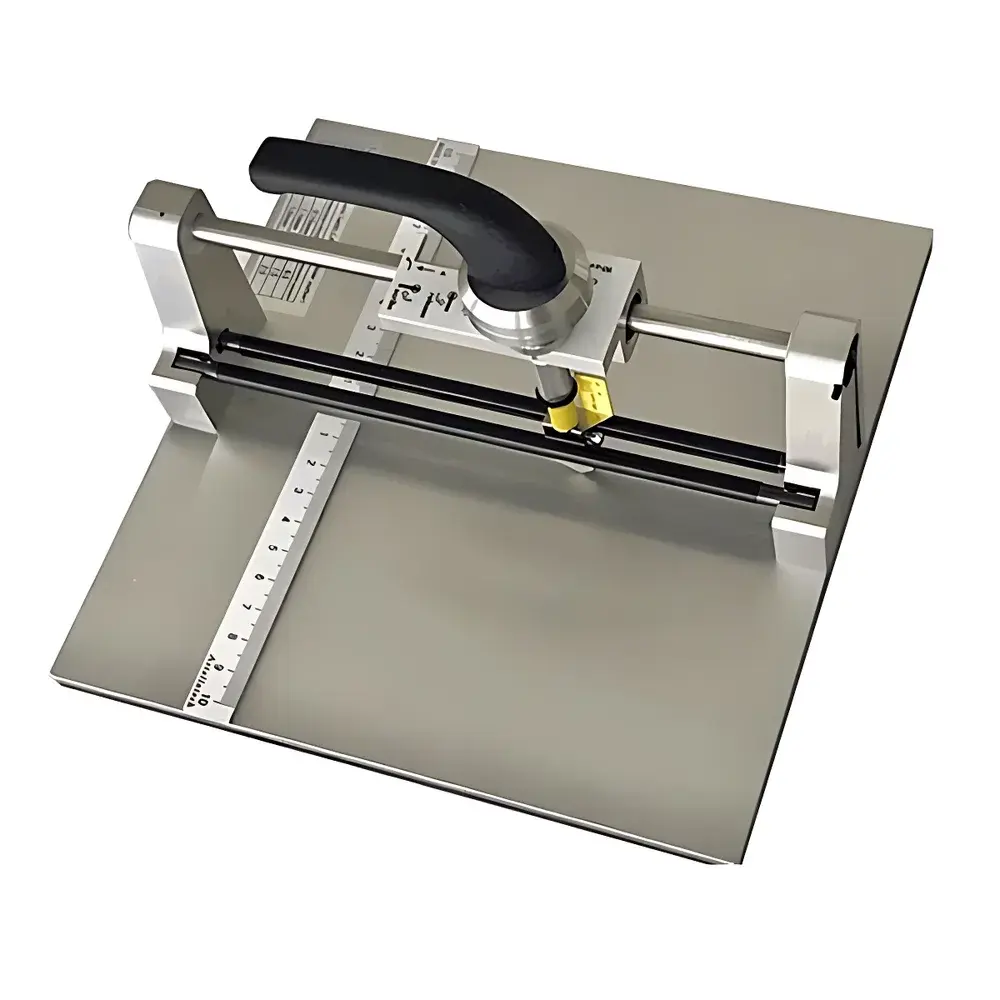
KJ GROUP SYJ-DS100 Precision Manual Scribe Machine
| Brand | KJ GROUP |
|---|---|
| Origin | Liaoning, China |
| Manufacturer Type | Authorized Distributor |
| Origin Category | Domestic (China) |
| Model | SYJ-DS100 |
| Pricing | Upon Request |
| Cutting Stroke | 100 mm |
| Adjustable Diamond Scribe Height | Yes |
| Spring-Loaded Downforce Control | Yes |
| Operating Environment | Altitude ≤ 1000 m, Temperature 25 °C ± 15 °C, Relative Humidity 55 %RH ± 10 %RH |
| Footprint | 300 mm × 300 mm Work Surface |
| Dimensions (L×W×H) | 210 mm × 210 mm × 140 mm |
| Power Requirement | None |
| Water/Gas Requirements | None |
| Ventilation | Required |
Overview
The KJ GROUP SYJ-DS100 Precision Manual Scribe Machine is a compact, hand-operated scribing instrument engineered for controlled linear scoring of brittle crystalline wafers and substrates. It operates on a mechanical scribing principle—utilizing a fixed-angle diamond-tipped stylus to induce localized micro-fracture propagation along a predefined path—without requiring electrical power, coolant, or compressed gas. Designed for laboratories and pilot-scale fabrication environments where process repeatability, minimal thermal disturbance, and substrate integrity are critical, the SYJ-DS100 supports deterministic cleavage of thin single-crystal materials including silicon (Si), sapphire (Al₂O₃), germanium (Ge), lithium niobate (LiNbO₃), and lithium tantalate (LiTaO₃). Its spring-loaded downforce mechanism enables fine-tuned control over scribe depth—critical for maintaining edge quality and minimizing subsurface damage in optoelectronic and MEMS-grade substrates.
Key Features
- Mechanically actuated scribing with zero electrical or pneumatic dependencies—ideal for cleanroom-adjacent or ESD-sensitive environments.
- Precision-adjustable diamond scribe height via calibrated rotary dial, enabling consistent tip engagement across varying substrate thicknesses (typical range: 100 µm–1 mm).
- Spring-based downforce regulation with marked scale (0–10 arbitrary units), allowing empirical optimization of fracture initiation without overloading fragile wafers.
- 100 mm linear stroke travel ensures full-width scribing of standard 2-inch and 3-inch wafers; compatible with manual stage repositioning for multi-line patterns.
- Modular scribe head assembly facilitates rapid diamond stylus replacement using standard hex-key tools—no alignment fixtures required post-installation.
- Compact footprint (210 × 210 × 140 mm) and low mass (≈4.2 kg) support integration onto vibration-isolated optical tables or shared lab benches.
- Non-powered operation eliminates electromagnetic interference (EMI) concerns and complies with intrinsic safety requirements in classified material handling zones.
Sample Compatibility & Compliance
The SYJ-DS100 is validated for use with monocrystalline and semi-insulating substrates exhibiting cleavage anisotropy, including but not limited to Si(100), Al₂O₃(0001), Ge(111), LiNbO₃(Z-cut), and LiTaO₃(X-cut). Substrate flatness ≤ 2 µm TTV and surface roughness Ra < 0.5 nm are recommended for optimal crack propagation fidelity. While the instrument itself carries no formal ISO/IEC 17025 certification, its mechanical design conforms to fundamental principles outlined in ASTM F1596 (Standard Test Method for Determining Cleavability of Semiconductor Wafers) and supports GLP-aligned documentation workflows when paired with traceable metrology (e.g., optical profilometry or SEM cross-section analysis). Ventilation is required per local occupational health guidelines to manage potential particulate generation during scribing.
Software & Data Management
As a purely manual, non-motorized tool, the SYJ-DS100 does not incorporate embedded firmware, digital interfaces, or data logging capabilities. All operational parameters—including scribe position, spring load setting, and stylus height—are recorded manually in laboratory notebooks or LIMS-integrated electronic logbooks. This analog architecture ensures full compliance with FDA 21 CFR Part 11 requirements for systems where electronic records are *not* generated, eliminating validation overhead associated with software-driven instruments. Users may integrate the SYJ-DS100 into audit-ready workflows by pairing it with calibrated stage micrometers (e.g., Mitutoyo 573 series) and referencing NIST-traceable step-height standards for inter-laboratory reproducibility reporting.
Applications
- Pre-cleavage scribing of semiconductor and piezoelectric wafers prior to controlled breakage in dicing processes.
- Prototyping of microfluidic channel boundaries on glass or quartz substrates.
- Edge definition for photonic crystal slab fabrication on SOI or LN-on-insulator platforms.
- Research-scale patterning of ferroelectric domain walls in LiNbO₃ via stress-induced polarization switching.
- Teaching tool for crystallographic cleavage mechanics in solid-state physics and materials science curricula.
- Low-cost alternative to automated scribers in R&D labs with budget-constrained capital equipment allocations.
FAQ
Does the SYJ-DS100 require electrical power or compressed air?
No—it is fully mechanical and operates without electricity, water, or gas connections.
What diamond stylus specifications are compatible with this unit?
Standard 30° included-angle diamond tips with shank diameter 1.6 mm and total length ≤ 12 mm; stylus geometry must comply with ISO 8486-1 for optical glass scribing tools.
Can the SYJ-DS100 be used for scribing patterned oxide layers on silicon?
Yes—provided the underlying Si wafer remains uncoated or features only thin (<500 nm), mechanically stable dielectrics; thick or stressed films may inhibit clean fracture propagation.
Is calibration documentation provided with the instrument?
A mechanical verification certificate is included, confirming nominal stroke linearity and stylus height repeatability (±5 µm over 10 cycles) under standard lab conditions.
How is operator safety ensured during scribing?
The unit includes a guarded scribe path enclosure and requires ANSI Z87.1-rated safety eyewear; users must follow institutional protocols for handling sharp-edged brittle substrates.
Related Products



