
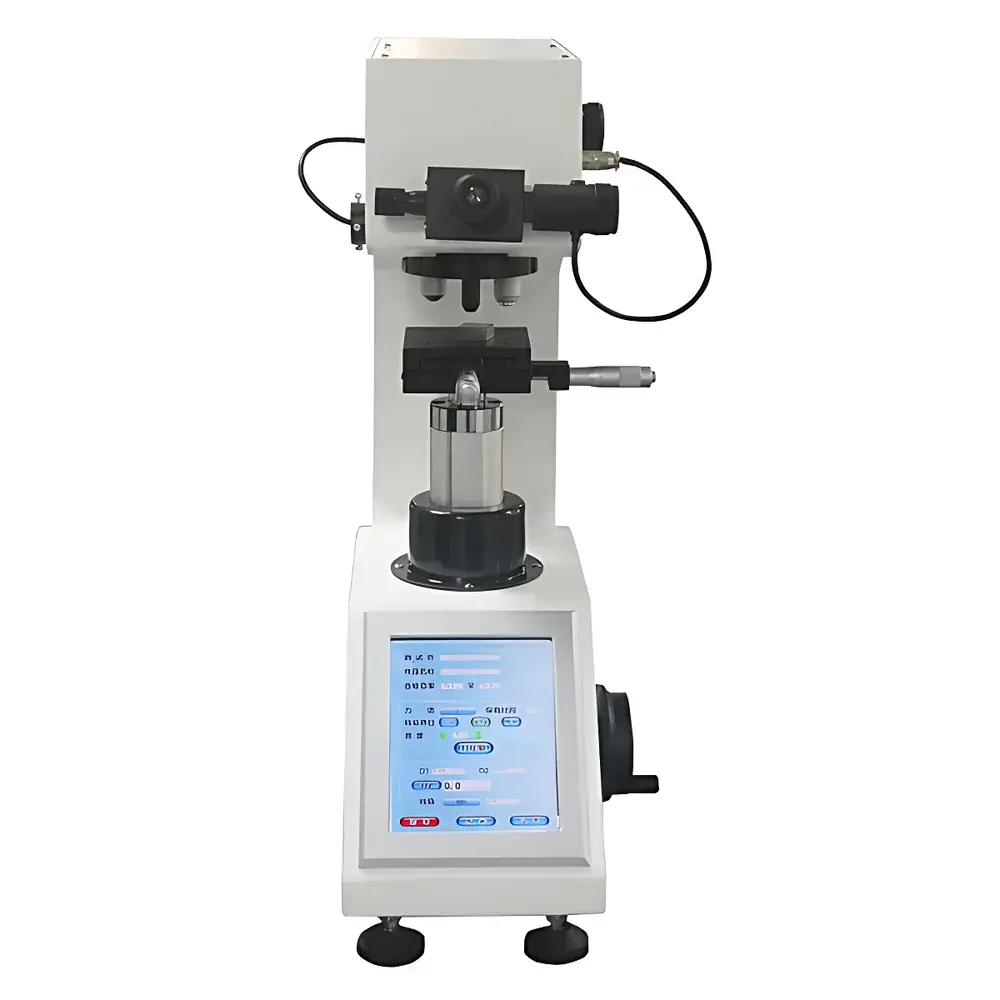
KJ GROUP TMVS-1S Digital Touchscreen Microhardness Tester
| Brand | KJ GROUP |
|---|---|
| Origin | Liaoning, China |
| Manufacturer Type | Authorized Distributor |
| Origin Category | Domestic (China) |
| Model | TMVS-1S |
| Pricing | Upon Request |
| Test Forces | 10 gf (0.098 N), 25 gf (0.245 N), 50 gf (0.49 N), 100 gf (0.98 N), 200 gf (1.96 N), 300 gf (2.94 N), 500 gf (4.9 N), 1 kgf (9.8 N) |
| Standards Compliance | GB/T 4340, ASTM E92 |
| Measurement Resolution | 0.01 µm |
| Hardness Range | 8–2900 HV |
| Indentation Force Application | Fully Automatic (Loading–Dwell–Unloading) |
| Dwell Time | 1–99 s |
| Max Specimen Height | 100 mm |
| Distance from Indenter to Column | 130 mm |
| X-Y Stage | 100 × 100 mm (25 × 25 mm travel) |
| Optical Magnifications | 100× (observation), 400× (measurement) |
| Illumination | Continuously Adjustable LED Brightness |
| Hardness Scale Conversion | HV ↔ HK ↔ HRB/HRC ↔ HB |
| Dimensions | 540 × 260 × 650 mm |
| Weight | ~50 kg |
| Power Supply | AC 220 V ±5%, 50–60 Hz |
Overview
The KJ GROUP TMVS-1S Digital Touchscreen Microhardness Tester is an entry-level yet precision-engineered instrument designed for quantitative microindentation hardness evaluation of metallic, ceramic, and thin-film materials in quality control laboratories, R&D centers, and academic metallurgy departments. It operates on the Vickers (HV) and Knoop (HK) indentation principles—applying a precisely calibrated diamond pyramid indenter under controlled static load, followed by optical measurement of the resulting impression diagonal lengths. The system integrates a high-stability mechanical architecture featuring crossed-optical linear guides, dual-stage gear-rack force transmission, and a high-ratio precision worm-gear drive mechanism to ensure repeatable load application and minimal mechanical hysteresis. Its fully automatic indentation cycle—including programmable loading, dwell (1–99 s), and unloading—eliminates operator-induced variability, supporting compliance with ISO 6507-1, ASTM E384, and GB/T 4340.1 test protocols.
Key Features
- Intuitive 7-inch capacitive touchscreen interface with hierarchical menu navigation—enabling rapid selection of test force, dwell time, hardness scale (HV/HK), and unit conversion without external PC dependency.
- Optomechanical encoder-integrated eyepiece delivers real-time digital readout of both diagonal measurements (D₁, D₂) and calculated HV/HK values directly on-screen—bypassing manual micrometer ocular estimation.
- Eight selectable test forces (10–1000 gf) cover applications from ultra-thin coatings (e.g., PVD/CVD layers) to bulk metallographic specimens, with force accuracy traceable to national metrology standards.
- Adjustable LED illumination with continuous brightness control ensures optimal contrast for indents in reflective or matte surfaces—critical for low-load testing where impression visibility is marginal.
- Robust cross-slide X-Y stage (100 × 100 mm base, 25 × 25 mm travel) with fine-positioning verniers enables precise targeting of microstructural features such as grain boundaries, phase precipitates, or heat-affected zones.
- Comprehensive hardness scale conversion engine supports direct output in HV, HK, HRB, HRC, and HB—facilitating cross-departmental data alignment per ASTM E140 and ISO 18265 requirements.
Sample Compatibility & Compliance
The TMVS-1S accommodates specimens up to 100 mm in height and 130 mm clearance from indenter to column—compatible with standard metallographic mounts, polished wafers, and small-part components. Its mechanical design conforms to the structural and operational criteria defined in GB/T 4340.2 (Chinese national standard) and ASTM E92 (withdrawn but still referenced for legacy method equivalence). Calibration is performed using certified reference hardness blocks (high/medium range) or traceable line-scale rulers, ensuring measurement uncertainty remains within ±1.5% at 500 gf—meeting GLP-aligned verification intervals. While not FDA 21 CFR Part 11–compliant out-of-the-box (as it lacks audit-trail software), its hardware platform supports third-party LIMS integration via RS-232 output for regulated environments requiring documented traceability.
Software & Data Management
The embedded firmware supports on-device storage of up to 500 test records, each timestamped and tagged with force, dwell time, D₁/D₂ values, and hardness result. Data export is available via USB flash drive in CSV format for post-processing in Excel or statistical analysis packages (e.g., Minitab, JMP). Optional PC-based software (sold separately) adds histogram generation, trend charting across batches, and automated report templates compliant with ISO/IEC 17025 documentation requirements. All hardness calculations follow the exact geometric formulae defined in ISO 6507-1: HV = 0.1891·F/d², where F is applied load in kgf and d is mean diagonal in mm—ensuring metrological consistency across global labs.
Applications
- Quality assurance of heat-treated steels, aluminum alloys, and titanium components in aerospace and automotive supply chains.
- Thin-film hardness profiling (e.g., TiN, DLC, Al₂O₃ coatings) using 10–50 gf loads to avoid substrate influence.
- Case depth evaluation in carburized or nitrided parts via stepwise microhardness traverses.
- Research-grade phase hardness mapping in multiphase alloys (e.g., duplex stainless steels, Ni-based superalloys).
- Educational use in materials science curricula for hands-on instruction in indentation mechanics and ASTM/ISO standard practice.
FAQ
Is the TMVS-1S suitable for testing brittle ceramics?
Yes—when using Knoop (HK) scale with low test forces (10–50 gf) and extended dwell times (≥15 s) to mitigate crack propagation around the indent.
Can I perform automated hardness mapping without optional software?
No—the base unit does not support motorized stage control or coordinate-based scripting; mapping requires the optional PC software package and compatible stepper-stage upgrade.
What calibration standards are supplied with the instrument?
Two certified reference blocks (high and medium hardness ranges) conforming to ASTM E92 Annex A1 and GB/T 4340.3, plus a calibrated line scale for eyepiece verification.
Does the system meet ISO 17025 requirements for accredited testing labs?
The hardware meets mechanical and metrological prerequisites; however, full ISO/IEC 17025 compliance requires documented calibration certificates, uncertainty budgets, and procedural SOPs—provided separately by the user’s internal QA team or accredited calibration provider.



