
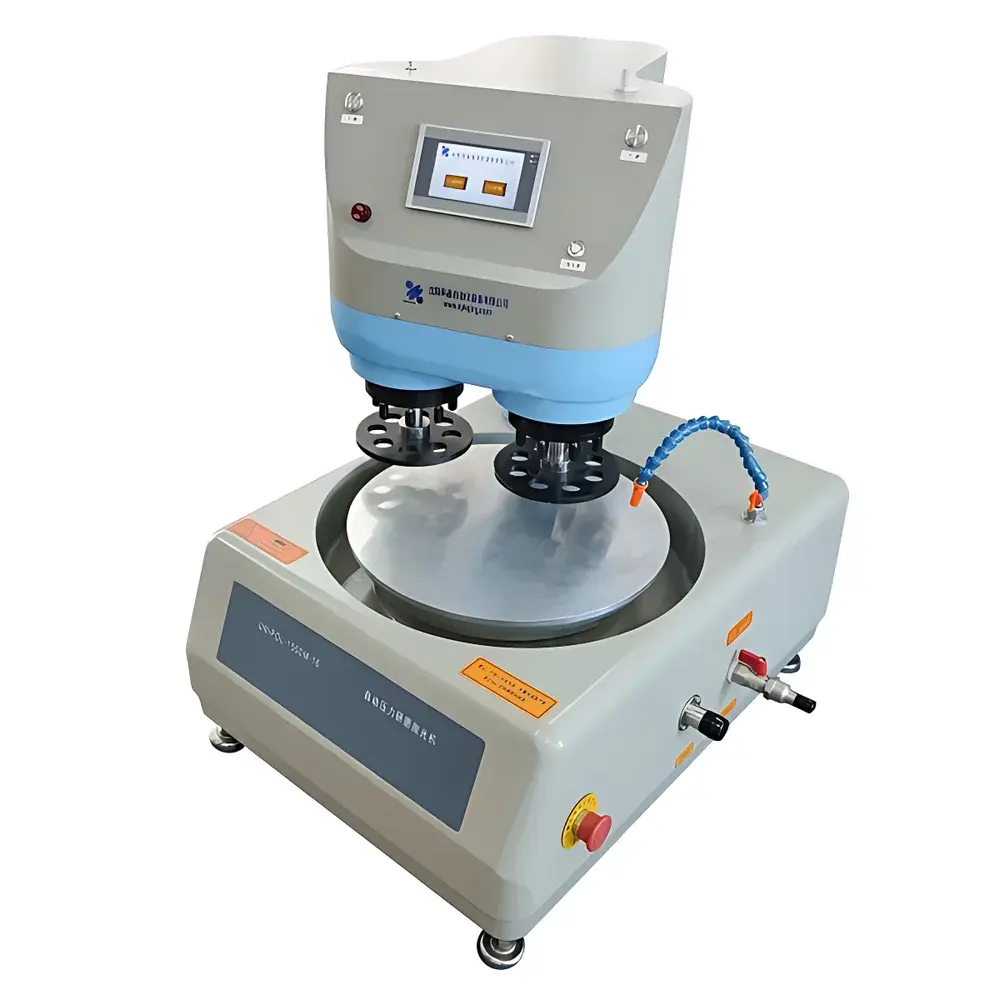
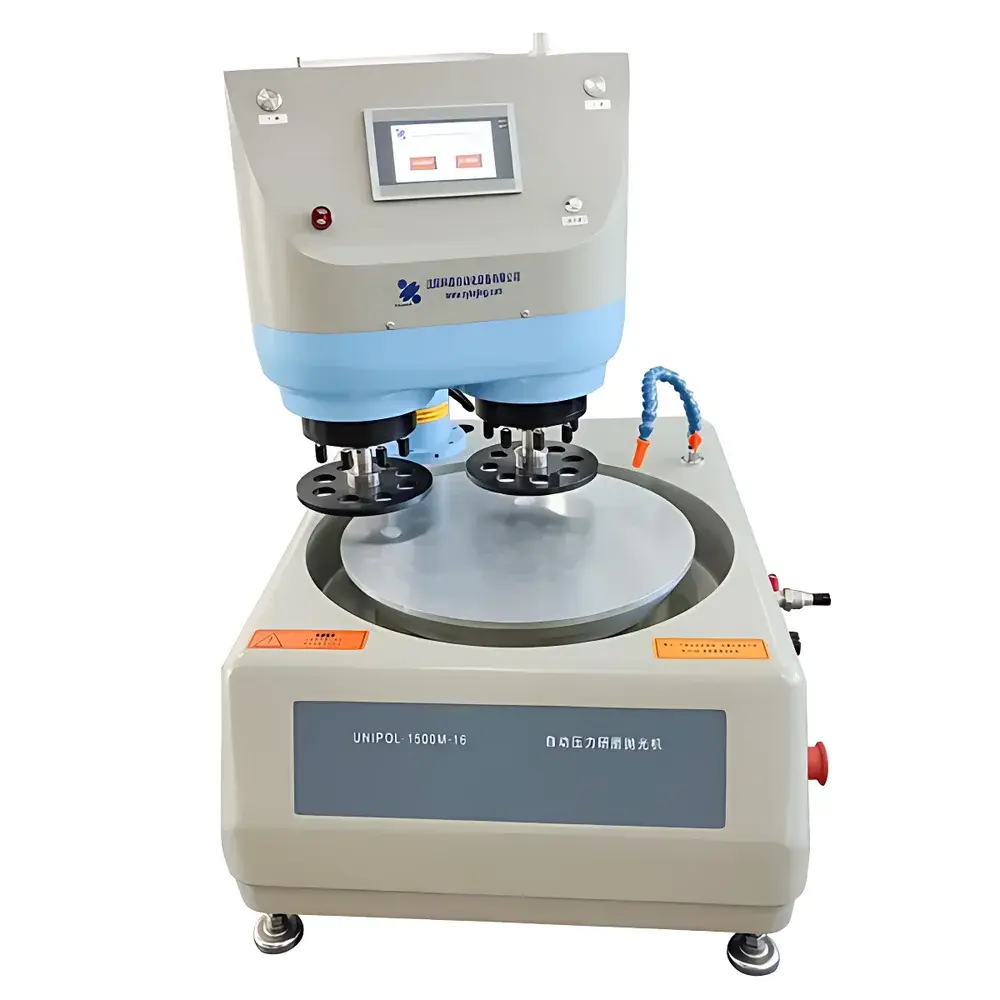
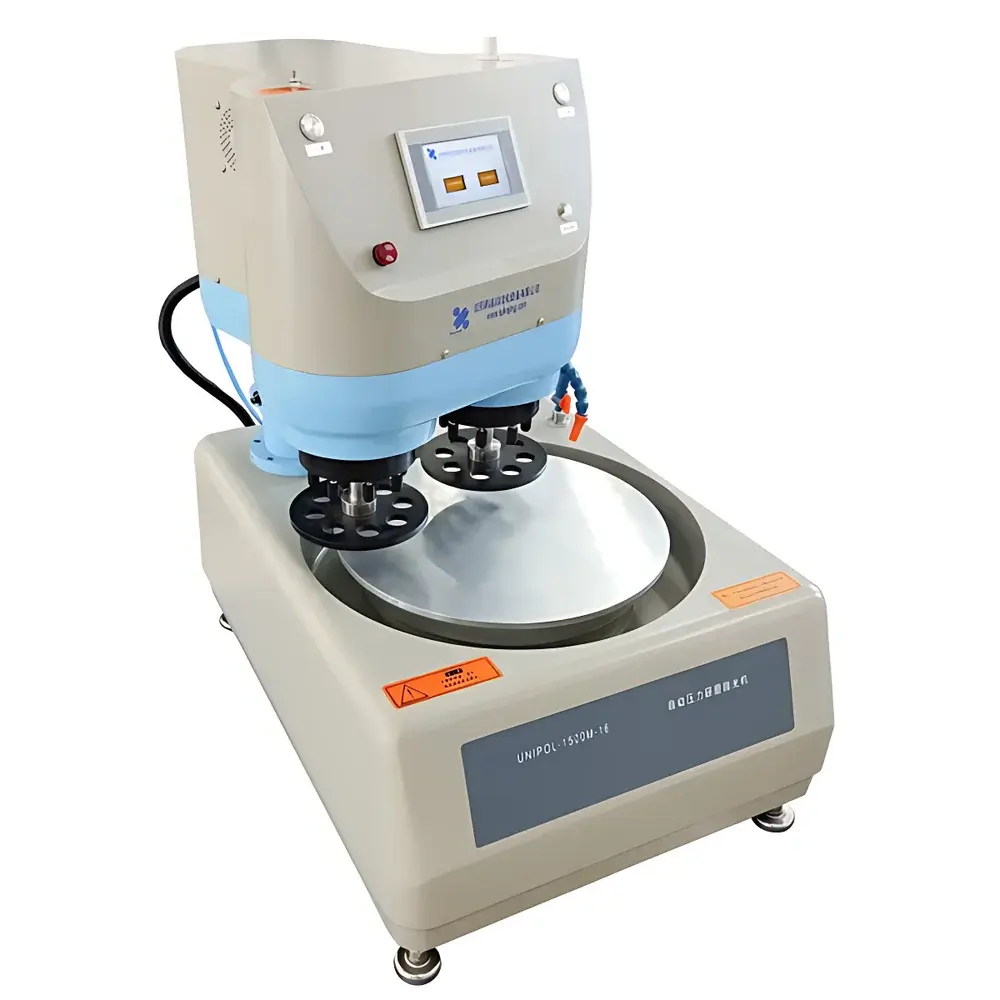
KJ Group UNIPOL-1500M-16 Automated Pressure-Controlled Grinding and Polishing System
| Brand | KJ Group |
|---|---|
| Origin | Liaoning, China |
| Model | UNIPOL-1500M-16 |
| Dimensions (L×W×D) | 600 mm × 720 mm × 800 mm |
| Number of Grinding/Polishing Plates | 1 |
| Plate Diameter | Ø381 mm |
| Upper Platen Speed | 10–100 rpm |
| Lower Plate Speed | 50–300 rpm |
| Sample Loading Capacity | Dual 8-position pneumatic chucks |
| Pneumatic Pressure Range | 0.15–0.4 MPa |
| Power Supply | AC 220 V, 50 Hz |
| Max Power Consumption | 1.5 kW |
| Net Weight | ≈125 kg |
Overview
The KJ Group UNIPOL-1500M-16 Automated Pressure-Controlled Grinding and Polishing System is an engineered solution for high-precision, repeatable sample preparation in materials science laboratories and quality control environments. Designed around dual-axis rotational kinematics and programmable pneumatic force application, the system implements controlled material removal via abrasion and mechanical polishing—principles grounded in tribological contact mechanics and surface energy minimization. Unlike manual or semi-automated grinders, the UNIPOL-1500M-16 integrates synchronized counter-rotational motion between the specimen carrier (upper platen) and grinding/polishing plate (lower platen), enabling optimized shear stress distribution across the interface. This configuration supports both coarse grinding and fine polishing stages within a single platform, minimizing cross-contamination risk and reducing inter-stage handling errors. The system is widely deployed for preparing cross-sectional and planar specimens prior to optical microscopy, SEM, EBSD, XRD, and microhardness testing—where surface integrity, subsurface damage depth, and edge retention are critical validation criteria.
Key Features
- Dual independent servo-driven axes: Upper platen (0.2 kW) adjustable from 10–100 rpm; lower grinding/polishing plate (1.0 kW) variable from 50–300 rpm—enabling precise kinematic matching for brittle, ductile, or composite substrates.
- Pneumatically actuated dual 8-position chucks with multi-point pressure distribution ensure uniform load application (0.15–0.4 MPa range), eliminating localized over-grinding and improving flatness repeatability (±0.5 µm across Ø30 mm samples).
- Programmable time-based operation with automatic shutdown: Timer resolution ≤1 s; supports up to 99 h 59 min 59 s per cycle—essential for unattended overnight processing in GLP-compliant labs.
- Integrated cooling water inlet/outlet ports compatible with external recirculating chillers or municipal supply—maintains thermal stability during extended cycles and prevents resin binder degradation in mounted specimens.
- Touchscreen + physical keypad HMI with embedded parameter storage: Up to 20 user-defined protocols can be saved, including speed profiles, pressure setpoints, and duration—facilitating SOP-driven workflows and audit-ready traceability.
- Robust cast-aluminum structural frame (125 kg net weight) mounted on vibration-damping feet—designed for stable operation in shared lab spaces without requiring dedicated anti-vibration tables.
Sample Compatibility & Compliance
The UNIPOL-1500M-16 accommodates a broad spectrum of rigid and semi-rigid materials, including but not limited to ferrous and non-ferrous metals (e.g., stainless steel, aluminum alloys, titanium), oxide and nitride ceramics (Al₂O₃, Si₃N₄), infrared optical crystals (ZnSe, ZnS, Si, Ge), geological specimens (granite, basalt, shale), polymer composites (CFRP, GFRP), and sintered carbides. Each 8-position chuck accepts standard Ø30 mm specimens (customizable to Ø22–Ø35 mm), supporting both single- and multi-specimen batch processing. The system complies with general electrical safety requirements per IEC 61000-6-2 (immunity) and IEC 61000-6-4 (emissions). While not certified to ISO/IEC 17025 or ASTM E3–22 out-of-the-box, its programmable repeatability, pressure calibration capability, and protocol logging functionality enable full alignment with ISO 14644-1 cleanroom-compatible sample prep workflows and internal QA/QC documentation standards. Optional accessories—including YJXZ-25 automatic filtration water tanks and SKZD-4 programmable dispensers—support integration into FDA 21 CFR Part 11–aligned environments when paired with validated electronic record systems.
Software & Data Management
The UNIPOL-1500M-16 operates via an embedded real-time controller with no external PC dependency. All operational parameters—including rotational speeds, pneumatic pressure setpoints, timer values, and active protocol IDs—are stored locally in non-volatile memory with timestamped change logs. The HMI interface provides immediate visual feedback of current status (e.g., “Grinding Phase – 42 min remaining”, “Pressure Stabilized at 0.28 MPa”) and fault diagnostics (e.g., “Low Air Pressure Alert”, “Coolant Flow Interruption”). Though the base unit does not feature Ethernet or USB export, optional RS-485 communication modules (available upon request) allow integration with centralized lab management software for remote monitoring and CSV log extraction. For regulated environments, users may implement manual protocol verification checklists aligned with ISO/IEC 17025 clause 7.2.2 (method validation) and USP analytical instrument qualification frameworks.
Applications
- Preparation of metallographic specimens for ASTM E3–22 and ISO 643 compliance—ensuring consistent grain boundary contrast and minimal deformation layer thickness (<1 µm in Al 6061 after final polishing).
- Surface planarization of semiconductor wafers and optoelectronic substrates prior to thin-film deposition or lithography alignment.
- Sectioning and polishing of geological core samples for petrographic analysis under polarized light microscopy (ASTM D5777).
- Routine QC of sintered ceramic components in aerospace and medical device manufacturing—verifying density homogeneity and pore structure integrity.
- Research-scale fabrication of TEM lamellae precursors and cross-sectional FIB targets—leveraging the system’s low-vibration kinematics and sub-micron flatness control.
FAQ
What types of consumables are required for routine operation?
Standard consumables include abrasive papers (240#, 400#, 800#, 1500# silicon carbide), polishing cloths (synthetic leather, polyurethane, suede), and diamond suspension (W2.5). Optional ceramic or glass grinding plates are available for specialized applications.
Is compressed air supply mandatory?
Yes. A clean, oil-free, dry compressed air source ≥0.5 MPa is required for pneumatic chuck actuation and pressure regulation. An optional quiet oil-free compressor (KJ Group model recommended) ensures stable pressure delivery without introducing particulate contamination.
Can the system be used for wet or dry grinding?
The UNIPOL-1500M-16 is configured exclusively for wet grinding and polishing. Integrated water ports support continuous coolant flow, and optional circulation pumps (YJXZ-12) or filtration tanks (YJXZ-25) maintain slurry consistency and temperature stability.
Does the machine support automated multi-step protocols?
While the base firmware supports only single-phase timed operation, sequential multi-step processing (e.g., grind → rinse → polish) can be implemented using externally triggered relay interfaces or by chaining saved protocols manually—a common practice in accredited metallurgical labs.
What maintenance intervals are recommended?
Bi-weekly inspection of pneumatic fittings and coolant lines; monthly lubrication of upper platen bearing assemblies; annual recalibration of pressure transducers and speed encoders—per manufacturer-recommended service schedule documented in the English-language technical manual.



